You’ve heard their names a million times. The diseases named after them may have personally affected your life or the life of a loved one. But who are these people? Why are these diseases named after them? Turns out many of them had a fascinating life story that you’ve never heard before. So we’re telling their story here in today’s video.
TRANSCRIPT:
Eponymous Diseases
The practice of naming diseases for people goes back a long way.
There are lots of eponymous diseases, or eponyms, we could discuss.
Researchers say there could be as many as 8000, in fact.
But today I just want to bring up a few of the more famous examples.
Before we start, here are some honorable mentions — diseases whose names deserve to be more famous than they are.
For instance, did you know there’s a condition named after Alice in Wonderland?
Alice in Wonderland syndrome is a neurological disorder that affects perception, making things appear larger or smaller than they are.
If you remember the story, this is how Alice saw things when she drank from a mystery bottle, ate cake off the floor, and scored mushrooms from a jazzy caterpillar.
Kinda trippy for a kid’s book, I’ve got to say. Looking further down Wikipedia’s list of disease eponyms we find this one: Christmas disease.
This sounds like what happens when you talk politics with Uncle Roy and Aunt Dorreen.
But it’s actually an alternative name for Haemophilia B. This variant on the blood disease was first identified in Stephen Christmas, a five-year old Canadian who showed the usual trouble with blood clotting typically found in haemophilia cases.
What Stephen didn’t show was a lack of Factor 8 — the protein in the blood that is deficient in most haemophiliacs.
Instead, Stephen lacked Factor 9, another protein that helps with clotting.
His doctors identified the deficiency and were able to use blood transfusions to extend Stephen’s life.
He lived for another 41 years after the diagnosis.
And then, sadly, he became infected with HIV and died at the age of 46.
This was a common story in the late 1980s and early ‘90s, when up to half of all hemophiliacs living in Canada and the US caught HIV.
On another historical note, Christmas disease is the same form of hemophilia that was passed down to Queen Victoria’s descendants.
That includes Prince Alexei of Russia, as confirmed by genetic testing on his family’s remains.
Treating Alexei’s hemophilia was how Grigori Rasputin got close to the royal family.
Hatred for him was one of the reasons for the Bolshevik revolution that led to the formation of the USSR.
So Christmas disease? Pretty big deal.
Just one more of these.
Let me look.
Here’s a doctor I’m surprised we don’t hear more about:
Edward Cock had many accomplishments in his medical career, including developing a new type of urethra surgery.
He’s credited with the discovery of Cock’s peculiar tumor, a fleshy growth known to pop up in hairy places and—
You know, let’s move on.
The Earliest One
I want to start our list today by telling the story of the very first disease to be named after a specific person.
It turns out that’s hard to do.
The answer depends on a couple of factors, one of which is whether or not we want to include fictional names.
I mean, Alice in Wonderland is fine for a syndrome named in 1955, but do we really want to give credit for first to a fantasy.
But even if we restrict our list to real people’s names, who’s on first still isn’t clear.
See, naming a disease for a person only came into vogue in the late 1800s, at which point several diseases were named more-or-less at once.
The eponymous diseases I’ve most seen cited as first are Hodgkin’s lymphoma and Parkinson’s disease.
Hodgkin’s was first named in a paper by Samuel Wilks that was published, as best as I can tell, in October of 1865.
Wilks studied cases of lymphatic cancer personally and read about earlier cases documented by Dr Thomas Hodgkin.
Those cases were written up in 1832 and Hodgkins later left the hospital system that Wilks was a part of, so giving him credit was a class act.
I’d like to follow Wilk’s example in giving Hodgkin credit because he was kind a of a legend.
In addition to being a doctor, Hodgkin was a campaigning abolitionist who fought for the rights of aboriginal Australians.
Thing is, the name of his disease appeared in print months after an article naming Parkinson’s.
Hodgkin’s came into popular use sooner, but if we’re talking about the act of naming itself, Parkinson’s wins the race.
And that’s OK, too; by all accounts James Parkinson was an interesting guy.
He was the first doctor to describe appendicitis in English and had a whole second career as paleontologist
In 1817, he wrote about a neurological disorder that he called “the shaking palsy” and “paralysis agitans”.
In May 1865, nearly 40 years after his death, a Scottish physician referred to “Parkinson’s disease” in print, beating Wilk’s honoring of Hodgkin by five months.
It would be another decade before most doctors noticed, however, which is why Hodgkin’s is cited as the first disease eponym.
The guy who popularized Parkinson’s as a name, btw, was the “father of neurology” Jean-Martin Charcot.
He’s the king of eponyms, with at least 15 diseases named by him or for him, so I’ll have more to say about him later.
Now, before we move on, I have one more candidate for first eponymous disease to introduce.
If we don’t care about the name belonging to a human being, at least two possibilities open up that predates Hodgkin’s and Parkinson’s by centuries.
For review, the earliest disease eponym with a real-live namesake I was able to find in my research was Parkinson’s disease circa 1865.
If we let fictional characters in the first I found find was…wait for it…venereal disease, a.k.a syphilis.
Yeah.
I was this years old when I learned that it’s called “venereal” because of Venus, the Roman goddess of love.
Her connection to a specific sexually transmitted disease was introduced in 1527 by French physician Jacques de Béthencourt.
He wasn’t fond of a popular name being used at the time — morbus gallicus, meaning “the French disease” — so he suggested blaming Venus for the pox.
And then, a mere three years after this name was written down, a Venetian doctor and poet gave the world siphylus.
I mean the name, obviously.
Doctor-poet Girolamo Fracastoro wrote a poem about a shepherd named Siphylus in 1530.
In it, Syphylus insults the sun god and is stricken with an illness that he then spreads to other shepherds.
OK.
I have questions about that, but I don’t want this video demonetized, so suffice it to say that scholars picked up on the name syphilis and used it shortly after the invention.
It was adopted by the public much later, but still before the naming of Parkinson’s disease.
Alzheimer
Alright.
With the bucket list of Hodgkin’s-Parkinson’s-syphilis finished, we’re on to the single items portion of our list.
I’m going to go through these in alphabetical order, so it’s a coincidence that the next one is probably the most famous eponymous disease in the world today. Alzheimer’s disease was named by Emil Kraepelin, a German psychiatrist, in 1910.
It’s namesake, Alois Alzheimer, was Kraepelin’s colleague, and he was working at the time in Kraepelin’s laboratory at the University of Munich.
Alzheimer studied brains. And I do mean brains here, not minds, like a psychologist would study.
Alzheimer cut brains out of dead bodies because his main interest lay in finding physical causes for psychiatric symptoms.
In 1906, he found a big one.
His most famous patient, Auguste Deter, died on April 8, 1906.
Frau Deter had a distressing series of episodes during the last five years of her life.
She suffered memory loss and would sometimes act paranoid, shouting and saying she was going to be murdered.
Alzheimer cared for her during her decline, eventually having her made a resident of a hospital.
He even agreed to pay for her stay, so long as her husband consented to let her medical records and her brain come to Alzheimer after her death.
And so it was that the expert anatomist was able to observe thick “fibrils” and “a peculiar substance” in his late patient’s cortex.
In modern terms, he was looking at tangles and plaques in Frau Deter’s brain.
Observations like this had been made before, but always in older brains, so doctors thought they were simply a sign of old age.
It was Alzheimer who fit linked the tangles and plaques in a 56-year-old brain to a definite disease.
Not that he was was given much credit at the time.
When Kraepelin wrote about his protege’s discovery, even he wasn’t sure what to make of the discovery.
”The clinical interpretation of this Alzheimer’s Disease is still unclear,” he wrote, before going on to point out how unusual it was to find dementia symptoms in a relatively young patient.
Medical historians speculate that Kraepelin only mentioned Alzheimer’s Disease because he wanted to thumb his nose at Sigmund Freud.
The men were contemporaries and they had different opinions on where mental illness came from.
Kraepelin said anatomy, and Freud said anatomy too, just, ya know, lower down.
Everything was sex to Freud.
Kraepelin, on the other hand, wanted mental illnesses to have physical causes, since that’s what his lab was all about.
In the end, it doesn’t matter if he named early-onset dementia for Alzheimer out of spite or admiration.
We can simply be glad he did as the discovery started the ball rolling on a century-plus of research.
There’s still no cure for Alzheimer’s disease but several treatments have come out in recent years.
Maybe in another decade the disease can join its namesake in the history books.
Asperger
Next up, Nazi talk. It’s amazing how much that comes up on this channel.
There’s going to be nuance in this segment, so watch for that. But before I say anything else, here’s the Mother of All trigger warnings.
I’m going to about to talk about Nazis, children, and neurodiversity.
Still here? In that case:
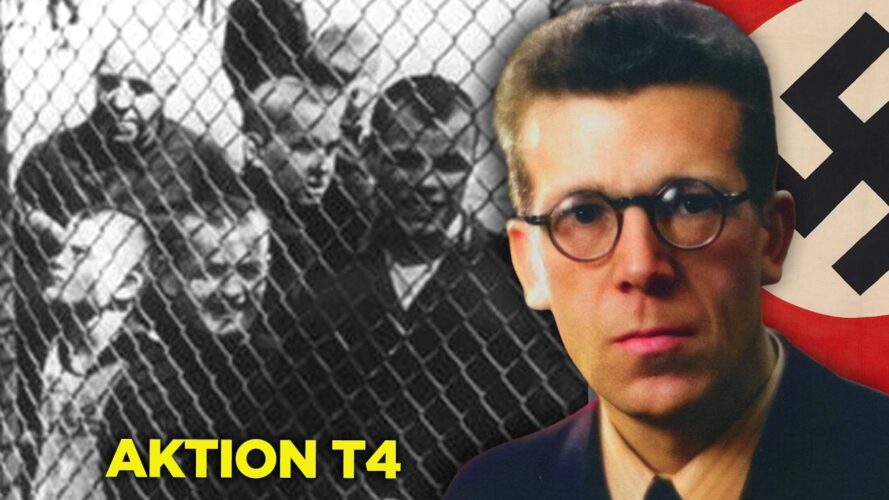
This is Hans Asperger.
And this is the entrance to the former Am Spiegelgrund clinic in Vienna.
I don’t usually take pictures directly from Wikipedia but for this story, they had exactly the right ones.
Asperger was a physician who focused on mental illness in children.
In the early 1940s, he participated in the evaluation of children’s mental health while his native Austria was under the control of the National Socialist Party.
Two young, female patients that he examined were transferred to Am Spiegelgrund, due in part to the reports by him.
They were killed, euthanized.
These two girls y were victims of Aktion T4, the Nazi campaign to exterminate disabled people and the mentally ill.
The Am Spiegelgrund clinic was the setting for a total of at least 789 child murders motivated by this campaign.
Alright, if you need to take a minute, I’ll wait.
Come back when you’re ready for the nuance.
Use of the term “Asperger’s syndrome” for a variety of autism came into use in the 1980s.
It was introduced by prominent British psychiatrist Lorna Wing as a way to advance the point that autism is a spectrum condition.
Autism shows up differently in different people and some of its symptoms can be harder to deal with than others.
Wing tipped the hat to Asperger because back in 1943, he wrote an treatise that helped define research into autism going forward.
In it, he highlighted the advanced abilities he and fellow researchers saw in some of their autistic patients.
He also discussed typical autistic behaviors and speculated on the heritability of autism.
Asperger then turned his attention to “The Social Value” of autistics.
This was significant, since Aktion T4 provided for the death of people who were considered of low social value.
After pointing out the difficulties faced by his subjects, Asperger concluded that “autistic people have their place in the organism of the social community.”
This doesn’t sound like a guy who wanted his patients destroyed at a facility like Am Spiegelgrund.
And during his lifetime, Asperger claimed that he was quite the opposite.
For decades after Lorna Wing popularized his work, Asperger was seen as a hero who defended kids from Nazi atrocity.
And then, in 2018, an article the journal Molecular Autism challenged that.
According to the author, Herwig Czech, Asperger “actively cooperated with the child ‘euthanasia’ program”.
Instead of a child advocate, he was complicit in child murder, according to Czech.
It didn’t take long for the public to ditch “Asperger’s” as a name for what is now typically called Level 1 autism.
Experts didn’t have to because they had already taken this step.
Level 1 autism is part of the spectrum, not a distinct condition, so experts stopped talking like it was around 2013.
Getting back to Hans Asperger, more recent studies of his life and work push back on his portrayal as a monster.
That said, most don’t go so far as to reinstate his hero status.
Asperger didn’t order those girls euthanized and there’s no compelling evidence he knew his reports would contribute to their deaths.
He did participate in meetings with Nazi officials about whether or not certain children should be transferred.
But what he knew going into those meetings, as well as what was said there, is a mystery.
Asperger’s detractors claim he knew about the extermination program and wrote reports supporting patient transfer regardless.
More favorable researchers doubt that he was in a position to learn the truth.
It’s a complicated issue that may never be resolved.
In the meantime, dropping Asperger’s syndrome for Level 1 autism is an option for non-professionals around the world.
Down
Phew! If you stayed for the last entry, I’m sure break from problematic namesakes as much as I do.
Luckily our next doctor with a disease named totally is.
John Langdon Down was a famous 19th Century physician and lecturer.
Among his most famous writings is an article published in the London Hospital Reports.
It’s called…let me check my notes.
Ah: Observations on an Ethnic Classification of Idiots.
OK, this is not as bad as it sounds.
What Down was driving at was that certain medical conditions that result in what was then called “idiocy” also affect the appearance of patients.
Down proposed classifying the illnesses by the resemblance he saw to various non-Europeans.
Oh, that’s still not sounding better?
Let’s get the background.
At the time Down wrote his report, he had been working as the Chief Physician of the royal Earlwood Asylum, a residence home for the mentally in Surrey, England, for about twenty years.
Earlwood was a large facility that cared for some 400 patients when he got the job.
Conditions were awful and Down was appointed as Chief specifically to improve the patients’ living conditions.
And this he totally did.
During his tenure, Down brought in new staff, raised hygiene standards, and introduced multiple programs that aimed to educate the patients, as well as enrich their lives.
His asylum went from a blight on the landscape to exemplary.
It became one of the most famous such facilities in the world.
Along the way, Down sought to advance the science of mental illness by working out the different types.
To his eye, many of his European patients had physical traits that made them look members of different “races” — and that word is in quotes for a reason.
Part of Down’s inspiration was a popular racial classification system of the time that we’re still trying to move beyond today.
Invented by anthropologist Johann Friedrich Blumenbach, the system attempted to put everybody on earth into five boxes, all labeled by color.
Side note, Blumenbach is actually where we get the myth that all “white” people are Caucasian, as mentioned in my video about the Khara Hora shaft.
It’s junk science, frankly, but Down didn’t know that, so he used this system to note that some of his “Caucasian” patients had features he thought looked Ethiopian, Malay, or Mongolian.
It was the “Mongoloid” people he focused on, as they were in large numbers at Earlwood.
So, yes, this is foundational racist theory and Down appears to have bought into it in a weird and insulting way.
I could write about the how he acted conflicts with the idea he was personally racist, but let me show instead.
The pictures you’re now seeing are some of the hundreds John Langdon Down himself took of Earlwood residents.
You’ll notice they’re not awful.
They depict people in natural poses and stylish clothes in dignified settings.
The sensitive depictions of so-called Mongoloids support accounts that say Down cared for his patients and did his best to help them thrive.
His racial classification system was an unfortunate product of its time.
Still, it’s fairly clear from his writing that he didn’t intend it to be discriminatory.
In fact, his famous article makes the opposite point.
Let me admit up front that I choose the following passages carefully because it’s one of the few that doesn’t use insensitive language.
Down was a Victorian Brit and a doctor so his phraseology comes off as clinical at best.
Still, I think you’ll get the gist.
Down wrote, “The tendency in the present day is to reject the opinion that the various races are merely varieties of the human family.”
He went on to conclude that his observations say differently.
If features like skin color, hair texture, and facial construction that could appear across Blumenbach’s racial boundaries, maybe the whole concept of racial division was wrong.
Here’s Down’s conclusion, uncut. I’ll only add that when he says “degeneracy” he’s talking about he mental illnesses he observed in his mostly-European patients.
”These examples of the result of degeneracy among mankind, appear to me to furnish some arguments in favour of the unity of the human species.”
These days we know that the syndrome named for Down results from having an extra copy of a chromosome.
It’s a genetic trait, but one that has nothing to do with Asian people in general or Mongolians in particular.
For these reasons and others, the World Health Organization’s decision to drop Mongolism in favor of Down’s syndrome in 1961 was a good one.
Despite coming up with the old name himself, I think Down would approve.
Lou Gehrig
Let’s start this next one right.
You know why Cal Ripken Jr was called the Iron Man of Baseball?
Because the record he broke for most consecutive appearances in a Major League game was set by a guy they called “Iron Horse”.
That guy was Lou Gehrig.
During a career that spanned 1923-1939, the legendary first baseman was an All-Star seven times and an MVP twice.
His consecutive games streak ran to 2,130 games a row, a record nobody was able to touch for fifty-six years.
It began because another player was ill, so Gehrig had to swap in.
Fourteen years and six championships for the NY Yankees later, it ended when Gehrig himself felt ill.
He benched himself, booked in with the Mayo clinic, and was diagnosed with ALS.
Short for amyotrophic lateral sclerosis, ALS affects the motor neurons.
Its symptoms include the gradual weakening Gehrig experienced.
The weakening leads to paralysis and eventual death, usually within five years.
On the 4th of July, 1939, Lou Gehrig announced his retirement to a stadium of over 61,000 fans.
Millions more heard his speech on the radio.
He died on June 2nd, 1941 from complications related to the disease.
Exactly when people adopted Lou Gehrig’s as the disease name is unclear, but that’s how it was commonly known in the US for decades.
Arguably, that only came to an end in 2014, when the Ice Bucket Challenge raised awareness of ALS again.
One of the three men who started the challenge, Pete Frates, was a ballplayer inspired by Lou Gehrig.
Frates himself died of ALS in 2019.
Since the first Ice Bucket Challenge, funding for research into the disease has exploded.
Progress is mixed but there are lots of clinical trials going on that have a hope, at least, of finally ending ALS.
When we do we’ll be putting down a disease that was originally named by Jean-Martin Charcot, who I brought up earlier.
Despite being an earlier user of eponyms — Parkinson’s, remember? — he didn’t name all the diseases he described after people.
After studying various cases, he coined the word “amyotrophic” from Greek — it means “no muscle nourishment” — and came up with sclérose latérale amyotrophique, the French name for the disease that is also called la maladie de Charcot.
Tourette
And speaking of Charcot!
His legacy is one of the most celebrated in medicine, not only due to his personal achievements but also due to the influence he had on his students.
The most famous of these was Sigmund Freud, but only slightly less well known is Georges Gilles de la Tourette.
Not only was Tourette a pupil of the great man, he was Charcot’s right hand, working as his secretary and medical assistant.
When Tourette was 27, Charcot asked him to focus his studies on motor disorders.
Tourette complied and the very next year he published a paper on a patient of his with a “convulsive tic illness”.
His was far from the first report on an illness like this, but his description of how it differed from other mental illnesses was what Charcot was after.
Much of Charcot’s career was spent figuring out the differences between illnesses and what that meant for their treatment.
When Tourette gave him a clue about tics, he thanked him by naming the condition in question “Gilles de la Tourette’s syndrome”.
The men remained friends until Charcot’s death in 1893.
This was, sadly, the beginning of the end for Tourette.
His son died the same year and, later on, a former patient shot Tourette in the neck.
Tourette survived and the patient was found to be insane.
Still, this incident seems to have marked a change in Tourette.
He grew increasingly depressed and was finally committed to a hospital in 1901.
He died there in 1904.
You may wondering why I’ve bothered to tell this part of the story, since it has nothing to with the illness named for Tourette.
That’s valid, but I do have a reason.
See, it turns out Tourette himself died of an eponymous illness.
His depression was no doubt deepened by the losses and the violence he suffered nine years before his death.
But its likely cause was his killer — syphilis.
That’s right.
The namesake of Tourette’s was taken out by the original eponymous disease.
If you’re wondering how he got it, I refer to my earlier comment on demonetization.
Also, he was French.
The Eponym Debate
That’s our list for today, but before we shout out the patrons, he’s a note on why naming diseases after people may be dying out.
The World Health Organization released new guidelines on disease naming in 2015 that quote “aim to minimize unnecessary negative
impact of disease names” unquote.
Naming a disease for a person is ruled out by these guidelines and the emphasis put on descriptive naming.
There’s still debate about this and the public can of course continue to use the eponyms.
Whether you personally should or not is a slightly different question.
Let me lay out the pros and cons.
On the pro side is ease-of-use. Quite a few eponyms are easier to call to mind than their more technical counterparts.
It’s also worth noting that several eponyms cover syndromes, like Tourette’s and Down’s, that tend to be more complicated than a descriptive name can capture. Some eponyms, like Lou Gehrig’s disease, have a positive association for victims of the disease and caretakers.
But, moving to the con side, this association can make it difficult for the public to grasp what the experience of the disease is really like.
Lou Gehrig was a strong, healthy man who had a run of tough games before his big speech, and that’s all the public got to see.
Gehrig’s rapid decline, his withdrawal from life, and his eventual loss of speech and breath was mostly behind closed doors.
Also on the con side is the fact some eponyms come from controversial figures like Asperger.
There are even some that come from figures who confessed to outright evil.
“Reactive arthritis” used to be called Reiter’s syndrome.
It was named for Hans Reiter, one of the first doctors to write up its symptoms.
During WW2, Reiter conducted experiments on detainees of the Buchenwald concentration camp, even helping design an experiment that led to 200 deaths.
Reiter knew about the sterilization and murder programs being carried out by the Nazis.
He was actually in the SS, lightning lapel pin and all.
He confessed to his guilt at a Nuremberg trial, so it was no surprise when doctors moved to change his disease name.
But don’t get me wrong.
Very few disease namesakes were actual war criminals.
Most people with diseases named for them deserve to be honored for the good work they did.
At the same time, most of them wouldn’t have minded being overlooked.
I’ve probably mentioned Jean-Martin Charcot enough, but indulge me once more.
A dozen diseases are regularly called by his name but that wasn’t his idea.
Charcot honored his students and his medical forebears with eponyms.
He didn’t name diseases for himself.
If the king himself can resist that urge, anybody can.



Add comment