
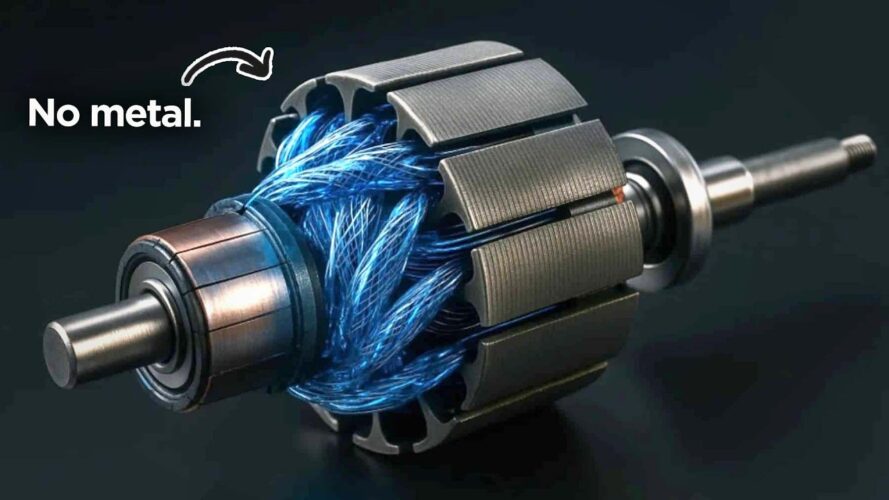
Electric motors are in almost everything these days. From electric cars to robots to generators, the list goes on. Each of these requires expensive and heavy materials like copper and rare earth elements, all of which are resource-limited and will only get more expensive over time. But scientists have come up with a new design that uses carbon nanotubes and, believe it or not, no metal whatsoever. Is this a game changer? Or just another even more expensive pipe dream?
TRANSCRIPT:
I feel like I’ve been talking about carbon nanotubes changing the world since I started this channel.
I did a deep dive on nanotech back in 2022 but that’s far from the earliest mention.
The reason I keep coming back to is that carbon nanotubes are a miracle material.
The fact they’re lighter and stronger than steel is just the tip of the iceberg of their benefits.
So why don’t we see them everywhere?
There are any number of reasons the revolution has been slow to rollout.
The big one used to be that carbon nanotubes are hard to make but production has been ramping up this past few years.
15 and a half tons of carbon nanotubes are expected to ship in 2026 from producers around the world.
Thanks to the production growth, carbon nanotubes are finally showing up in products from transistors to medical devices.
They haven’t changed the world yet but they’re getting there.
And one way that’s happening is the replacement of metals by carbon nanotubes in some machines.
There are a numerous benefits, including weight reduction and cutting down on environmental damage.
We shouldn’t expect carbon nanotubes to replace all metals.
But some of the replacements they can make are surprising.
One surprise came last year when a team at the Korean Institute of Science and Technology, or KIST, announced they had built a working electric motor with zero metal windings.
It’s a huge achievement for Dr Dae-Yoon Kim and his team and KIST, paving the way for metal-free motors to take over.
Understanding why that’s a sign the revolution is happening?
Well, that’ll take some explaining.
Let’s start by talking about how motors do their thing.
At its core, a motor works by exploiting the 1st Law of Thermodynamics.
Energy isn’t created or destroyed in an isolated system, it only changes form, and in an electric motor, that change is from electricity to momentum.
Now, there is a massive amount of complexity I’m going to skip in this explanation, both on the engineering side of motors and in the history.
If this video was about the past, I’d talk about the differences between AC motors and DC motors and how many inventors helped out in their creation.
But this video is about the future, so here’s the the gist.
Electric motors work by applying force to a rotor.
The force pushes in one direction and sometimes pulls in the other, causing the rotor to rotate.
It turns out it’s easy to flip a rotor 180 degrees using magnets, which is what most electric motors do.
The tricky part is turning the flip into a spin.
To explain why, let me put on my [lab coat/Beakman wig/bow tie] for a little experiment.
Here we go.
This is a rotor, also known as a compass needle, and this is a bar magnet.
The rotor is magnetic too, so if I want it to turn 360 degrees, I can make it happen by moving the magnet in a circle.
But that’s not a very efficient solution — it’s like if the only way to spin a fan blade was to drag it around.
Notice what happens when I pulse the magnet from the side.
The needle pulses, too, swinging from north-south to east-west and back again.
I can get a full flip of the rotor by bringing the magnet up from the south instead, but I still can’t get a full spin without dragging.
How do I get a dragless spin?
Pause the video if you want to think about it.
Ready?
One answer is to do this.
By using two magnets, and the North Pole, I can get a full 360 degree spin with less effort than dragging.
To make it faster and reduce the total work, I can replace my bar magnets with electromagnets.
See, the thing about electromagnets is you turn them on and off.
If these were electromagnets I wouldn’t have to move in and out, just leave them in place and flip switches.
I can also automate the switching and speed up the rotation with a clever piece of tech.
That tech is a commutator.
I’m going to super gloss the detail, but see that cut on sides of the circle?
That’s there to swap which end of an electrical circuit is getting charge.
The circuit magnetizes the rotor.
Swapping the charge reverses the rotor’s polarity.
If you add that up, the effect is the same thing as pulsing the magnet to flip our needle, only faster.
So, to take this from experiment to reality.
This [compass needle] is this [rotor pic].
This [magnets set around] is this [stator].
I know circle-in-a-circle is a leap but it’s all the same principle.
Every slice of the circular rotor is a rotor itself.
And the outer circle is just a set of stationary magnets.
The stationary circle is called a stator and it surrounds the rotor in most electric motors.
Imagine a ring of magnets around a wheel of compass needles, add the charging-swapping commutator.
And hopefully it all makes sense.
Now, you’ll probably have noticed the coils of wire in the cutaways I’ve been showing.
These are called windings.
They serve as conductors for electromagnets in the stator and sometimes for those in the rotor as well.
Copper is used most often because it’s highly conductive and relatively cheap compared to other metals.
Aluminum is cheaper but it’s less conductive; silver is more conductive but less cheap.
Copper sits in the balance although it’s so pricey these days that it’s a target for thieves.
Real briefly, if you think motors are too complicated, don’t even ask about conductivity.
At an extremely basic level, metals “conduct” by sharing their outermost electrons between atoms.
You’d think that would mean that a metal with lots of outer electrons would be the most conductive.
But that’s not true.
The levels electrons inhabit aren’t exactly like rungs on a ladder, despite how atoms are modeled.
And the ladder picture is even less true when atoms are mashed together in solids.
Electrons in solids act like they occupy bands instead of rungs, and the bands can overlap.
A good conductor, like copper, has overlapping bands that allow electrons to pass through without having to jump energy gaps.
What the gaps are in this context, how electrons can be made to jump them, and why heat makes a difference are topics you can read about in the links below.
Copper theft is a huge problem globally, but a much bigger downside of using copper in motors is the weight.
Heavy windings make for heavy motors, and this has consequences when weight makes a difference.
Transportation is an obvious example — depending on the design, copper windings can account for 10-18% of a motor’s weight.
EV makers have experimented with aluminum windings for this reason.
It’s lighter than copper but has lower conductivity so they have to pack in more windings.
There’s only so much room in a motor so engineers are always looking for better ways to fill the space.
Materials scientists, on the other hand, are always looking for something better to fill it with.
One of those things is carbon nanotubes.
So what, exactly, makes CNTs better?
Glad you asked.
The easy part of the answer is that carbon is 4-to-5 times lighter than copper by volume.
Raw carbon is also cheaper than copper and it’s less attractive to low-tech thieves.
Of course, none of that matters if the carbon doesn’t conduct as well as the copper.
Turns out, it can conduct as well as better, but only under the right conditions.
See, carbon comes in different forms called allotropes.
This guy knows what I’m talking about.
Now, Superman crushing a diamond out of coal isn’t super realistic, but it does illustrate how allotropes of carbon can differ.
Coal and diamond are both useless for making magnets.
The gap in their energy bands are just too big.
But it’s a different story when carbon is structured like the core of this pencil.
Graphite, or so-called pencil lead, can outperform copper as a conductor on a 2D plane.
Here I mean 2D in the sense used by materials scientists.
It’s like how we say a layer of bricks is flat compared to the 3D wall.
Like that wall, the graphite in this pencil is stacked in layers.
That’s how it naturally occurs.
A single one of those layers is graphene…we’ll come back to that.
For now you need to know that electricity travels quickly across the surface of each layer.
But between layers?
Not so much.
A deep explanation would take a long time.
So suffice it to say that the electrons in graphite move easily across each layer.
But it takes a lot of energy for them to jump between graphite layers.
Because of the need for 3D movement, graphite is poor material for motor windings.
But what if we could eliminate the need to move in 3D?
And that, my friends, is where carbon nanotubes come in.
The best way to explain is to show you, so here is an animation of a carbon nanotube.
How many layers do you see?
That’s right. One.
The 2D nature of carbon nanotubes will come as no surprise to if you knew they are rolled up sheets of graphene.
Don’t feel bad if you didn’t know.
We all have to start somewhere.
So, at this point you may be wondering why motors with carbon nanotube windings are just now becoming a thing.
If CNTs, as I’ll call them to save syllables, are both lighter and more conductive why haven’t they replaced copper already?
Production has been an issue, also expense as it takes sophisticated equipment to make CNTs at scale.
There are some difficulties with handling and safety with CNTs, too.
But the main reason we haven’t seen a CNT revolution in motors is technical.
For CNTs to outwork copper as a conductor, they have to be pure.
Pure as the Blue Sky.
Simply put, most CNTs are simply too cluttered with impurities to conduct as well as they should.
Remember, it’s the ease of electrons sliding over the layer that makes a CNT a good conductor.
But CNTs are tiny — up to 100,000 times smaller than a human hair — so any amount of impurities can gum up the works.
Scientists have been devising ways to clean CNTs for decades.
And the paper I mentioned from Doctor Kim’s team at KIST is really about what happens when you apply one of these.
Their groundbreaking result is that properly cleaned CNTs are conductive enough to use in stator magnets.
To demonstrate this, the team used a technique called wet-spinning to produce CNT wires.
They then wrapped 9 of the wires in an insulating film to produce core-sheath composite electric cables, or CSCECs.
These are the cables used as windings for the metal-free stator.
I mention wet-spinning because the process used to be confined to the lab.
Explaining how it works could easily take a whole ‘nother video.
The gloss of the gloss is that carbon fibers are drawn through an acid bath to help them align, then twisted together like yarn.
Since its discovery in 2001, the wet-spinning of CNTs has slowy gained traction in the industry.
To the point that these days, manufacturers are using it to produce CNTs more cheaply than was once thought possible.
To be clear, there are other methods of producing CNTs that have different advantages, but for highly-conductive CNTs, wet-spinning is great.
So, the KIST team created their CNTs with wet-spinning.
They then used a special cleaning process to supercharge the conductivity of the wires.
The process is called LAST, short for lyotropic liquid crystal-assisted surface texturing.
I’m sure I’m leaving something important out but in essence what LAST does is induce a chemical change in the impurities.
They become a film on the surface of the carbon that water strips off.
What’s left are CNTs in pristine condition, ready to carry a charge.
According to tests by the team, LAST made the CNTs significantly more conductive.
They started at a conductivity of 5.8 megasiemens per meter and improved to 7.7 megasiemens per meter after cleaning.
This is nowhere near the potential conductivity of graphene, or even the conductivity of copper, but it didn’t really have to be.
Copper weighs so much more than carbon that you can include more CNTs windings and still have a lighter motor.
More to the point, LAST is just one technology that can boost conductivity.
Others exist that could take CNTs even further.
But before we talk about that, let’s go back to the question of why a “metal-free motor” is worth pursuing.
I put “metal-free” in quotes because it looks like the shaft in the KIST motor is metal.
Maybe that’s paint, I don’t know; here’s why the goal is a good one.
First, the weight.
You can’t get around the fact that metals are heavy.
Reducing weight will obviously benefit a vehicle motor, where moving every gram costs extra energy.
Electric cars are a clear target for metal-free motor tech but an even better target may be urban air mobility.
Doctor Kim and his fellow authors call out this growing field of aviation in the paper.
They expect it will soon come to rely on CNT wires.
But even non-vehicle motors can benefit from weight reduction.
Spinning a rotor generates heat and a lighter motor has less mass to cool.
So if CNTs become a cost-effective replacement for metal windings, motors will benefit across the board.
I’ve already mentioned the potential theft deterrence effect of replacing copper with carbon.
Another benefit is to the environment.
According to the International Copper Association, the industry currently releases about 0.2 percent of global greenhouse gasses.
That’s a small share of a huge problem, but demand for copper is expected to double in the next 25 years.
Meeting at least some of that demand with CNTs would prevent an uptick in air pollution that could save lives.
Granted, producing CNTs is energy intensive, but modern methods are still cleaner than digging rocks out of the ground.
And some CNT production methods are actually carbon negative, meaning they remove carbon from the atmosphere.
There’s even technology that can turn CO2 emissions into CNTs.
It’s not caught on like it should, unfortunately, but that just shows another advantage to the planet of increased CNT demand.
So, what are the hurdles of making metal-free motors a reality?
Cost is a big one.
Even with those modern production methods I mentioned, CNTs typically sell for between 20 and 80 cents a gram.
Compare that to the current price of copper, under 1 cent per gram, and you can see the problem.
CNT manufacturers are quick to point out that they’re not yet producing “at scale” meaning that comparing them to the metal industry is like comparing gourmet brioche to a loaf of Wonderbread.
That’s fair, but for now the high cost prevents lots of CNT projects from getting off the ground.
Cost aside, the other reason metal-free motors won’t be popping up in everything from fridges to firetrucks in the next six months is that the KIST wires were still not conductive enough.
Despite LAST getting its carbon so clean that Howie Mandel could lick it without flinching, Kim & co’s tech is not quite ready for primetime.
This can be easily seen from the experiment they ran to test the efficiency of their metal-free windings.
In the test, they built two toy cars.
One was powered by the metal-free motor, the other by a similar motor with copper windings.
The metal-free version was able to drive its car down a track at 0.52 meter per second, or about 1 mile and hour.
The copper car managed 1.35 meters per second, about 3 mph.
This is disappointing to all of us who want to see a flying car in every driveway.
But it’s still a groundbreaking result.
The idea that a metal-free motor could function at all would have been laughable decades ago.
The KIST team proved such a motor is possible.
And in so doing, they may have made its widespread adoption inevitable in the long term.
Like I explained before, CNT manufacturers aren’t operating at scale.
As they continue to ramp up production, CNT prices will fall, removing a major barrier to metal-free tech.
But what about conductivity?
The KIST team discussed this in the article.
Here’s a quote:
“If the electrical conductivity of CSCECs is further increased beyond the current level achieved by the LAST process, the output power of the electric motor demonstrated in this study would improve, allowing the metal-free motor to operate more powerfully while also benefiting from mass savings.”
I mean, leave it to scientists to soft-sell, but what they’re saying here is, “Dude! This motor’s super light. Somebody’s got to keep working on it.”
As it happens, somebody has.
In April 2026, which happens to be a year after the KIST article came out, a team in Spain was able to produce CNTs with a conductivity rating of 24.5 MegaSiemens per meter.
That’s three times higher than the CNTs used by the KIST team.
It’s also about half the conductivity of copper.
The Spanish team is already working with manufacturers to stabilize their process, which involves adding aluminum trichloride to CNTs.
Now, strictly speaking, I’m not sure this is good news for the KIST team, as the new method seems to make LAST obsolete.
But I’m not a scientist.
It could be the methods fit together, maybe support each other somehow.
And of course, science is awesome.
The people who do it usually want to see it advance.
Hopefully, whether LAST is adopted by the CNT industry or not, the achievement of the KIST team will be remembered.
So where does that leave us?
After years of talking about carbon nanotubes, I love seeing this progress.
CNTs show so a ton of potential to clean up and improve the technology we use everyday, like the technology behind motors.
The complexity involved in making and using CNTs, plus the expense, has lead to years of disappointment.
But with breakthroughs like the metal-free motor it looks like we’re finally on the verge of a revolution.
Or at least a rotation, I guess.



Add comment