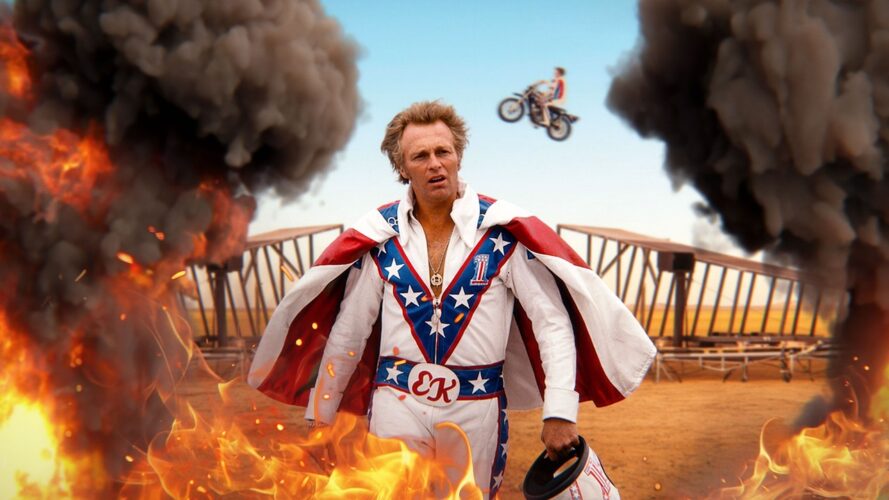
Evel Knievel was one of the greatest entertainers of all time. Bold statement, yes. But not only was he one of the biggest superstars of his day, he pioneered a style of attention marketing that has basically become the norm in today’s social media landscape. He was, however, a deeply flawed man, riddled with contradictions. Today we examine the many rises and falls of Evel Knievel.
TRANSCRIPT:
Evel was born on Oct. 17, 1938. His real name is Robert Craig Knievel.
He was born in Butte, Monta to Robert E. and Ann Keough Knievel who was also known as “Zippy” but he was raised by his grandparents Ignatius and Emma Knievel.
He developed an interest in daredevil-ism when he attended an auto stunt show at the age of 8.
He may have found his calling at a young age, but he also had a troubled childhood. He dropped out of high school and fell in with a bad crowd. He was picked up on a hubcap theft charge, and the judge gave him a choice: go to prison or join the Army and straighten out his life. He chose the latter.
Robert Jr. earned his “Evel” nickname with two “e’s” while serving time in prison. Police picked him up on a reckless driving charge. The jailer liked to give the inmates rhyming nicknames. He called one prisoner named “William Knofel” “Awful Knofel.” He called Robert Knievel, “Evil Knievel” and when he started his stunt show career, Evel added the extra “e” to his name so his show wouldn’t sound like the frontman of an 80s hair rock band.
Man, I wouldn’t want to be a guy named “Ennis” in that prison.
He continued to perform stunts in the Army. He competed in rodeos and learned how to do ski jumps.
When Evel left the Army, he started a career as a diamond drill operator for the Anaconda Mining Company in his hometown. He was promoted to surface work as a large earth mover, but he got fired when he tried to do a wheelie with it and drove the thing into Butte’s main power line. The accident caused a city-wide blackout that lasted for hours.
After he started a family, he took on a series of odd jobs and businesses that showed off his business acumen. He sold insurance door-to-door, which is hilarious. That’s like Billy Joel becoming a driving instructor…
or Will Smith running a sensitivity training encounter group.
He was actually pretty successful…until the company realized that most of his clients were patients at a psychiatric hospital.
He also ran a hunting encounter group called Sur-Kill Guide Service. He guaranteed his clients that they would bag an animal on every trip. The reason why is he was leading hunting parties into Yellowstone National Park and letting them shoot at the elk.
He also started a hockey team called the Butte Bombers. Ever the showman, he challenged the Czechoslovakian national team to play them. The Bombers lost 22-3.
Three kids later, Evel moves his family to Moses Lake, Washington where he opens a Harley-Davidson dealership.
In between his various jobs, Evel participated in motorcross races.
He suffered his first serious injury on a motorcycle in 1962 breaking his collarbone and shoulder. Doctors sidelined him from racing for at least six months.
When he opened his dealership sometime later, he would teach riders how to do tricks and it gave him an idea.
He remembered the stunt shows he used to watch as a kid, so to promote the shop, he would stage jumps.
He did pretty much everything from promotion to hosting.
One of his first jumps involved riding a motorcycle over a 20-foot-long box filled with rattlesnakes and two mountain lions. His motorcycle clipped the end of the box but he landed it safely.
He wanted the show to be bigger and more spectacular. So he snagged a sponsorship deal with ZDS Motors. He also changed the name of the show to Evel Knievel and His Motorcycle Daredevils.
Eventually, he turned the show into a solo act and started jumping cars and buses.
This is when he suffered what he called one of his worst injuries.
He was performing in a show in Barstow, California when he attempted to jump over a speeding motorcycle on foot. Instead of clearing it, his crotch — OOF! — collided with the cyclist’s helmet, sending him flying through the air.
He was rushed to the hospital with sprained legs, an injured back, and one sore pair of…um, let’s call them Knievels. Needless to say, he never attempted this stunt again.
The more towns he visited, the more cars he would jump because he would have to outdo the previous jump.
He once tried to jump a line of 12 cars and a cargo van. He missed the landing and broke his arm and several ribs. The stunt earned a ton of publicity.
In 1967, he tried to top himself in Washington by jumping a line of 15 cars. He crashed and suffered a concussion. A month later, he tried the jump again and broke his left wrist, his right knee and two ribs.
That same year, Knievel made his big…break. Get it?
C’mon. You saw that pun coming from a mile away. Maybe we could do a timer for broken bone puns too?
In 1967, Evel visited Caesar Palace’s casino and hotel in Las Vegas for a boxing match. It had this huge fountain out front and he got the big idea to jump it. The way he scored the deal is a masterclass of cunning promotion and publicity.
He started calling the casino’s founder Jay Sarno pretending to be reporters who wanted to cover the jump. The calls created a word-of-mouth campaign among the casino’s executives. So when Knievel approached him about doing the jump, they just went ahead and let him do it.
He wanted to get the footage on ABC’s Wide World of Sports, but ABC wouldn’t air it live.
He hired director John Derek to shoot the footage of the jump. Derek was also married to actress Linda Evans who served as one of the camera operators.
On Dec. 31, 1967, Evel took a red, white and blue-painted Triumph motorcycle to match his attire and attempted the 141-foot jump needed to clear the foundation.
He didn’t make it.
He cleared the fountain, but his body went flying when it hit the landing ramp. He flipped over head first and landed on the concrete on his back.
He broke his pelvis, femur, wrist and ankles.
People all over the world watched his recovery. By the time he left the hospital, Evel Knievel became a household name.
After the Caesar’s Palace jump, Knievel became an instant global celebrity.
His first attempt to top himself came a few months later following his recovery when he announced he wanted to jump the Grand Canyon.
Unfortunately, the plan fell through because the Grand Canyon is US protected land and the government didn’t want a motorcycle rider to die falling into one of its greatest natural monuments. It’s just not good marketing.
Evel tried to negotiate a deal for months to secure a jump site but the U.S. Department of Interior refused to budge.
Evel continued to tour doing jumps for bigger and bigger crowds and every time one of his stunts appeared on TV, they had to be bigger and more spectacular than the last one.
He also set several records along the way.
In 1971, he set a new world record in Ontario, California by jumping over 19 cars. The stunt was filmed for his film Viva Knievel.
Two years later, he set the record for jumping over 50 stacked cars on a Harley-Davidson XR-750 motorcycle. He kept the record for 35 years until it was broken by stunt rider Travis Pastrana who cleared 52 cars. The bike is also part of the Smithsonian’s National Museum of American History.
In 1975 at King’s Island amusement park in Ohio, he jumped a total of 14 Greyhound buses.
There were also a lot of jumps he didn’t land, and he even set with his failed landings. To this day, he holds the Guinness World Record for sustaining the most broken bones in one lifetime, at 433.
He also had a defined persona by this time that helped cement his celebrity status.
Whenever he performed a jump, he dressed in a red, white and blue leather outfits and a cape inspired by looks that were made famous by musicians like Liberace…
and Elvis Presley. Basically, he looked like someone mutated Sam the Eagle from the Muppets with a peacock.
He also was a staunch advocate against drugs. He always gave an anti-drug speech before every jump.
Because of his anti-drug stance, he was also a vocal critic of the Hells Angels motorcycle. He even once got into a fight with a local club in 1970 at the Cow Palace in Daly City, California when someone threw a tire-iron at him during his show. The incident started a fight between the motorcycle club and the spectators and even Knievel jumped into the fight.
His movie, Viva Knievel, also features an anti-drug plot as he tries to stop smugglers from bringing narcotics into America.
Then in 1971, he found a way to redeem his chance of failing to jump the Grand Canyon by focusing on the Snake River Canyon in Twin Falls, Idaho.
This time, he wouldn’t make the jump on a motorcycle.
Instead, he would catapult himself across the canyon in a X2 Skycycle steam powered rocket.
He leased 300 acres of land along the canyon to complete his stunt and set a tenative launch date of September 1974.
He hired aeronautical engineer Doug Malewicki who created the SkyTran personal rapid transit system…
and a little piece of awesomeness known as ROBOSAURUS…
to design his rocket.
He also hired NASA rocket engineer Robert Truax to design the engine for the Skycycle.
He couldn’t reach a deal with ABC to broadcast the launch. Instead, he hired a production company to broadcast the event on closed circuit televisions and into movie theaters.
It was also the first time Evel would work with sports promotor Shelly Saltman. He’s best known promoting other iconic sports moments like the heavyweight title fight at Madison Square Garden between Muhammed Ali and Joe Frazier, and the famed “Battle of the Sexes” tennis match between Bobby Riggs and Billie Jean King at the Houston Astrodome.
Knievel attempted the Snake River Canyon jump on Sept. 8, 1974. The plan was to launch on one side of the canyon and deploy a parachute so he would land safely on the other side.
Unfortunately, that didn’t happen.
Once the parachute was deployed, it dragged the rocket away from the lip of the canyon. The wind pushed it back and he landed in the mouth of the canyon just a few feet from the water. He was strapped into the rocket so if he landed in the water, he would’ve drowned. Fortunately, he walked away with only minor injuries.
The Snake River Canyon jump may not have been successful but Evel was riding high as a celebrity. Someone chalk up another win for the pun meter.
He had a top selling line of merchandise that includes lunchboxes and a line of toys that recreated some of his iconic vehicles. Ideal, the company that made his toys, made over $137 million in sales. The Evel Knievel toy line made up 18 percent of their total sales.
Knievel not only starred in his own movie, but he also made guest appearances on TV shows. He played himself on an episode of NBC’s The Bionic Woman.
Evel went back to motorcycle jumps in on May 26, 1975. He flew to London to perform a stunt at Wembley Stadium.
He attempted to jump 13 single-deck AEC Merlin buses, also known as “London buses,” but crashed during the landing.
The motorcycle bounced when it hit the ramp sending him flying over the handlebars. At one point, Evel’s bike rolled over him.
It was supposed to be his triumphant return to stunts after failing at Snake River Canyon, but he sustained a bunch of injuries.
Evel suffered a broken right hand with a compound fracture, a compressed fracture of his fourth and fifth vertebrae, a fractured left pelvis and a 7 and three quarter inch split in his right pelvis.
Despite all of his injuries, he walked up to the podium and told the crowd they just witnessed his last jump. Then he walked out of the arena, refusing to be carried off in a stretcher.
And then you know what happened next. He un-retired.
Just six months later, Knievel jumped 14 Greyhound buses at Kings Island amusement park in Ohio. The jump set a new record at 163 feet. The broadcast on ABC’s Wide World of Sports scored the highest viewer rating in its history.
Once again, Knievel stepped up to the mic and announced his retirement…
only to once again do another jump. Dude! Jump or get off the pot.
Instead of doing record breaking jumps, Evel stuck to smaller, more gimmicky stunts. One time, he only jumped seven buses to a crowd at the Seattle Kingdome in October of 1976 and he actually apologized to the crowd because he thought it wasn’t his best jump.
The following year, the massive success of Jaws at the box office inspired Evel to pull a Fonzie from Happy Days and jump a shark tank.
No, not the irascible cast of billionaire misfits on that demeaning reality show. Because people would be rooting for the motorcycle to hit them.
I mean an actual tank of live sharks.
Unfortunately, Knievel lost control his bike during a rehearsal and crashed into a cameraman. Knievel broke both of his arms and the cameraman eventually lost his eye.
The footage of the crash was so embarrassed to Knievel that he wouldn’t let anyone see it for 19 years until a documentary on his life was made.
Evel officially retired from stunts after the accident, saying “a professional is supposed to know when he has jumped far enough.”
And you can probably guess what happened next.
No, wait, this time he stayed retired.
In 1977, Shelley Saltman published a very unflattering book about him called Evel Knievel On Tour that described the stuntman as a pill addict, an anti-Semite and just an all around immoral person.
Evel retaliated by attacking Saltman with an aluminum baseball bat in a parking lot.
Evel got six months in jail after pleading guilty to assault and his reputation was tarnished even further.
Ideal stopped making his million dollar selling toy line, and the company actually ended up in the red during its first fiscal quarter.
Saltman sued him for damages and they reportedly settled on a sum of around $12 million, but Evel never paid him. The family continued to pursue a settlement from his estate well into the 2000s.
In 1981, Evel declared bankruptcy.
He focused on supporting his son Robbie Knievel who followed his father’s footsteps as a stunt performer.
The scandals didn’t just follow his life. Some of them happened before he became a household name.
Remember the hockey team he started in Butte, Montana? Uh huh, Butte.
There were reports from some players that they were supposed to get paid $50. One player said, “We never got paid too often, but I remember a couple of good meals.”
Eventually, the team ended up going into bankruptcy and facing a lawsuit over several unpaid bills.
In 1994, Evel was dating a 25-year-old woman who accused him of hitting her during an argument. Eventually, she decided to drop the charges but reports at the time said she had visible injuries in her face and neck.
Scandal even followed Evel Knievel after he died.
In 2008, the FBI released a series of files detailing allegations that he was involved in “a string of beatings in Phoenix, Kansas City and San Francisco.”
He was never charged but one story said at the time that they were close to filing charges in 1970 for his alleged involvement.
He made appearances throughout the 1990s and even did some public motorcycle rides, but he never did any jumps or the stunts that made him so famous.
His health started to deteriorate towards the end of the decade.
In 1999, he suffered from Hepatitis C that he contract from a blood transfusion and it destroyed his liver. He was told he’d only have months to live until he received a new liver from a donor.
He lived for another seven years until his doctor diagnosed him with idiopathic pulmonary fibrosis, a chronic lung disease that is terminal and uncurable.
A man who once walked away from jumps with a pelvis broken in two places could walk from his condo to his swimming pool without help.
He required the use of an oxygen tank and had to take up to 50 pills a day including fentanyl just to deal with the pain.
Then he passed away on Nov. 30, 2007 at the age of 69.
Knievel may be gone but his legacy lasted throughout his remaining years and even after his death.
His son Robbie continued to do stunts just like his father did.
In 1989, he recreated the Caesars Palace jump that kicked off his father’s career and actually completed it.
He also managed to complete a jump that Evel never even got to try.
He found a stretch of the Grand Canyon where he could secure permission to perform a jump.
He cleared the canyon on May 20, 1999 and only sustained a broken leg from the landing.
Evel Knievel’s career and persona have inspired other acts over the decades that followed his most famous jump.
Comedian Bob Einstein, the brother of Albert Brooks, who appeared on shows like Curb Your Enthusiasm, is probably best known for creating Super Dave Osborne.
Super Dave is a parody of stuntmen with a very obvious nod to Evel Knievel since they both wear red, white and blue jumpsuits, and speak openly about causes that mean a lot to them.
Super Dave would perform outlandish stunts that would inevitably go wrong in hilarious ways.
Super Dave also parodied Evel’s advocacy and dedication to the support by staging his dangerous stunts for some outlandish cause like raising awareness about using profanities on highways.
Then there’s the MTV series and movie franchise Jackass in which Johnny Knoxville and his gang would perform inane and dangerous stunts like getting hit by bulls or launching himself into lakes, simply for a laugh.
One of Knoxville’s most serious injuries happened during a tribute to Evel Knievel.
Knoxville appeared on an MTV special starring BMX legend Mat Hoffman in which he tries to back flip a motorcycle, something he’s never done.
He lets go of the bike in mid air and the bike lands on top of him on his crotch.
OW!
The accident tore his urethra, which we know is possible now thanks to Knoxville.
He says he had to wear a catheter for over three years while it healed.
He told Entertainment Weekly, “The doctor said a couple centimeters down and it would’ve been out of commission.”
Yeah, can we go back to talking about nuclear bomb projects next week?
I think Knievel’s life and career speak to something bigger: the idea of spectacle.
We live in an age where our senses are constantly being bombarded by screens.
We work on computers. We immersive ourselves in stories and experiences on screens. And it seems like we are constantly engaging each other on our phones whether we’re communicating or engaging in behavior that once could only be replicated with desktop computers or TV sets.
By the way, if you’re watching this on a phone now, please like, share and subscribe.
That phrase and those actions have become almost a new kind of currency, a crypto for our attention.
Sometimes it involves trends on platforms like TikTok that can involve dangerous stunts like…
the milk crate challenge or…
the Tide Pod challenge.
Sometimes it can be a force for good or even change like the ALS Ice Bucket Challenge.
These trends can become so popular and pervasive that they’ve been used by athletes, celebrities and even politicians. They may sometimes be for a good cause, but they’re almost always about gaining some kind of attention.
Knievel knew that the bigger the stunt he’d perform, the more attention he’d receive. He took it farther. He created a persona associated with the very idea of making a spectacle of himself.
And it’s not just by performing stunts. Sometimes simply announcing that he would jump the Grand Canyon or fly in a rocket or put himself in a dangerous situation would gain the world’s attention.
Even the bad press he received for some of the awful things he did gained attention.
Knievel harnessed this idea and created the spectacle economy we now live in long before portable phones were even an idea in some tech mogul’s mind.
Evel didn’t invent the concept of being a stuntman, but he clearly knew how to model and shape one to capture the attention of the world.
Thanks for watching my latest spectacle, by the way. God I feel dirty.


Add comment