
Life can change in a heartbeat. You never know what comes next. These are photos that have become infamous on the internet for the fact that they have crazy backstories. Some were taken right before disaster, some hide a sinister reality, but all look perfectly normal – until you find out why they’re not.
TRANSCRIPT:
Life can change on a dime.
There’s a poem called “To A Mouse” written by Robert Burns. Burns was a farmer and wrote about accidentally destroying a mouse’s nest when plowing a field. In the story he stops to apologize to the panicked mouse and is so guilt-ridden that he ruined the mouse’s hard work in an instant. The mouse was just trying to make a safe home for the winter and thanks to him, it’s gone.
He then draws a point that we are like the mice, vulnerable to life altering events beyond our control. Our plans for happiness are not immune to the reality of life. Hence the phrase, the best laid plans of mice and men.
In other words, control is an illusion. And these photos capture the moment right before the farmer’s plow crashes into these lives.
… day bow bow oh yeah.
Irish Republicans and Nationalists who wanted to unite Northern Ireland with the Republic.
The Nationalists want to go about it through more politically peaceful means. And the Republicans took more of a “the end justifies the means” sort of approach.
Here we have the paramilitaries who fought under each flag. A paramilitary is an armed group that operates like a military but actually has no legal authority to act on the government’s behalf. Like a militia…
Famously, the IRA or the Provisional Irish Republican Army
The INLA the Irish National Liberation Army
And Sinn Fein a political group who was central to peace talks. Eventually. They are considered to be the party of the IRA.
In another protest Nationalists marched through Protestant Loyalist neighborhoods where three hundred Loyalists arrived with iron clubs, and hurled rocks at the protestors, who the RUC did little to protect.
In return, Loyalists known as the Apprentice Boys paraded through Bogside which was a Catholic part of town. And the Bogsiders were ready for them with barricades and Molotov cocktails. The ensuing three days of violence and rioting was known as the Battle of Bogside. Loyalist mobs burned fifteen hundred Catholic homes to the ground.
Things were getting ugly. Northern Ireland phoned London for help and so British troops were deployed.
Then came one of the defining moments of the entire conflict. Bloody Sunday. On January 30, 1972, British soldiers shot 26 unarmed civilians during a march in Bogside.
So, the IRA burned down the British Embassy.
From there the violence was tit for tat, and it was personal. Bombings, shooting, riots. Acts of terrorism traumatized local citizens. During the 30 year period of The Troubles, over thirty- five hundred civilians were killed. These were not activists who belonged to paramilitaries or special forces. They were ordinary people going to work, visiting family, heading to church, or simply walking through town with their kids.
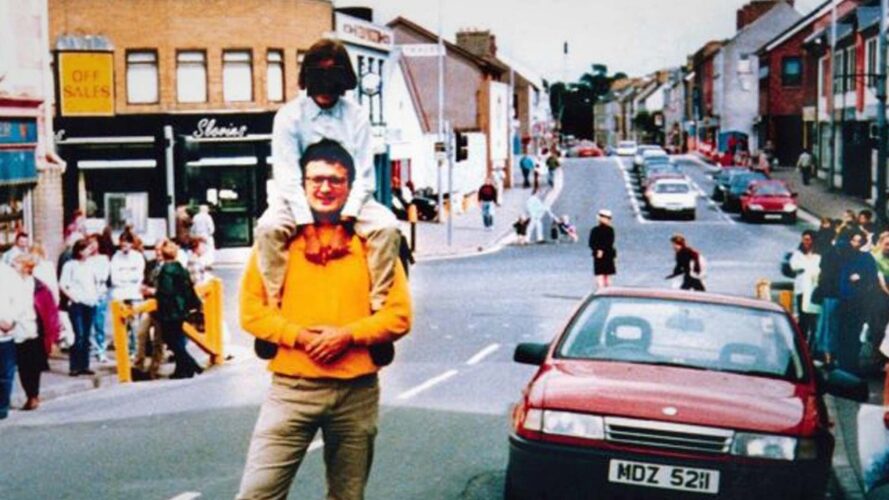
And here was the devastation after the bomb went off. (photos)
The Omagh bombing killed twenty nine people and injured more than two hundred twenty others. It was the deadliest single attack of the Troubles. What made it even more shocking was that the Good Friday Agreement had been signed four months earlier. For most, that marked the end of the conflict.
The deal was signed on April 10, 1998, by the governments of the United Kingdom, Ireland, and Northern Ireland. It laid out the framework for multi-party politics in Northern Ireland and reinforced civil rights protections for all. Maybe most importantly, it declared that the constitutional status of Northern Ireland will change only with a majority vote.
After three decades of fighting, the people were exhausted. They wanted the blood shed to stop. So why did a car bomb in Omagh explode after the Agreement was signed?
Well, the peace deal was between governments, but not everyone agreed. The group behind the Omagh bombing was the Real Irish Republican Army. The “Real IRA” was a splinter faction that considered the standard IRA to be too compromising. They believed violence, not politics, was still the path to a united Ireland and they had no interest in Sinn Fein, the political party of the IRA.
They have since merged with other Republican splinter groups and go by the New IRA. They are still active today, but on a much smaller scale than during the Troubles.
To end on a high note! We don’t know the names of the subjects in the photograph with certainty but reportedly they survived the bombing. Apparently they walked on after it was taken. Sadly, the photographer did not survive. The camera was found in the rubble of the blast.
It’s not really a high note sort of episode.
In 1970 a woman walked into a social services office with her thirteen year old daughter who was clearly malnourished. …Except the mother didn’t mean to walk into that office. It was a mistake. She was nearly blind and was trying to go to the disabilities office next door. The staff there immediately noticed something was seriously wrong with the girl. She couldn’t speak and she did a sort of bunny hop rather than walk.
This was Genie Wiley.
Genie had spent her entire life locked in a bedroom, cut off from other people. Not only was she imprisoned, she was strapped to a toilet seat or left in a crib with a cover on it. Her father hated noise so he didn’t allow anyone in the family to talk around Genie. She grew up not hearing a word of the English language. Or any other language for that matter. Her only exposure to another human was when her brother fed her baby food and cereal every day in silence.
The level of neglect is almost incomprehensible.
When Genie was finally removed from the home at thirteen, she became a ward of the state of California. Researchers began to study her almost immediately. Here they had a rare albeit messed up opportunity to investigate some of the biggest theories in language development. Noam Chomsky was a famous linguist who said humans have an innate capacity to learn to speak. The blueprint for language is in our DNA.
But what does that look like if you were strapped to a chair in solitary confinement for all of your life with no one to speak to? Where does nature versus nurture come into play? Genie survived a scenario no ethical study could ever create.
So doctors, therapists, and linguists began working with her around the clock. Susan Curtiss was a graduate student who became especially close to Genie.
And then amazing thing happened. Her vocabulary grew quickly. She came into the hospital with the mind of a 1 year old, but with a supportive environment she began to learn hundreds of words. She couldn’t always say them out loud, which kinda make sense considering she used to be beaten for opening her mouth.
Even though she couldn’t always express herself through language it became clear she understood much more than she could say. She had her own nonverbal way of communicating by putting together words, gestures, and pictures.
As Susan Curtiss said “Her lights were on. She was not mentally deficient.”
In one transcript, Genie described her father’s abuse:
“Father hit arm.
Big wood.
Genie cry … Not spit.
Father. Hit face—spit … Father hit big stick.
Father angry.
Father hit Genie big stick.
Father take piece wood hit.
Cry. Me cry.”
But beyond putting a few words together, Genie never could develop complex grammar. She would say “applesauce buy store” instead of “We need to go to the store to buy some applesauce.”
She was one example that proved Eric Lenneberg’s critical period for theory. He said if a child didn’t learn a language by puberty, it was unlikely to happen at all.
It seemed as thought the Wernicke area of the brain which is the area responsible for understanding and written word was totally fine. The Broca area where the brain processes speech and grammar was essentially reduced to nothing.
Genie proved intelligence was not the same thing as the ability to learn speech. Unfortunately all of the progress came to a halt when Genie turned eighteen. Federal funding ran out at the same time Genie’s mom sued for custody. She claimed they were exploiting her daughter for research. Genie went back to live with her mom… in the same house where she suffered over a decade of extreme abuse.
It was only a matter of weeks before Genie’s mom admitted she was overwhelmed and turned her back over to the state. From then on, Genie was passed around institutions and foster homes. Stories of further abuse were reported over the years and Genie stopped talking altogether. She totally regressed.
Susan Curtiss and a few other researchers have tried to locate her even now, but because of privacy protections her location is unknown. But she is supposedly still alive. Her story is heartbreaking. Even with the capacity to learn, language cannot be cultivated without the stability of a safe home.
As far as natural disasters go, the deadliest of this century happened in 2004.
This photo was taken on Christmas Day at the beautiful Maya Bay in Thailand. This is Deborah Garlick, a British property manager on holiday with her boyfriend. The next day, Deborah and roughly 228,000 other people would lose their lives to a record-breaking tsunami.
The tsunami was triggered by a massive 9.1 magnitude earthquake beneath the Indian Ocean, just off the coast of Sumatra. Sumatra is an island not far from Malaysia and Singapore. 9.1 is a huge reading– the scale only goes to ten.
The earthquake happened along what’s known as the Ring of Fire. That’s a belt of tectonic plates around the Pacific Basin where some of the world’s most powerful earthquakes and volcanoes occur. Mount Saint Helens is actually along this path as well.
When the Sumatra-Andaman earthquake struck in 2004, it violently shook the ocean floor. The shift sent waves in all directions across the Indian Ocean, devastating coastlines along the way.
The first and hardest hit country was Indonesia. Just fifteen minutes after the earthquake a wall of water around one hundred feet high slammed into the capital city of Banda Aceh. Around one hundred thousand people were killed.
The waves then traveled toward Thailand at speeds of up to five hundred miles per hour. That’s where Deborah was killed along with thousands of locals and tourists. Thailand’s death toll landed at roughly 5,400. The tsunami hit fifteen countries around the Indian Ocean.
228,000 deaths. It’s staggering.
That’s the population of Durham, North Carolina. Or, imagine finding out that Boise, Idaho had been wiped off the map in a matter of hours.
Damage from a tsunami doesn’t happen all at once. It comes, literally, wave by wave. The waves can arrive minutes apart, or even an hour apart. And the first wave might not even be the biggest.
Once that first wave hits, though, the debris and flooding become a huge part of the danger. Most people don’t die from a single cinematic wall of water. They die from being swept away, trapped in debris, or from the conditions that follow.
No food. Dangerous rescue attempts. Rushing water filled with debris and splintered wood. Unsanitary surroundings with plumbing gone.
The 2004 earthquake showed us just how vulnerable countries in that area were to tsunamis. It was tragically clear we needed better warning systems. In the aftermath, international groups worked to improve tsunami detection and warning systems, along with response when they do strike.
I’ve probably seen this photo a hundred times. Any semi-scientifically literate person can look at this photo and know what’s going on, and that they are in significant danger. What I didn’t know was these brothers were actually struck by lightning.
Happy to spoil the ending for you– they lived. But they were seriously injured. Sean and Michael McQuilken were hiking with three others on Moro Rock in the Sequoia National Park in 1975 when their hair stood straight up. They thought it was hilarious. This is a photo of their sister Mary before the strike.
“All of sudden I’m slammed into the ground. It was a huge explosion. And Sean is doubled over and there is smoke coming out of his back,” said Michael. Moments after the photo was taken lightning connected to the top of the granite dome they were standing on and knocked everyone to the ground.
Another one of their sisters who was on the hike remembered vomiting the whole ride home the next morning. She said: “The lightning, I actually saw it, and it looked like an umbilical chord of energy,” she said. “The smell, the burning of the bodies were just awful.” Sean was knocked unconscious and suffered third degree burns.
So what exactly is happening?
Lightning is essentially a huge electrical arc. It happens when the positive and negative charges separate inside a cloud. Typically the bottom of the cloud gets strongly negatively charged, which causes the ground below to become positively charged. The voltage difference gets so extreme that the air becomes a conductor. An electrical channel moves downward toward the earth from the cloud and sometimes positive electrical streamers rise up and meet it. When they connect we see that bright flash of current moving through the air. I talk more about how this works in my Ball Lightning video
But why is their hair standing up?
Because the electric field is so strong it causes the charges on your body to redistribute. Positive charges from the ground rise up through you, and similar charges repel each other, so, each of your hairs is standing up to push away from the other, and reach the clouds.
Basically, if your hair ever starts to rise during a thunderstorm, get to lower ground immediately. Not joking. You can’t outrun lightning but you can put as much distance as possible from yourself and the highest point around you. Lightning wants to strike at the easiest path so it will find the highest point of contact with a positive charge.
The McQuilkken brothers were taken immediately to a hospital for treatment. All five hikers survived, though sadly, Sean took his life at the age of 27 after struggling with mental health. Lightning strikes are actually known to damage the nervous system. Michael said depression runs in his family but it is worth noting the physical trauma extends to the brain, the spinal cord, the autonomic nervous system and peripheral nerves.
Those left with scars on the outside have a fern-like pattern. It’s almost as if left a map of where the current traveled across the body.
It’s incredible to survive a lightning strike. And very unpleasant. It’s always a good idea to check the weather before going out on a hike.



Add comment