
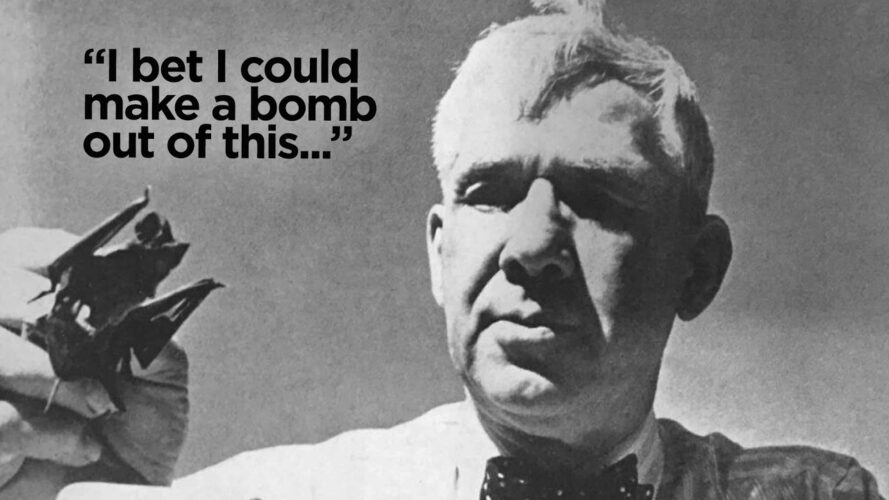
It sounds too crazy to be true, but at the beginning of World War 2, a crazy idea was hatched. What if we strapped bombs to bats? The idea is they would roost in attics and crawlspaces all over Tokyo and then set the whole city on fire. Believe it or not, this was tested for years, at the cost of millions before being shelved. But here’s the craziest bit… It could have worked.
TRANSCRIPT:
Meet Dr. Adams
If you’re a regular viewer of this channel, then you probably remember the story of Hedy Lamar and how she and George Antheil came up with the idea for frequency hopping to help the Allies in World War II.
She wasn’t the only person to come up with an idea that people in charge thought were crazy to help out with the war effort. In fact, some of them are the exact opposite: crazy ideas that people in charge took seriously.
This is Dr. Lytle Adams, a dental surgeon from Irwin, Pennsylvania. He was so shocked to hear the news that on Dec. 7, 1941, Japan attacked Pearl Harbor, he felt compeled to do something to help win the war.
He just visited Carlsbad Caverns in New Mexico and was impressed with the way that Mexican free-tailed bats flew and nested on the roof of the caves. So he came up with an idea, and I quote…
“Couldn’t those millions of bats be fitted with incendiary bombs and dropped from planes? What could be more devastating than such a firebomb attack?”
It’s a new idea. I’ll give him that.
Carlsbad Caverns is known for its annual bat migration, and it’s a majestic sight. Over 1 million bats migrate to the caves during the summer. It keeps them safe from predators and they have plenty of food to eat with the crickets and insects who live in the cave year round. It’s one of the few places in the country where you can see such an impressive display of wildlife in one place.
This guy witnessed this spectacle and thought, “Hey, what if we attached bombs to them?” The funny part is a lot of very important people heard this pitch and didn’t say, “No, really, what’s your idea?” They actually took it seriously, and tried to make it a reality.
The Great Kantō Earthquake
Dr. Adams’ idea also came from the Great Kantō Earthquake that hit Tokyo in 1923.
Japanese homes were usually built out of bamboo and paper, so the 8.0 earthquake caused massive fires across the city.
Dr. Adams thought this made one of the key access powers vulnerable to attack if someone could think of a way to start a bunch of fires in one concentrated area…and he thought, hey, let’s attach tiny bats to bombs.
You know an idea is insane when even Wile E. Coyote hasn’t thought of it yet to catch the Road Runner.
The Plan
Here’s how his plan worked. And try to keep up because it’s quite complex.
First, the military would capture thousands of bats…
and attach tiny explosives to them.
Then a plane would fly over the city…
and release the bats all at once.
The bats would seek shelter…
…in the attics and ceilings of homes and buildings…
…where they would detonate and cause mass destruction.
The White House approves
Adams was so certain this idea would work, he typed up a proposal and sent it to the White House.
Now, you might think that the White House, a place presumably staffed by top experts, the people leading in their field, would just laugh this idea off. Bombs attached to bats? Sounds like something a nine-year-old on a sugar high would dream up.
It’s so crazy, it probably wouldn’t surprise you to learn that they typed up a letter with just the word “ha” written on it over and over again. Well, that’s not what happened.
Well, that didn’t happen. I mean, someone probably laughed at it. They got thousands of ideas a day from people all over the country. However, the White House took it seriously.
That’s because Dr. Adams was good friends with someone very high up in the executive branch…
And her name was Eleanor Roosevelt, the first lady of the United States.
Eleanor helped get Adams’ proposal on FDR’s desk and in front of the eyes of the country’s highest ranked military personnel. President Roosevelt personally vouched for the plan writing in a memo, “This man is not a nut. It sounds like a perfectly wild idea but is worth looking into,” according to a memo in his official archives.
FDR sent Adams and his idea to his head of wartime intelligence William Donovan along with other top military, weapons and presumably bats experts.
Together, they came up with a name for the plan: “Project X-Ray.” That’s probably because “Project No Seriously, This is the Plan, Stop Asking Us if We’re Serious” was already taken.
Types of Bats
The super-secret plan had a name and approval from the highest-ranking people in our government. And the story just gets more bizarre from here.
Bats are great at carrying things in mid-flight, like most flying animals. Female red bats, for instance, can carry their young in flight as they develop.
They originally thought the mastiff would be the ideal bat to carry bombs because it’s the largest species of bat. It has a twenty-inch wingspan and is capable of carrying an entire stick of dynamite.
They also considered the mule-eared or big-eared bat, which could carry up to three ounces.
They eventually settled on the Mexican free-tailed bat because it could carry something big enough to cause serious damage, and they gathered together in large groups. So the military could scoop up and capture a bunch of them for the project.
Collecting and Storing Bats
They started collecting bats by the thousands with nets by sweeping them on the ceiling of caves or capturing them as they swarmed out of the entrances.
They stored the bats in cages in refrigerated trucks because the cold air sent them into hibernation, making them easier to transport and store.
The military built bat houses tended to by US soldiers. These bat houses sat on tall stilts in San Antonio, so mosquitos would fly into them and provide the bats an easy food source.
Since they planned on blowing them up, this is the bat equivalent of a last meal.
The Designers
The National Defense Research Committee assigned Harvard chemist Dr. Louis Fieser to Project X-Ray to come up with the incendiary device. He’s best known for inventing napalm.
The committee also assigned special investigator Dr. L.F. Fisser to design a lightweight bomb for the bats to carry.
They also probably considered those round bombs you see in cartoons but dismissed the idea because they couldn’t be grasped by bats. Plus, the idea of tying a bomb to a bat was cartoony enough.
The Committee’s Chemical Warfare Service, among other agencies, started demanding tests to determine the feasibility of transporting and releasing the bat bombs.
Lightweight bombs were used in WWI called “baby incendiaries.”
“Shhhh, the baby incendiary is sleeping! Don’t wake it up or we’ll all die a fiery death!”
They were filled with a special thermite mixture and only weighed about 6 ounces each.
Dr. Fisser came up with two different sizes of bombs for the bat experiments. One weighed just half an ounce and could burn for four minutes off of a 10-inch fuse. The other weighed just under an ounce with a 12-inch fuse. They were also built into long cylinders filled with kerosene, so they could be fixed to the bats.
Each bomb had an igniter with a firing pin held in place by a spring of steel wire. To ignite the bomb, a copper chloride solution would fill the cylinder and corrode the wire to release the firing pin and strike an igniter to light the kerosene.
Some of the bats also carried smoke bombs, so they could be traced on the ground during testing.
The bombs were attached to the loose skin on the bat’s chest with a surgical clip and a piece of string. The plan was for the bats to nest in dwellings and buildings, and gnaw at the string on their chest and release the incendiary device, creating a massive fire.
The first tests happened on May 21, 1943 with five bat drops using 6,000 bats from B-25 bombers at an altitude of 5,000 feet, and it was a disaster.
Why It Didn’t Work
Most of the bats didn’t wake up from their hibernation so they just fell out of the planes like rocks. They were outfitted with duds but the bats that didn’t fly out of the plane died from the fall. Those that did wake up flew out of the plane before the drop.
There were other problems as well.
The bombs were difficult to attach with surgical clips without damaging the bats.
They also tested different sizes of dummy bombs to see how the bats could handle the weight. The bats that carried the heavier devices decided to return to the hanger they were stored in, which would’ve been a disaster if the bombs were real. Most of the bats with lighter devices just flew away.
An accidental fire destroyed any chance of a second successful test. One captain who conducted tests at Carlsbad Air Force Base in New Mexico tried to hide a report about one of the bat handlers accidentally leaving a door open to one of the bat houses. Some of the specimens escaped with live fire bombs attached to them. They nested under a fuel tank that burned down test buildings, a control tower, and a general’s car.
So technically, hooray? It was a success?
Maybe It Would Work
Project X-Ray transferred to the Navy and the Marine Corps in the following months. They were actually more successful.
More than two years after the bombing of Pearl Harbor, the Marines conducted more experiments with the bat bombs. They caused 30 accidental fires, four of which had to be extinguished by firefighters.
More tests were planned with bombers but Fleet Admiral Ernest J. King, the Chief of Naval Operations, cancelled the entire project when he learned they wouldn’t be ready until the following year. Three years and $2 million later, Project X-Ray was dead.
Instead, the military focused their efforts on a different kind of warfare weapon.
The Bombing of Nagasaki and Hiroshima
That’s right, the government refocused on Robert Oppenheimer’s atom bomb…which he tested on July 16, 1945 in a desert near Alamogordo, New Mexico by attaching it to a bat. I’m just kidding.
When President Harry Truman heard about the successful test, he made the decision on July 25 to drop bombs on Hiroshima, Kokura, Niigata and Nagasaki, Japan in that order. Eventually, they settled on Hiroshima and Nagasaki as targets. The attacks were carried out the following August and killed at least 150,000 people, both from the blast and the radiation fallout. Japan surrendered within a week of the explosions.
Dr. Adams continued to insist that his plan would’ve worked, and even if his idea sounded like something concocted by an evil Rube Goldberg, maybe he had a point. The Marine Corps tests showed they could’ve worked even if the bats were difficult to control. He also said he found bats up to 20 miles away from their drop points, so the bat bombs could’ve created fires across a 40-mile diameter without creating such a massive loss of life.
Other Military Animals
Dr. Adams’ idea also wasn’t completely unheard of when it comes to the military using animals in its operations. It’s just, you know, harder to train a bat.
The term “slip the dogs of war” originated from Mark Antony in William Shakespeare’s “Julius Caesar” and referred to war dogs that troops would release on the battlefield.
Dolphins have been trained by the US and Soviet navies to locate mines. The US Navy also has the Marine Mammal Program that’s operated since the 1960s in which they train bottlenose dolphins and California sea lions to search for and recover objects in harbors, coastal areas and the open sea.
In France during World War I, parrots were posted around the top of the Eiffel Tower because they could hear aircraft up to 20 minutes away. The plan wasn’t ideal because the parrots couldn’t distinguish between enemy and friendly aircraft and according to one researcher, “they got fed up and stopped responding.”
Carrier pigeons have been used in several conflicts and they could be quite resourceful and even dedicated to delivering messages. In 1918, German forces shot a pigeon carrying a message to the front line. The bullet broke one of the pigeon’s legs and drove the metal cylinder it was carrying into its body but it still finished the nine-mile journey to its destination before it died.
Dogs have been used in all sorts of conflicts to transport medicine and messages across front lines.
One of the most famous is a dog named Chips, a part-German shepherd, part-husky dog who served during World War II on a number of missions across the world. He transported a phone cable while under fire to help his platoon call for help. He also served as a sentry dog to alert warnings of approaching enemies saving countless lives in the process. He actually received a Distinguished Service Cross, a Silver Star and a Purple Heart before the military revoked them over a policy preventing animals from receiving official commendation.
That may be the saddest dog story I’ve heard since I first saw the ending of Turner and Hooch.



Add comment