
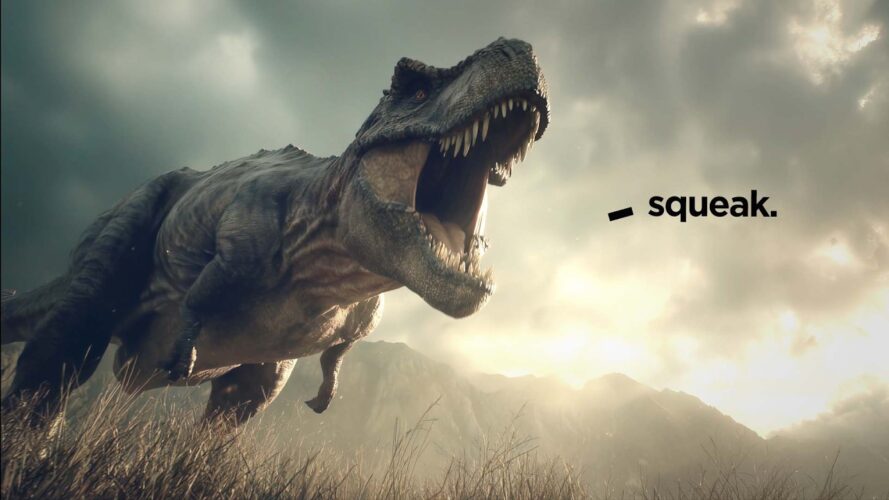
We’ve heard them in movies for decades, but of course we don’t know what they sounded like in real life. But we do have some educated guesses, and today we’re going to look at the theories behind dinosaur sounds, what they sounded (or felt) like, and ponder the likelihood that maybe some of these guys could even talk.
TRANSCRIPT:
The word “dinosaur” wasn’t even coined until 1842.
Which is pretty recent, given the millions of years dinosaurs have been buried.
Before that, people thought the bones were from mystical creatures, giants, or they misidentified them as other animals.
Like, the griffin. That’s a mystical creature with the head, wings, and talons of an eagle and the body, back legs, and tail of a lion.
Its legend comes from Scythian miners who found the skeletons of Protoceratops and other dinosaurs in the Gobi Desert.
Not knowing exactly what they found, they invented the griffin.
In China, long-necked sauropod fossils may have been the basis for stories about dragons. Even today, their skeletal pieces are sold as “dragon bones” for medicinal powers.
Dinosaur bones were also viewed through personal beliefs.
Like fossils found in medieval Europe were sometimes looked at through a Christian lens.
In the 18th century, a Swiss physician named Johann Jakob Scheuchzer came across some giant bones.
He published a paper describing them as the fossilized remains of Homo diluvvi testis [HOH-moh dih-LOO-vee-eye TES-tiss], or “the man who witnessed the flood.”
He said it was evidence of ancient humans who lived during the time of Noah.
Turns out, the bones he found belonged to a giant salamander.
And then you have people misidentifying fossils as the remains of other animals.
That’s what happened during the Lewis and Clark expedition in 1806.
While exploring the Louisiana Purchase, Lewis discovered the rib of what he thought was an enormous fish near Billings, Montana.
But looking at his notes and description, it’s pretty certain that he found a dinosaur rib in the Hell Creek Formation.
Yeah, so we’ve come a long way from thinking of dinosaur fossils like mystical creatures, ancient humans, and other fantastical things.
Our knowledge has evolved to the point that we now view dinosaurs as early versions of birds. Some of the dinosaurs even had feathers!
And we’re still finding new dinosaur species. In 2025, scientists discovered 44 new species. That’s almost one new one a week.
Clearly, we have a lot to learn about dinosaurs. And one of the biggest questions is, what did they sound like?
In fact, what were the first sounds made by animals? How did hearing actually evolve?
Let’s take that last question first.
With humans and other terrestrial vertebrates, an ear can be divided into three sections: the outer ear, the middle ear, and the inner ear.
In simple terms, the outer ear captures sound waves, and the middle ear transmits them via the eardrum and the three small bones called ossicles [aa·suh·klz] to fluid movements in the inner ear, where they are converted into nerve signals.
Sensory structures in skulls emerged around 1.5 billion years ago in prehistoric life forms. Cells used cilia to help with movement, feeding, and their surroundings.
Then, around 380 million years ago, when fish started to evolve and move onto land, they developed the ossicles, those three small bones.
For example, the 370-million-year-old Panderichthys [pan-dur-IK-thiss] was an intermediate genus between fish and the first four-limbed land animals. It had small bones in its skull that looked like early versions of both ear canals and the gill system in fish.
Those canals turned into the ears we know today after its descendants fully lived on land.
Research shows that ears capable of hearing airborne sounds evolved on their own at least six times among groups like mammals, reptiles, and birds.
But they all share an eardrum-like membrane and those small bones that help transmit sound to the inner ear.
And based on fossil records, the earliest known ears of this type are from around 200 million years ago or later.
Scientists thought that hearing evolved so that vertebrates could catch buzzing insects for food. But a new idea is that it evolved to hear better in dimly lit areas.
As for when the first sounds were made by animals, that was probably caused by a katydid around 250 million years ago.
That’s because fossil records from that time show that it had the anatomy to produce sounds.
We don’t know exactly when insects started making sounds. Just like we don’t know exactly what dinosaurs sounded like. But we can make a pretty good guess.
Birds
If you think about it, the way sound is used hasn’t really changed between the time of the dinosaurs and today’s animals. It’s used to communicate, scare off threats, and woo lovers. So, it’s not crazy to think that adapting modern sounds to ancient ones makes sense.
But as one scientist said, “We can’t start talking about sound production in dinosaurs until we truly understand the system in living species.” And for that, we turn to birds.
According to a recent study in Current Biology, the syrinx [see·ruhngks] and the larynx share the same developmental programming. By the way, the syrinx is the vocal organ of birds, and the larynx is the vocal organ of reptiles and mammals.
Scientists observed that the same genes controlled the development of the vocal organs in chicken and mouse embryos, even though the organs arose from different embryonic layers.
Or, as one of the study’s authors said: “They form under the influence of the same genetic pathways, ultimately giving the vocal tissue similar cellular structure and vibratory properties in birds and mammals.”
While this helps shed light on the syrinx’s origins, we still don’t know when it first developed and if non-avian dinosaurs had it. No one has yet found a fossil syrinx from one.
But a fossilized larynx from one non-avian dinosaur has been found. It was discovered in Mongolia in 2005 and belonged to Pinacosaurus grangeri [pih-nah-koe-SAWR-us grane-jer-eye]. This dinosaur lived 80 million years ago, moved on four legs, and had a club-like tail. The larynx scientists found may have worked in the same way the syrinx works in today’s birds. Research in 2023 suggested that the dinosaur may have created loud explosive calls and bird-like sounds like those that parrots make.
The Sound of Predators
Dinosaurs were huge. They looked scary. So, it makes sense that we view them as predators. With that as a base, we could imagine they sounded like today’s predators.
Like, this is the sound of a male red fox. You might want to start running if you heard that at night in a park.
Other animals that let out scary sounds include cougars and bobcats, whose screeching has been described as sounding like a child wailing in distress.
Even small animals like frogs and salamanders make chilling sounds. People who own nocturnal leopard geckos say their pets sound like they’re possessed when they make this high-pitched sound with an open mouth.
Another animal that makes haunting sounds is the barn owl. They will sometimes scream or let out a loud, scary hiss. But that’s just one bird. For the most part, birds let out sounds that some people find calming, relaxing, or entertaining.
So, maybe dinosaurs sounded like the dulcet sounds of doves.
Physical Evidence
To help us figure out what dinosaurs may have sounded like, we turn to their modern relatives, like crocodiles and birds. Using these two points of reference, we can create a bracket around a segment of the tree of life. We can then compare the behavior and biology of living relatives and infer how likely those characteristics were to have appeared in their ancestors.
This process is called phylogenetic bracketing.
So, crocodiles and birds make totally different sounds. As explained earlier, birds have a syrinx. But since a crocodile is a four-legged vertebrate, it has a larynx. And since most other four-legged vertebrates have this type of voice box, it’s safe to imagine that’s what dinosaurs had, too.
But when did the syrinx take over in dinosaur evolution?
We can compare syrinxes in living bird groups and place them on the family tree. Groups that branched off closer to the origin of birds have less well-developed syrinxes.
And with this evidence, we can place our bets that dinosaurs weren’t making songs with their voices, either. They probably sounded like modern crocodiles and primitive bird species. Think croaks, hisses, squawks, honks, and rumbles.
Size mattered, too. Like, a T. Rex probably didn’t sound like a lion. That’s because it was twice the size of an elephant, had a huge mouth, and a chest full of air chambers. It’s probably safe to say it sounded loud.
But was it a loud hiss? A loud croak? A loud honk?
For that, we turn to what dinosaurs physically looked like. There was one group of dinosaurs that evolved specialized skull structures that could create sounds.
They’re called Hadrosaurs, or duck-billed dinosaurs. They were large herbivores that live in the late Cretaceous Period around 145 to 66 million years ago.
Many of these dinosaurs had fancy bone structures on their heads that were of all shapes and sizes.
Like, some had raised nasal bones, and others had crests longer and taller than the rest of their skulls.
X-rays and CT scans of their fossils show that these structures were connected to the nostrils and throat via hollow passages through the skull’s interior.
These crests acted like built-in resonators and channeled air through the skull. This helped create sounds through the nose. And since each species’ crest was a different shape, they could’ve had their own unique sounds.
In fact, the Parasaurolophus [peh·ruh·saw·raa·luh·fuhs] had a crest with an internal shape similar to a trombone. Some scientists even built their own “hadrophones” to try to recreate the sounds they made.
Another thing to consider when thinking about how dinosaurs may have sounded is soft-tissue structures.
Many animals today rely on these structures to enhance their noise-producing abilities. These structures are often elastic and delicate, making them unlikely to be preserved in the fossil record.
What kind of soft tissues did non-avian dinosaurs have that enhanced their sounds? Dinosaurs like theropods and sauropods had the same system of air chambers that birds inherited.
Other dinosaurs, like hadrosaurs and ceratopsians, had large nostrils and complex air passages in their skulls. This could’ve given them a deeper, bellowing sound.
And some of those sounds we may not even have been able to hear.
Like, crocodile calls are in the infrasound range. That’s below 20 Hz, and it helps them communicate over long distances above and below water.
Elephants also communicate over long distances using infrasound, and the Sumatran rhino uses it to “whistle” to break through the thick forest habitat where it lives.
So, a huge dinosaur like the T. Rex may have used infrasound, or very low-frequency sound, to communicate with other T. Rexes over long distances.
Dinosaur Sound Effects
Designers use current animal and landscape sounds when making sound effects for dinosaurs in movies and amusement parks. For example, the most believable T. Rex roars use natural reverb from cave echoes and recordings of elephant rumbles and lion grunts, often scaled up in pitch.
For bird-like dinosaurs, designers may mix three-to-seven layers of bird vocals and pitch them up or down depending on the different dinosaur sizes.
Like, a Microraptor chirp might use the call of a sparrow, pitched up 30 percent, layered with a bat click, pitched down.
It’s a mix of scientific research, hypotheses, and creativity.
All of this to say, we don’t know what dinosaurs exactly sounded like. The closest we’ve gotten to recreating the sounds of one of them is the Parasaurolophus, as mentioned earlier.
Let’s listen again to its soothing sounds. Sweet dreams. Or nightmares, my friends.



Add comment