
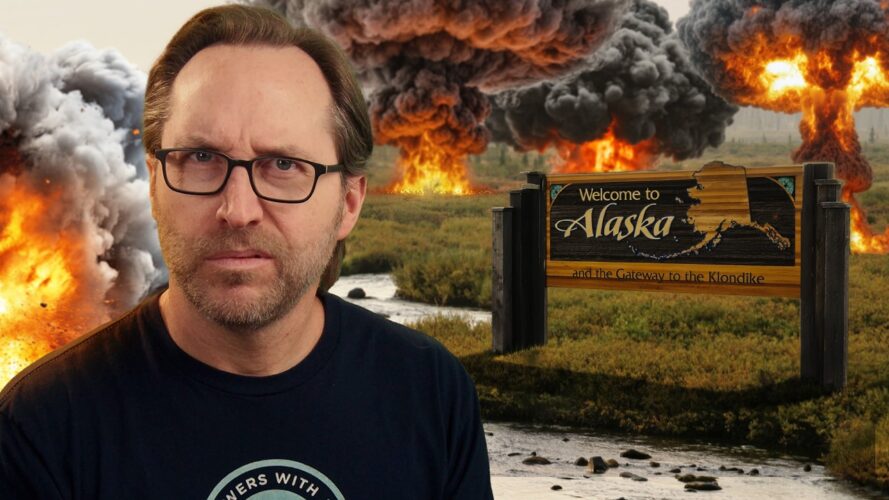
Operation Plowshare was a US Government program in the 1950s that had the goal of finding peaceful uses for nuclear weapons. And yes, you read that right. It was partly a sincere effort to find practical uses for the most awesome power humanity had ever harnessed, and partly a cynical attempt to justify stockpiling nukes. One of those Plowshare projects was called Project Chariot, which aimed to create a new harbor in Alaska by setting off SIX hydrogen bombs in a river inlet near Cape Thompson. This is the story of that insane idea.
Transcript:
The US Atomic Energy Commission presented a new plan as a new use for nuclear weapons dubbed Operation Plowshare. The name came from the Biblical edict meaning to beat swords into plows. The goal was to find peaceful uses for nuclear weapons.
No, really, that was the idea.
“All right, so we’ve got all these nuclear bombs lying around. How do we take the most destructive weapon on the face of the planet that can kill millions of people at once and find a nice use for it?”
“Oh, I know! We could turn the bomb into a vase.”
“You know, for flowers?”
Somebody get him outta here.
Project Chariot was one of the proposals that came out of Operation Plowshare as one of the possible “nice uses” for nuclear weapons.
The AEC figured they could use the weapons as excavation tools to for “large-scale excavation and quarries” and “underground engineering.” The proposal suggested it could literally open up new territories of land to create things like canals, harbors, roads that could cut through mountains, open pit mining and dams.
Some of the early ideas for these weapons of mass construction included expanding the width of the Panama Canal, creating the Nicaraguan Canal, both of which we discussed in a previous video. They also thought about blowing up a path through the Bristol Mounts to create a new railway between California and New Mexico.
They also toyed with the idea of creating underground explosions that could open up natural gas production and create reservoirs for petroleum storage.
Blowing up the Earth to get at oil and gas? Are they crazy? Phew! It’s a good idea that never caught on.
One of the first tests they conducted (and yes, this is the actual name) was Peaceful Nuclear Explosion, presumably because Operation Huge Oxymoron was taken.
Project Gnome was conducted on Dec. 10, 1961 in a salt bed located in southeast New Mexico. The AEC wanted to see if they could harness the heat from the explosions “to produce steam for the production of electric power.”
They also thought they could recover radioisotopes for other “scientific and industrial applications.”
They buried a bomb with a yield of 3.1 kilotons more than 1,100 feet into the earth.
Scientists thought the blast would close the tunnel and contain any radioactive materials or fallout from pouring out of it. Yeah, that didn’t happen.
Instead, radioactive steam and and smoke poured of the shaft spreading radiation that fortunately, quickly decayed.
The tests was such a disaster that it killed any further testing for other proposals.
Before that though, one idea got through called Project Chariot. The idea was to place hydrogen bombs along a river bank located in Cape Thompson in Alaska, detonate them and turn the giant crater into an artificial harbor.
Well, that sounds perfectly reasonable. What could possibly go wrong?
The idea was to place five hydrogen bombs along a river outlet located in Cape Thompson in Alaska, detonate them and turn the giant crater into an artificial harbor. Alaska was also a fairly new state for the U.S.
Why would anyone want to nuke a brand new state just added to the union? It’s kind of like when you buy a new car and you wanna take really good care of it, but part of you thinks it would be fun to just smash the windshield with a ball peen hammer for fun. What? Just me. OK. Excuse me for admitting I like to have a little good natured fun.
Hungarian theoretical physicist, chemical engineer and eyebrow breeder Edward Teller was one of the first champions of the project.
He’s been called the father of the hydrogen bomb who studied in Germany before fleeing in 1933 to escape the rise of the Nazi party. In America, he studied with Enrico Fermi at the University of Chicago and famously visited with Albert Einstein in 1939 to convince him to pen a letter warning President Roosevelt about Germany’s attempt to develop an atomic weapon. The famed “Einstein letter” led to the creation of the Manhattan Project.
He joined Project Y in Los Alamos, which was part of the Manhattan Project, that led to the first successful atomic detonation in 1945.
When the Soviet Union detonated an atomic weapon in 1949, Teller urged President Truman to develop the hydrogen bomb, which he approved the following year. They produced a weapon nicknamed the Mike Shot that was 1,000 times more powerful than the bomb dropped on Hiroshima, which they tested in the Pacific Ocean in 1952.
Teller conducted a study trying to drum up support for his idea to nuke a harbor into part of Alaska. The leaders of Project Chariot championed the idea because if it was successful, they could get the approval for other projects using nuclear weapons…assuming anyone would be left alive to sign off on them.
There was a lot at stake on this project other than just getting the OK to blow up other stuff in the name of science.
Alaska was a brand new U.S. state and needed economic development. Teller’s study proposed that Project Chariot could be a way to drum up some new dollars.
Blowing up a state for dollars. What was that pitch meeting like?
“Gentlemen, we need to create some economic development or financially, we’re dead. Any ideas? Johnson?”
“We could blow up part of the state with a nuclear bomb.”
“That’s brilliant! All right, who’s ready for lunch?”
Of course, the thinking was a little more complex than that.
The idea was that the coal mines in Alaska could have a new port to ship out their products to other ports around the world.
There were just a couple of tiny problems with that idea.
Maybe no one involved in the planning stages knew this at the time but Alaska is a cold state. It’s very cold, like Canada cold. Hoth cold.
Now don’t be so quick to judge. Alaska was, after all, a new state and maybe America bought it as part of a blind deal. You know, one of those grab bags you can buy at fan conventions where you don’t know what you’re getting until you open the box. Maybe something like that happened.
The problem is that the waters in the surrounding Chukchi Sea would be frozen for nine months out of the year. So a port which contains water, the key component in ice, wouldn’t be useful for ships, the main mode of transportation on water, most of the year.
Maybe they could’ve put ice blades on the ships and turned them into giant dog sleds. Sure, it might not have worked but…
Who could say no to these faces? Oh, whose gonna save Alaska’s economic output? You are! Yes, you!
Even if they somehow sped up global warming to keep the sea from freezing most of the year, getting the coal to the harbor would still be a huge challenge.
The coal mines that would’ve benefitted from the project were located on the other side of the Brooks Range of mountains.
So in addition to building the new harbor, they would also have to build railroads and storage warehouses to transport the coal they collected.
But hey, you can’t make an omelette without nuking the hell out of a few eggs. Am I right?
So the whole idea of turning this harbor into a new cash cow for the state was completely abandoned. Instead, it turned into a feasibility test but there was a much bigger problem looming on the horizon.
The area the government wanted to nuke wasn’t a remote location. People lived there, and they would have to deal with the fallout of the explosions – literally.
The local Native American populations teamed with biologists to oppose the plan because they knew there would be environmental repercussions that could last for decades.
This opposition movement created a chain of events that led to some major legislative changes designed to protect these lands for years to come. It raised awareness about native communities and exposed the risks of allowing complete federal control over native lands.
In 1971, Congress passed the Alaska Native Claims Settlement Act, which transferred 44 million acres of land to native corporations, provided compensation, and settled indigenous land claims in the region.
There was another problem that reached beyond Alaska’s borders.
The US was right in the middle of ironing out a nuclear test ban treaty, which both sides signed in 1969. The treaty banned nuclear tests above ground and the US argued that since Project Chariot would detonate bombs underground, it wouldn’t violate any agreements. The Soviets disagreed, and conducting those detonations could’ve erased years of peace negotiations.
The native population also had evidence of decades of mistreatment to their land and people to back up their arguments. Nuking their land would’ve just added another example to the pile.
Speaking of underground explosions, there was a lot of speculation that these explosions wouldn’t have any fallout since they were being detonated underground.
Teller and the government claims tested were conducted that show fallout was minimal from underground blasts.
The Inupiat of Point Hope met with members of the Atomic Energy Commission in 1960 at a town hall meeting. The AEC claimed the bombs they detonated wouldn’t have any effect on fishing populations or local wildlife or even the human population. The Native people, however, did their homework.
They read about the BRAVO test conducted in 1954 on Bikini Atoll in the Marshall Islands where the US detonated a hydrogen bomb using solid lithium deuteride. The scientists left out an important fusion reaction, and the explosion was much bigger than they anticipated. They originally predicted a blast of 5 megatons, but it actually detonated at 14.8 megatons, making it a record-breaking nuclear test that no one intended to reach. The blast created a crater more than half a mile wide and several hundred feet deep, sending millions of tons of radioactive debris into the air. No one was living on the island at the time, but neighboring islands like Rongelap and Utirik, just a few hundred miles away, had 236 people living there who were exposed to as much as 200 rems of radiation.
The residents of Utirik weren’t evacuated until two days after the test. Some started showing signs of radiation poisoning and a decade later, residents of both neighboring islands developed thyroid tumors.
The native population also had evidence of decades of mistreatment to their land and people to back up their arguments. Nuking their land would’ve just added another example to the pile.
William Teller and his eyebrows were still adamant that the plan would work with minimal environmental damage, but a key study quietly sunk Project Chariot.
AEC biologists conducted some of the first tests on the area as a control and they found something startling, even before they buried the first bomb in the ground.
Some of the Inuit and caribou populations were already showing levels of radioactivity in their system.
The local caribou ate a type of algae called lichen that tested positive for traces amounts of radioactive fallout from tests that were already conducted around the world. The Inuit hunted and ate the caribou and you can probably guess what happened next.
So if small amounts of radiation could get into the food supply for the animals from hundreds of miles away, imagine the damage it could do if the blast was just 30 miles away.
The mix of strong opposition to the plan from the native, the expanded costs and environmental concerns caused officials to quietly kill Project Chariot by 1962.
…or as Teller and his supporters might characterize it: They safely nuked it.
Even though the project never happened, some of the preparation caused serious damage to the environment and even some of the neighboring residents.
Crews started construction on the site where they planned to build the harbor. Even though they didn’t explode any devices like they planned, they brought in some radioactive material to conduct studies that stayed in the soil for decades.
Scientists also detonated nuclear weapons in other regions until the 1970s even after Project Plowshare came to an end. One device was exploded on the native Aleutian island of Amchitka in the Bering Sea between Russia and Alaska. These tests created more distrust between native people and the US government.
The fallout from the construction even affected the health of some of the residents. For years, the leading cause of death in Point Hope was cancer.
U.S. News and World Report lists the Yukon-Koyukuk area of Alaska as one of the US communities with the highest rate of cancer cases.
Even the drilling procedures causes major damage to the environment.
Crews bore holes into the ground with equipment that used refridgerated diesel as drilling fluid instead of conventional drill fluid and it contaminated the soil.
It took decades to clean up the site. Crews worked off and on until 2014 to clean up the area around Point Hope.
I guess if your plan involves blowing up part of the Earth with nuclear bombs, cleaning up after yourself isn’t high on your to-do list.
And of course, when government shows up, conspiracies always follow them.
Some residents across Cape Thompson believe the government went ahead and buried nuclear devices underground anyway and that they are still underneath the Earth.
One resident claimed they saw the military plant one of the nuclear bombs into a drilled hole and the rumor spread like wildfire.
It also didn’t help that the government kept all of these contaminations and outbreaks a secret until 1992 when a researcher at the University of Alaska found documents while researching a book about Project Chariot.
Government officials said they conducted more testing and that the land was safe, but it’s hard to believe when the cancer rates in the region are higher than the national average. It also doesn’t help that so many people kept these and others huge facts a secret for so long. There are still parts of Project Chariot that remain classified to this day.



Add comment