
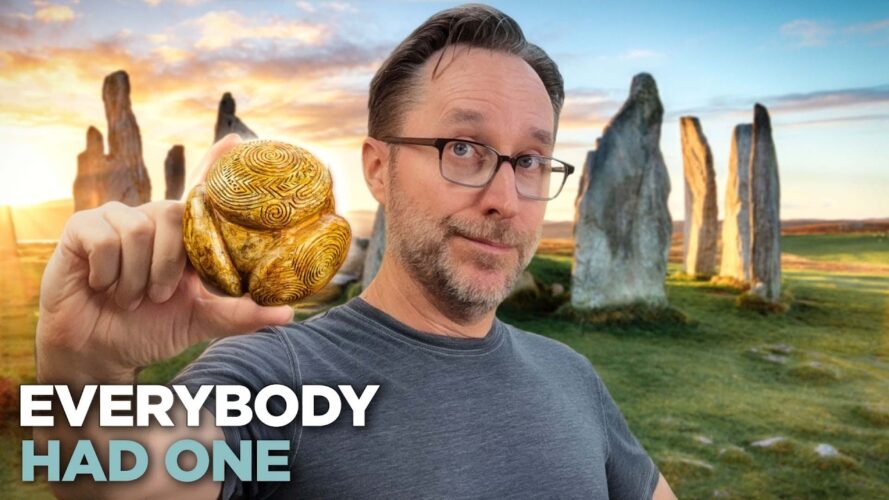
All across Scotland, neolithic stone balls have been found with specific designs and bumps on them that have perplexed archeologists for decades. Were they some kind of toy? A religious artifact? A status symbol? Today we look at these mystery objects and examine the theories to get an idea of just what these ancient people were up to, and why they were important.
TRANSCRIPT:
It was 1860, and some men were working on a farm called Drumellachay [drum-ELL-uh-kay] near the Scottish town of Towie.
They were cutting into a drain several feet underground when something weird came out.
It was a ball made of stone. But not just any old ball. This one had four disks, or knobs, with three of them intricately decorated. The fourth disk was blank.
The ball weighed just over 500 grams and was 73 millimeters in diameter.
James Kesson was the farmer who owned the land where it was discovered, and he gave it to a local minister, a Rev. John Christie of Kildrummy.
After that, the National Museum of Antiquities of Scotland acquired the ball.
It was dated to five thousand years ago and became known as the Towie Ball. But it was just one of hundreds found throughout the country.
Almost 500 stone balls have been found in Scotland. They’re made from various stones, like sandstone or granite, and they’re all about the same size as a tennis ball.
They’re decorated with carved patterns of circular bosses or knobs around the surface of the sphere. The designs vary, but most have six knobs.
As shown in this chart, the fewest knobs on the balls are three. The largest is one hundred and sixty.
And they’ve been found all over Scotland. For example, around thirty-seven of them have been found in the Highland Region, along its eastern side.
Several have been found in Aberdeenshire [AB-ər-deen-shər] and Orkney, too. It’s thought that most of those found in the Highlands were imported from other parts of Scotland, possibly Aberdeenshire.
What makes these balls unique are their knobs and carved patterns. Now, we don’t have time to look at them all, but here are a couple.
One of the balls was discovered during tree-planting work on the Blackford Estate in Shiriffmuir [SHEHR-if-myoor] in 2017. It was found at the base of the topsoil in pristine condition.
It’s made from a greyish-green igneous rock with two fine white veins. It has six symmetrical circular knobs equal in size, with two of them decorated.
One knob has a cross-hatch grid of thirteen by fifteen incised lines, and the second one has five incised parallel lines across the knob’s center.
Microscopic analysis showed that the cross-hatching was formed by incising parallel lines in one direction, then rotating the stone ninety degrees to incise the second set of lines.
There were no traces of marking visible on one of the knobs. But the knob with five lines showed that they were marked over previous lines. Both designs had irregularities, suggesting that they were created freehand.
And the differences between them also suggest they were made with different tools, and maybe by different people.
Another group of carved stone balls comes from Skara Brae [SKAH-ruh bray] in Orkney, an archipelago of Scotland’s north coast.
Skara Brae is one of the world’s best-preserved Neolithic villages. People lived there from around 3180 B.C.E. to 2500 B.C.E. and then abandoned the place. No one knows why.
The balls found at this site and at other Neolithic sites on Orkney have a characteristic style. They have more pointed projections compared to other stone balls found in Scotland.
Could this be a clue as to what they were used for? Look at it. It looks like a weapon, yeah?
The Neolithic Period
So, these carved balls were found at Neolithic sites. But what is Neolithic? Who are Neolithic? How is Neolithic?
The Neolithic period is also called the New Stone Age, and it occurred around 7000 to 1700 B.C.E. Its main characteristic is the beginning of a settled human lifestyle. People began learning to cultivate plants and domesticate animals for food, rather than hunting and gathering.
More sophisticated stone tools also arose during this time period, and they were used for farming and animal herding. But Neolithic people did not write. No tools were invented yet for that.
Because they lived in settled communities, they left many traces behind, like house foundations, burial sites, tools, and crafts. There was extensive pottery production, too.
Like, in China, cultures along the Yellow River were known for their painted pottery. Toward the late Neolithic period, around 5000 to 1700 B.C.E., black and gray elaborate pottery started to emerge.
The same thing was happening in Scotland around this time. While people have lived there for more than twelve thousand years, it was during the Neolithic period that some of the country’s most prized ancient sites emerged.
For example, at Maes Hose [MEEZ hohz] near Stromness on Orkney, there is a stone-built chambered tomb where the sun shines directly down a carefully designed entry, flooding the chamber with sunshine on the winter solstice.
Also on Orkney in Skara Brae, that place mentioned before, there are houses connected by covered passages. These houses also include stone beds and seating.
And between Maes Howe and Skara Brae is the Ring of Brodgar [BROAD-gur]. It’s a stone circle that’s similar to Stonehenge and dates back to 2000 B.C.E. It may have been used for astronomical observations or rituals, but no one really knows.
Kilmartin Glen is on the west side of Scotland. It contains some of the country’s most important evidence of Neolithic and Bronze Age remains. Spanning over five thousand years, there are multiple carved rocks, stone circles, cairns, forts, and castles.
Some of the Neolithic highlights include cup-and-ring markings at Achnabreck [akh-nuh-BREK]. The rock art is believed to be around five thousand years old and includes spirals and several ring marks spread across several outcrops.
Another interesting site is a two-kilometer line of burial cairns running north to south through Kilmartin Glen. Also called a “linear cemetery,” the five large round cairns date to the late Neolithic period, and the original central chamber was divided into four compartments, probably to hold several burials at once.
And then there’s the Temple Wood Stone Circle that was used for almost two thousand years, from the Neolithic period through the Bronze Age. Its earliest remains show that it was originally a timber circle, maybe used for astronomical activities. But again, no one knows for sure.
Since there was no writing, there was no historical record. No instruction manuals. No ads promoting the latest technology. And that’s why figuring out what these carved stone balls were used for is hard. But there are some theories, some better than others.
Weapon Theory
We’ll start with the most common theory, that they were weapons. One idea is that the grooves in many of the balls are where a leather strap or rope would go to fasten them to a wooden handle or something like that.
But the main issue is that there aren’t any signs of damage on the balls. Like, if they got thrown around, we’d see dings and dents in them.
Archaeologist Dorothy Marshall did an extensive study on the stone balls in the 1970s. She wasn’t a fan of the weapons theory, saying:
“When one appreciates the skill and time which has been used in the fashioning of these balls, it does not seem possible that the owner would have risked their loss or damage in war or chase.”
Weighing System Theory
Some think they were used as part of a weighing system. Like, the stone balls were the weights used on scales.
But this idea doesn’t hold weight because there isn’t much uniformity among the balls.
Then again, maybe they were used to weigh down fishing nets. Now, that makes sense until you start to wonder why people spent so much time carving elaborate designs on them. Maybe Neolithic people just really liked fancy fishing weights?
Storytelling Theory
Another idea comes from science writer Lynne Kelly. Drawing on Australian Aboriginal cultures and their rock art, she thinks the stone balls may have been used as memory devices. The carvings were used as reminders when telling stories orally.
Blessings or Power Symbol Theory
The stone balls could’ve been used for blessings or as a symbol of power. For example, many of them have been found in boxes or recesses around ancient homes. Could they have been like the horseshoes we hang for luck or the religious items we hang for peace in our homes today?
Take the Towie ball, for instance. It probably belonged to a well-off Neolithic farmer in Aberdeenshire, who may have seen it as a symbol of power. Its carvings resemble those found in a passage tomb at Newgrange in Ireland.
Hugo Anderson-Whymark is a curator at National Museums Scotland. About those similarities, he says:
“One thing they show is that there was perhaps a long-distance contact in that period which we don’t always give prehistoric people credit for…We’re seeing things, ideas and people moving with them through that time.”
Oracle Theory
Another theory is that the stone balls were used as oracles. People would roll them on the ground and interpret the future from how they rolled and their resting positions.
Speaking Stone Theory
Marshall also thinks people may have used the balls as ceremonial speaking stones at important meetings. Like a speaking stick, if you held the ball, it was your time to talk.
Moving Stones Theory
One archaeology student at the University of Exeter proposed that the balls were used to move the huge stones in Aberdeenshire’s stone circles. But if they were used that way, smooth balls would have worked better, not carved ones.
Pollen Theory
Then we have a wild theory posted by MysterX on the Abovetopsecret.com forum. This person thinks the balls were made to represent pollen. They even posted microscopic images of pollen next to photos of the balls to support their case.
Interesting, yeah, but MysterX does end their post with a caveat:
“The obvious question arises, if the stones are indeed representations of pollen, how could Neolithic people see microscopic pollen grains in order to carve them on the macro scale?”
Yeah, MysterX, how could they?
Resume Theory
One of the more plausible theories comes from a Scottish graphic designer named Jeff Nisbet. He thinks the balls could have served as resumes for stonemasons during the Neolithic period. They’d carry the balls around to show what kind of stone work they were capable of doing.
Dang. That might be the best theory yet.
Toy or Gift Theory
Then again, maybe the carved stone balls were just toys, something to hold in your hand, run your fingers along the lines. Kind of like a Neolithic fidget spinner.
It may have felt so satisfying in the hand that leaders and thinkers sought them out. Then, they became symbols of power and affluence.
Or maybe it was a gift. Since malls hadn’t been invented yet, people could’ve made things out of what was around them, like stones. Some were better at making the balls than others, and that’s why there’s a variety of them.
We may never know what specifically they were used for, but that doesn’t diminish their charm.



Add comment