
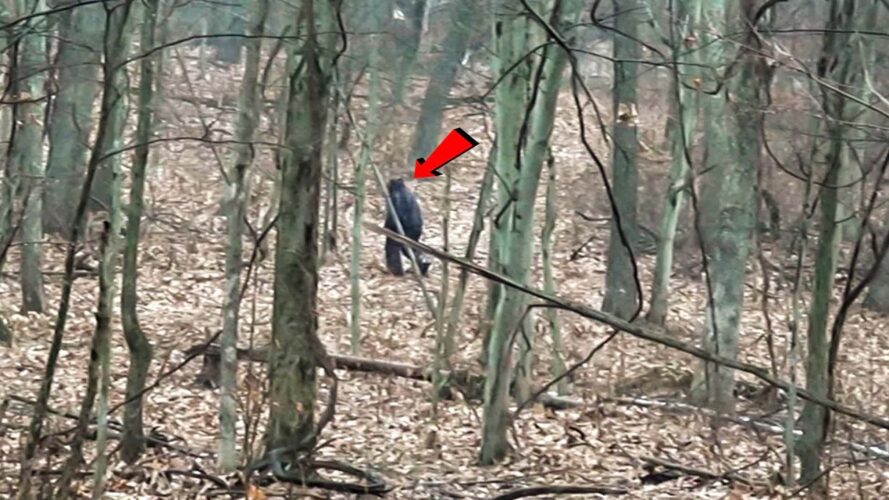
Sasquatch. Bigfoot. Yeti. The Wild Men of the Woods. Yowlies. On almost every continent and almost every state, people tell legends of a hairy ape man in the wilderness. The ubiquity of these sightings – and the life-changing experience that often comes from it – beg for the subject to be taken seriously. Even though actual evidence of their existence never seems to materialize. Today I talk with Laura Krantz, creator of the Wild Thing podcast, to share her favorite story of a bigfoot encounter. The one that really makes her wonder, despite all the odds… Could bigfoot be real?
TRANSCRIPT:
1972 was a big year in modern American history.
Most famously, it was the year Watergate became a scandal, but it was also the year The Godfather came out.
The famous “Blue Marble” picture was taken in 1972 as well, forever throwing off the grade curve for astronaut photographs.
In the Summer of 1972, a naturalist named John Mionczynski set out to research big horn sheep for the U.S. Forest Service. His last’s names a doozy, by the way, so I’m going to use John from here on out. John was only 25 at the time of our story, a college grad who majored in marine biology because chemistry had too much math.
As a native of Long Island, he was as familiar with the woods as with the ocean. And he spent a lot of his time learning to live off the land. All this is to say that when the job tracking sheep in the wildnerness came up, John jumped at the chance.
As part of the job, he had to spend nights camping high in the Wind River Mountains. Wind River is a range that cuts across 100 miles of Wyoming and includes 19 of its twenty tallest peaks. The park service equipped him with a tent, but when he picked it up, he found a large spot where a previous camper had spilled bacon grease.
Worried the smell would attract bears, he packed a Tupperware bowl of cayenne pepper for defense. This was in addition to a .357 Magnum. I think it says a lot about John that he was willing to try the pepper, at least.
So, picture the scene. A young but experienced camper beds down for the night on a lonely mountain. The light of an almost full moon shines through the grease spot on the side of his tent.
All is quiet under the pines until the stillness is broken by the sound of breathing from outside. The breath sounds are followed by a shadow about three-and-a-half feet high, just the right height for a snuffling bear. Bear visits happen in the mountains, of course, so John isn’t too worried…yet.
Still, the breathing is odd, very slow and with a rumble to it like snoring. It goes on for minutes before the shadow trots off, only to approach the tent again twenty minutes later. This time, it comes too close for comfort, so John makes a loud noise and smacks it through the nylon with the back of his hand.
The thing retreats, briefly. When it comes back, it’s not a four-footed shadow any more. It’s walking on two legs, something bears don’t usually do.
John lashes out again and this time hits something hard, like a bone or a kneecap. The moment this happens, the thing looms over the tent, and it is at this point that John makes a key observation. It’s the sort of observation that, if you believe John, makes it hard to argue he was dealing with a bear.
See, the thing had hands. At least, it had one hand, because it put that hand on the tent. John was able to make out the fingers of the hand, even the hairs between the fingers.
And he saw an opposable thumb. Now, I said earlier that bears don’t usually walk on two legs. That’s true, but there are exceptions.
The bear in this video, for example. He was seen strolling around a New Jersey neighborhood after an injury to his forepaw. As you can see, a large North American animal walking upright can be a thing…but one with a thumb like I’ve got here? Not so much.
According to John the hand he saw was twice the size of his own. He didn’t see it long because the hand’s owner seemed to be confused about the strength of the tent. It went to grab it or something and smashed it instead.
Then, as if this story wasn’t crazy enough, the thing lost its balance and fell on John’s legs. This is a giant mystery animal with opposable thumbs, remember, and it’s lying on top of him. I’m pretty sure I would have needed a new pair of pants.
Luckily for John, his visitor didn’t stick around. It sprang up and ran into the trees, leaving John with a head full of questions. He crawled out of the busted tent, noting that the poles were bent, and huddled at the fire with his gun.
He could still hear the breathing but the trees were too dense to see anything that wanted to hide. After a while, John heard a different sound, something hitting the fire. It turned out to be pinecones.
Over the next 40 minutes, about 20 pinecones were lobbed into his camp with impressive accuracy. John got the message that the thing didn’t want him around, but he wasn’t about to run into the dark. So he sat with a sleeping bag over his head for the rest of the night.
In the morning John did what any good tracker would do: he searched the ground. But the pine duff — that’s the stuff you walk on under pine trees — was too thick for tracks. Puzzled by his experience, John hiked back to where his boss, the guy who gave him the bacon tent, had his HQ.
He reported what happened and was surprised when the boss asked him if he believed in sasquatch. It seemed several other reports had come in that summer of a large hairy primate hanging around. In fact, the boss had a list of people he wanted someone to interview.
He thought there might be some truth to the sightings, but he couldn’t get funding to search for an unconfirmed animal.
There was funding available to investigate a hoaxer who might get shot, on the other hand.
So that’s the story the boss sold his agency to explain why he paid John to leave the sheep and check out the Bigfoot sightings.
That part of John’s career ended pretty soon but his encounter and some of the interviews he conducted changed his life. Over the decades that followed, he worked with several famous Bigfoot researchers, including Grover Krantz, Jeff Meldrum, and Jeff Freeman. And he’s still out there now, applying science to the search for an unidentified North American primate who happens to like chucking pine cones.
Now, there are several reasons I think John’s Bigfoot sighting is more credible than some others I’ve read.
Before I explain, we should probably establish a baseline for where I’m at with the big guy.
The X-Files said it best: “I want to believe.”
It’s funny, actually.
X-Files never did a Bigfoot episode.
The closest we got was Mulder in a gilly suit talking about going squatching to unwind.
Anyway, casual that I am, even I have to admit the sheer amount of evidence is impressive. The quality? Yeah, that can vary. But nobody can doubt there are a lot of Bigfoot stories around.
Sightings have been reported in every US state except Hawaii. Plenty of other countries have their versions of a large, unidentified primate too. The best known are the Yeti of the Himalayas and the Yowie of Australia.
There are also stories of the wild man, or man of the woods, in Europe. Did you ever wonder why cave men are depicted with clubs, by the way? One theory is that writers adopted the idea from wild man legends featuring hairy men who loved whacking fools with sticks.
A trait all the accounts of these creatures share is how readily people used to be to accept them. That was the default attitude in the “here be dragons” era of mapmaking. These days, it’s harder to believe in an animal that could evade modern observation attempts.
But evasion is baked into quite a few of the legends. And some Bigfoot believers — or Bigfooters — say it’s our modern world that sasquatch and his cousins are hiding from. A recent documentary about indigenous approaches to the topic touched on this idea.
Guardian of the Land, which aired on Oregon Public Broadcasting, features Columbia River cultural and community leaders discussing encounters from across the centuries.
The link is in the description, if you want to check out the full movie.
The part I want to point out is the characterization of Bigfoot as a gatherer who comes down from the mountains to eat berries in season and otherwise keeps to himself.
Even more to the point is an statement by Acosia Red Elk, a world champion jingle dancer featured on the doc.
That pretty much sums it up.
But it’s not the only theory about why Bigfoot is hard to find. Some cryptobiologists propose that the species we call Bigfoot is a relict hominid with a high degree of specialized intelligence. They’re a relative to homo sapien, in other words, who have survived millennia in isolation by being great at hide-and-seek.
There are even guesses about where Bigfoot sits on the hominid family tree. Here’s a popular speculative ancestor: Gigantopithicus. Basically a giant orangutan, this 10 foot tall unit used to rove the jungles of Southeast Asia.
The ancient ape was supposedly first identified as a possible Yeti ancestor by Wladimir Tschernezky, the zoologist who examined the famous footprint pictures.
Grover Krantz later championed the connection between Gigantopithicus and Bigfoot.
He speculated that Gigantopithicus migrated to North America over the Bering Land Bridge and spread out from there.
Quick aside. Doctor Krantz, to give him his title, liked Gigantopithicus as a Bigfoot ancestor but wasn’t married to the idea. In an article from back in 1984, he talked about various possible ancestors, including Neanderthal and something in the australopithecine family.
Gigantopithicus had it over both of those for being the right size for sasquatch. It also had a mix of humanlike teeth and fangs, a good match for Bigfoot accounts. The downside is that we don’t know if Gigantopithicus was bipedal.
This is in contrast to the downside for Neanderthal and the other ancestor candidates. There were definitely bipedal but they were mostly human-sized or smaller. They were also not as hairy as Krantz would have liked.
The need to account for differences like this led Dr Krantz to really want a Bigfoot skeleton. He wanted one so badly that he asked John Mionczynski to go out and shoot a squatch at a time when he, Grover, was dying of cancer. John is a hunter, but he’s not a “shoot first, ask questions later” guy, so he politely declined.
Even if we accept that a relict hominid could have evolved advanced hiding abilities, there are still problems with this theory. The central one to many critics is how a population of Sasquatch could breed enough to survive while keeping out of sight. There’s this concept of minimum viable population that we have to consider.
Species on the decline eventually reach a point where they no longer have enough genetic diversity to combat diseases. On the slide to those numbers, births will decline so low that it would take a humanlike intelligence to escape the extinction spiral. And intelligence is only the start as saving such a species takes dedicated effort across scientific disciplines.
According to the Bigfoot Field Researchers Organization FAQ, “informed estimates” of the Bigfoot population range from about 2000-6000. This is based on the idea that far fewer Bigfoots are sighted than exist in the wild. And also that Bigfoots are sighted.
Simplifying an already highly summarized take, BFRO.net says that there are plenty of Bigfoots to breed. But not all experts agree. They doubt that such an elusive creature could exist as a viable but unidentified natural species.
I’m tempted to make a joke about the difference in how big a population they think there needs to be coming down to if they ever hooked up at Cochella.
Would that be crude?
Moving on.
Another theory about how so many people could see Bigfoot without his existence being proven is that the encounters are with misidentified animals. Even Bigfooters acknowledge that some sightings fall into this category. Misidentifications are more likely to happen when something unusual is going on with an animals, like our bear friend from earlier with the hurt paw.
A popular twist on the concept says Bigfoot is often a bear with mange. That’s kind of compelling because the one thing a mangy bear looks the least like is a bear. Trigger warning for animals looking rough, I guess.
This is the so-called “Jacob’s creature.” It was caught on a Pennsylvania trail cam and it clearly shows…uh…Chewbacca in a space helmet? Mothman’s butt?
As you can see, this Lovecraftian horror is disturbing on a primal level. It looks wrong, it feels wrong. No wonder people see this and say, “Yup. Sasquatch.”
While bears are the most likely animal to be mistaken for Bigfoot, they’re not the only ones. In 2015, a Bigfoot alert in Grand Rapids, Michigan turned out to be caused by…wait for it…a big dog. A chocolate Newfoundland to be exact.
The poor pupper was abandoned and spent months on his own before he was finally rescued and given a forever home. This picture of the dog, who is now called Shaggy, is a good one to show off a correlate to this whole misidentification thing. You can tell Shaggy’s a dog, right?
But what if I do this?
OMG! Sasquatch.
I’m going to pivot on this image because it sums up the problem with all the theories that stick to established science.
If Bigfoot isn’t a natural animal being misidentified, you’d think we’d have better pictures.
Let me note that I get the specialized intelligence argument but come on — there are so many cameras.
I’m not just talking cell phones. There are drones and trail cams like the one that filmed this chupacabra. Plenty of cameras are hidden or camouflaged, so it’s not like Bigfoot can avoid them all by being shy around people.
And we have case studies that say trail cams are good at snapping pics of evasive animals. The videos I’m showing now were taken by some of the 140 trail cams in Yellowstone National Park specifically set up to watch cougars. There are, at most, 45 cougars spread across Yellowstone’s 2,221,766 acres and the cams got ‘em — they’re right there.
Since the 1970s, there have been a total of 14 sightings reported to the BFRO from in and around Yellowstone. There have also been some audio and track reports. 14 isn’t huge, but I can’t think there are that many more cougar reports considering their small population.
Anybody who’s owned a cat knows they’re super good at hiding. And cats are ambush predators, so hiding is kind of their thing. Some Bigfooters think he’s an ambush predators too, but the cougar comparison shows that even if so, that alone can’t explain evading the cameras.
Honestly, the more I think about the ubiquity of recording devices these days, the more the indigenous take on Bigfoot makes sense. I’m not saying I believe Bigfoot’s a spirit. But it would explain a lot.
Let me pause to says that if “spirit” makes you uncomfortable, call him an interdimensional being instead. Plenty of Bigfooters do that, though I should emphasize I’m using the term “Bigfooter” broadly. There’s another term, Apers, for people in the community who insist on keeping out the woo.
Like with so many topics I cover, whether you side with the Apers, embrace the woo fully, or think Bigfoot is nothing but confusion and hoaxes comes down to a lot of personal factors. But the camera thing? That’s a much harder problem for Apers to explain than it is for everybody else.
Although, maybe that’s just my perspective. Sightings get posted all the time on social media. Maybe there’s one out now that I’ll find even more compelling than John’s woodsy lap dance.
Having gone through all that, Why? It’s really down to the kind of guy John is.
During the research for this video, I read about his life both inside and outside the Bigfooting world and listened to a few of the hundreds of interviews he’s given. He comes off as intelligent and down to earth. Perhaps more important, he comes off as self-aware.
We all have our biases but John seems consistent in approach his scientifically. He didn’t go into the Wind River Mountains to find a North American primate after all. He went to watch sheep and something found him that he couldn’t explain.
Like most of us would at that point, he tried to find answers. When the ones he found were surprising, he didn’t give up. He asked new questions and pursued the answers to them using his scientific training.
By John’s own account, he was among the first Bigfoot researchers to have evidence he gathered rigorously tested. One of his interviewees gave him hair samples that he took to a wildlife lab. The samples were later sent to a leading primatologist who determined that the hairs were from a primate but not from a primate known to science.
I mention this story just to back up the fact that John took his encounter as a starting point to gather evidence. And after 54 years of gathering, he believes in Bigfoot more now than he did back then. You could argue he’s profited but he’s also faced ridicule from peers and even the occasional threat to his profession.
And frankly, he just doesn’t seem the kind of guy who would lie about his experience and research. He’s been a teacher at multiple Wyoming schools and community colleges.
He’s also been deeply involved with indigenous-led teaching movements in his state.
When I compare the way I look at the world to John’s, I see a lot of commonality.
Like I said when I talked about The X-Files, I wanna believe.
I haven’t seen enough evidence yet to believe in Bigfoot, but I can accept that John did when it fell in his lap.
So, what do you think? Did you believe in Bigfoot before this video? Did anything we checked out convince you? Drop your answers in the comments and if you had a Bigfoot encounter, definitely drop that in there.



Add comment