
Celebrities are just like us! Some not that bright. Some very smart. And some have even made scientific and engineering discoveries that changed our lives. So we thought we’d call out the celebrity scientists and engineers that have entertained and enlightened us.
TRANSCRIPT:
This is Hedwig Eva Maria Kiesler, better known to the world Hedy Lamarr. She’s a movie star who was one of the biggest and most famous people in the world from the late 1930s and throughout the 1940s. She once said, “The biggest people with the biggest ideas can be shot down by the smallest people with the smallest minds – think big anyway.”
This is Hedwig Eva Maria Kiesler, better known to the world Hedy Lamarr. She’s a movie star who was one of the biggest and most famous people in the world from the late 1930s and throughout the 1940s. She once said, “The biggest people with the biggest ideas can be shot down by the smallest people with the smallest minds – think big anyway.”
She wasn’t just spouting nonsense. She did think big.
When World War II broke out in 1939, Lamarr felt compelled to do something to help the Allies. By the summer of 1940, things looked bleak for the allied powers. During the Battle in the Atlantic, a German U-boat sank a ship that was transporting 90 children from Great Britain to Canada, and most of them didn’t survive the attack.
Lamarr wasn’t content with just sitting back and being a Hollywood starlet when the world seemed like it was about to catch fire.
So she got together with her friend and composer George Antheil and the two devised a…
…“Secret Communication System” that used a concept called frequency hopping to guide torpedoes and protect them from being jammed.
I promise, the puns stop here. I can’t promise that.
Initially, the Navy rejected their patent but years later, it caught the military’s attention. They used it to develop “sonobuoys” that could detect enemy submarines, and eventually torpedoes that could be controlled on frequency-hopping systems.
Their invention’s reach doesn’t stop there. Without this kind of technology, we wouldn’t have things like GPS, cellular phones, Bluetooth, and Wi-Fi. The thing you are watching this video on right now is made possible by their innovation.
These aren’t MIT trained engineers who wear tweed jackets with those weird leather elbow patches or mathematical whizzes who carry calculators in a shoulder holster. These are famous artists who just wanted to help the world during a dire time and created something that revolutionized communication.
This got me thinking: Are other artists contributing things to the world besides just art?
First, living celebrities and let’s start with ones that might surprise you.
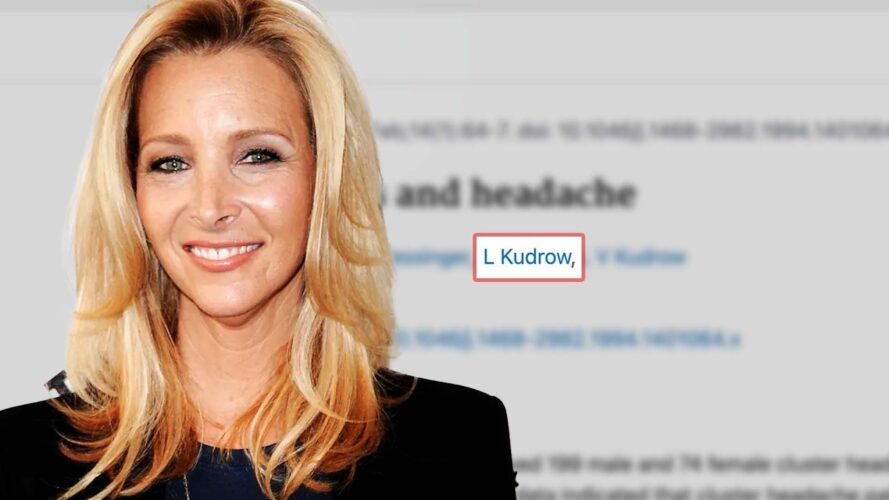
Lisa Kudrow may be best known for playing the ditzy Phoebe on TV’s Friends but in real life, she actually participated in medical research…and not as a test subject.
She actually started her career in science, not acting. She has a bachelor of science in biology from Vasser University and while she pursued her acting career, she assisted in studies on migraine susceptibility with her father Dr. Lee Kudrow.
In 1994, Lisa Kudrow, her father, and two other authors wrote a paper in the journal Cephalagia (sef-hal-a-gee-a) exploring if left-handedness had any correlation with headaches. The paper examined over 600 people who suffered from cluster headaches and migraines. The paper contributed to further studies that explored genetic and neurological causes for migraines.
Danica McKellar had a thriving career as a child actor on shows like The Wonder Years, but she took a break from acting to attend UCLA where she earned a degree in mathematics. She and two other authors came up with a new theorem called “Percolation and Gibbs States Multiplicity for Ferromagnetic Ashkin-Teller Models on Two Dimensions, or Z2.” It’s also known as the Chayes-McKellar-Winn theorem for people who don’t have a spare day to say its full name.
The trio took the Ashkin-Teller Model or the Potts model which helps simulate how magnets behave using math. Imagine there’s a giant checker board that goes on for infinity. When it’s cold, the tiles copy the ones next to them and when it’s very hot, the tiles go nuts and point in different directions.
Basically, their theorem proved that these changes actually happen at the exact same temperature.
Yeah, I’m still just as confused as you are right now. Hey, I think I just found a correlation between math and headaches! Someone call Lisa Kudrow’s dad.
Actress Natalie Portman’s acting career started when she was a kid in movies like The Professional, Romeo + Juliet, and a little independent film series known as the Star Wars prequels.
She has a bachelor’s degree in psychology from Harvard University where she also studied Hebrew literature and neurobiology.
But even before that while she was still in high school, not college, she co-authored a paper under her real name, Natalie Hershlag, showing a new way to produce hydrogen from sugar. The paper helped find a new energy source that show how sources like municipal waste could create whole new fuel sources.
She was so committed to her education that she didn’t go to the premiere for Star Wars: Episode 1 because she had to study for her high school finals.
That and she probably read the script and figured, “Na, I’m good.” NERD BURN!
Some of you are probably saying, “But at least with acting, you have to know how to read so of course they would be smart. What about rock stars?” For starters, please stop talking that way. You’re better than that.
There’s some pretty smart rock stars out there.
Take Brian May from Queen. When he was a kid, he learned how to build his own telescope and electric guitar. He went for his doctorate in physics from Imperial College in London, studying infrared astronomy and zodiacal dust from interstellar asteroids.
He quit college to pursue a music career but years later when he, you know, became the freaking guitarist for Queen, he re-registered for his doctorate and submitted a thesis after a year of studying.
He’s actually a specialist in stereoscopic imaging, which is a fancy word for seeing images in space on a 3D plane. He even worked with NASA on the OSIRIS-APEX spacecraft, which landed on and collected samples from a moving asteroid.
That’s right. He’s an astrophysicist. You call him DR. Brian May. Take that, Elton John, and your “Rocket Man” title, which isn’t even a thing.
He was the valedictorian of his high school and planned on going to medical school. He enrolled in college as a biological sciences major in the mid-80s while playing in punk bands on the side.
He put a hold on his degree when the band took off but in 2017, he went back to the University of Southern California to finish it. He published a thesis on the molecular dynamics of HIV/host interactions by identifying microRNA sequences within the virus that allow it to remain “hidden” in the human body.
Wow, a rock star who studied microbiology and helped science reach a better understanding about HIV!
Just imagine what other musicians were trying to accomplish with their career.
Maybe Keith Moon from The Who drove a Cadillac into that hotel pool so he could understand the air pressure created by large American luxury vehicles in bodies or water.
Maybe the reason Britney Spears shaved her head was so she could learn about aerodynamics. The possibilities are limitless!
Perhaps the most famous example of smart famous people is Mayim Bialik, who starred on shows like Blossom and The Big Bang Theory and once hosted Jeopardy!…
In 2007, she helped publish a study on the role of oxytocin and vasopressin in obsessive-compulsive disorder in adolescents, a genetic abnormality called Prader-Willi syndrome. It’s a rare condition caused by missing genes that create incredible hunger in adolescents and can lead to severe, life-threatening obesity later in life.
That’s impressive but she was the host of Jeopardy! at one point. I mean, you have to be smart to host TV’s smartest game show. You never saw the host of “Match Game” trying to triangulate the position of space junk using advanced calculus with their _______.
Also, I’ve always wondered. Jeopardy’s name always has an exclamation point at the end of it. Have we been saying it wrong all these years?
Like Mayim Bialik, who starred on shows like Blossom and The Big Bang Theory and once hosted [emphasize the exclamation point] Jeopardy!…
Now let’s take a look at some of the pioneering celebrities from the past.
Beatrix Potter, who is best known for writing children’s books like The Tale of Peter Rabbit, had scientific ambitions before becoming an author.
In 1897, she worked as an amateur mycologist studying fungi and lichens.
She also made some beautiful watercolor paintings of fungus samples that later appeared in a 1967 book Wayside and Woodland Fungi.
She even studied spore germination and wrote a scientific paper on the subject, but they were rejected because her ideas were too radical for “professionals” and women weren’t accepted in the scientific community.
The truth is that amateur mycologists in her time helped pioneer the field by laying the foundation upon which studies stood, even if they weren’t accepted in their time.
In 1997, the executive secretary of the Linnean Society, one of the world’s oldest and most storied scientific associations, acknowledged the way “she was treated scurvily by members of the society.” Future mycologists also accepted and used her research for further study.
Louis Daguerre invented the daguerreotype process of photography but he also had an artistic side to his life.
He first dedicated his studies to architecture, theatre design and panoramic painting. He studied painting under Pierre Prevost, the first French panorama painter.
Now we just take panoramic pictures with our phones by spinning around so we look like dizzy idiots.
Wheeeeeeee! I’m not living in the moment!
Of course, he went on to create the world’s first heliograph and the world’s oldest surviving camera photo
Creating a way to make photographs required a heavy amount of study of subjects like chemistry, optics and material science. They also gave scientists in pretty much every field a way to document their findings and share them with others. His practical photography even led to the creation of specific scientific fields of photography.
Lewis Carroll is celebrated for writing timeless stories like “Alice’s Adventures in Wonderland” and “Through the Looking Glass” and should also be celebrated for inventing the phrase “Eat Me.” He was also a noted scholar and a brilliant mathematician.
He taught math and logic to undergrads at Oxford at the same time he was writing his stories.
In fact, he was able to marry his two skills by crafting entertaining math and logic problems, and turning math and logic concepts into games to make them easier to learn.
Ada Lovelance, who was also known as the Countess of Lovelace and Lord Byron’s only legitimate child, became a friend and mentor of pioneering computer creator and mathematician Charles Babbage and wrote what is considered to be the first algorithm.She was inspired by Babbage’s “Difference Machine” and struck up a correspondence with him.
When Babbage started work on his “Analytical Engine,” Lovelace basically wrote the code for it serving as its “interpreter” of sports. She even helped write a paper on the machine penned by mathematician Luigi Federick Menabrea. Thanks to her help, Babbage’s machine served one of the cornerstones of computer science…
and helped create an amazing chain of software and video game stories in malls throughout the 80s and 90s.
You may or may not have heard the name Zeppo Marx, but you’ve definitely heard his last name.
He was one of the four original Marx Brothers, appearing in movies like “Horse Feathers,” “Monkey Business” and “Duck Soup.”
He wasn’t as interested in show business as his brothers. He left the group in the mid 30s and worked in theater management and his own engineering business.
In 1969, Herbert Marx was the co-inventor of a wristwatch that could check the wearer’s heartbeat. If it detected an irregular heartbeat, the watch’s alarm would ring.
He basically invented an early version of one of the chief features of a smartwatch. Imagine how pioneering that must’ve been for medicine. Think about that the next time you get mad at your watch for telling you to do something.
16 seconds? I’m just trying to clean my hands, not prepare for thoracic surgery!
So what makes these great creative minds so adept at scientific concepts and aptitude?
I mean, I like to think I have a deep and abiding mind for understanding and learning about science, but I still can’t do origami.
It’s supposed to be a swan.
For starters, learning about the arts just helps create more well rounded people. The ability to express our artistic side is one of those things that makes us human like having thumbs and symbolic language.
There’s actually a term for this kind of thinking in scientific education and it’s called STEAM. It’s just the term STEM with an “A” added for the arts.
In 2018, a team of professors from different specializations published a paper in the Journal of Microbiology and Biology Education exploring the importance of providing arts education to STEM students through all grade levels.
It’s more than just knowing how to draw an apple in a bowl or memorizing the birthdays of impressionist painters. Scientific and mathematical concepts and studied are still visual in nature and knowing how to see and reconstruct them in visual forms helps create a better understanding of them.
The paper says the benefit of an arts education allows for “broader access and inclusion in STEM, enhancing learning of scientific concepts, building technical skills that are underserved in the curriculum, and enhancing students’ mastery of design and cross-disciplinary collaboration.”
Also, it gives students the ability to draw a face when they need to test a new pen.
In other words, if you can see it and create it, you’re more likely to learn it.
And you don’t need to be a Renaissance painter to be artistic. Anyone can draw even if it’s just basic shapes. There’s two great TED Talk called “Why people believe they can’t draw” and “How to draw to remember more” given by motivational speaker and visual learning advocate Graham Shaw. He shows how just basic drawing concepts can be utilized in education to make learning more engaging and memorable. Links to both are in the description.
Even the performing arts like theater and dance have practical benefits in STEM education and researcher.
The paper also cites a practice known as “Reader’s Theater” in which students tell an interesting story to a class in an interesting way, usually in the form of a script. Theater and dance can help students and scientists think on their feet, and increase their communication skills.
Unfortunately, when cuts in education happen, the arts are usually the first to go.
This past year saw some of the biggest cuts to grants from the National Endowment for the Arts that provides funds for non-profit theaters and public art projects all over the country.
The National Association for Music Education reported last year that Title II, Title IV-A and the Assistance for Arts Education programs were consolidated and place a higher emphasis on math, reading, science, and history. All of those are important but so are art, theater and music education. They aren’t just electives. They are essential.
Studies show that an education that incorporates the arts vastly improves students’ abilities to learn. A 2013 study from Johns Hopkins university examined students’ content retention and found that educational program that incorporated arts-based learning in the curriculum achieved an average, long term content retention level of 105 percent. The students remembered more because they’re more likely to remember something when it’s the form of a song than a dry, boring lecture.
There’s a quote that gets thrown around a lot in these discussions from Albert Einstein. “Imagination is more important than knowledge.” It’s probably his most misunderstood quote. He’s not saying that concepts trump scientific fact. Here’s the full quote from an interview he did in 1929 with the Saturday Evening Post…
“I am enough of the artist to draw freely upon my imagination. Imagination is more important than knowledge. Knowledge is limited. Imagination encircles the world.”
Imagination gives us the ability to seek and explore knowledge in ways nothing else can.
I’m still working on it.

Add comment