
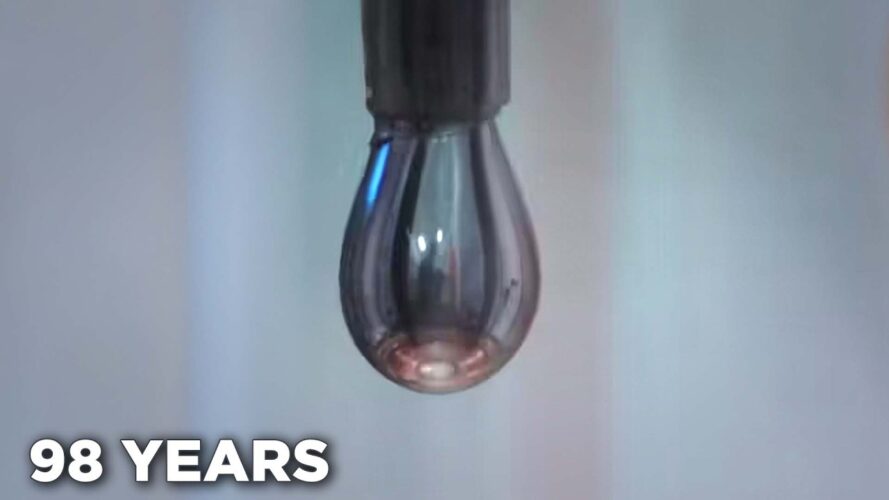
In the hallway of the University of Queensland in Australia, an unassuming little experiment is kept in a glass case. It’s not that interesting, until you know that it’s the longest-running lab experiment in the world, and is just about to turn 100 years old. It’s the Pitch Drop Experiment, and it teaches us a lot about the unseen world of long time scales.
TRANSCRIPT:
This is a water clock. It’s the oldest water clock ever discovered, in fact. It was found at the Temple of Amen-Re at Karnak in 1904 and it’s nearly 3500 years old.
About that long ago, a sculptor made this clock out of alabaster. There’s a hole in the bottom that lets water drain at a fixed rate. By looking at the height of the water you can tell how many hours it’s been since the clock’s basin was filled.
Compared to clocks now, this one is primitive. But back in the day, it influenced decisions about when to eat and when to sleep and when to worship the great god Khonshu. And trust me, this is not a guy you want to keep waiting.
As I talked about in my recent documentary, a single human lifetime is brief. It’s practically nothing compared to the eons of geologic time. We tend to plan our lives in the short term, too, rarely thinking ahead more than a few years.
But plenty of the forces that affect our lives operate on a longer timescale. In order to measure those, scientists have to think long term. And some of the experiments they devise wind up taking more than a lifetime to complete.
The scientists who start experiments like that are a special breed. The scientific ball they start rolling has to be left for future generations to pick up. That takes a lot of trust.
There’s an expression that may or may not be an old Indian proverb that sums up why they make the effort:
Blessed are those who plant trees under whose shade they will never sit. The sort of sacrifice these no-shade scientist make is laudable so today I want to laud it by talking about some of the longest-running experiments ever.
I’ll admit up front that some of these examples will stretch the definition an experiment a little bit. A useful scientific experiment usually involves a tightly controlled setup. If I throw a paper airplane in this room, I can control the air currents. I can’t do that if I throw the airplane in my backyard.
Setup affects results. A well-constructed experiment has to account for that. It’s especially hard for a long-running experiment to keep the same setup because everything changes over time.
We’re going to see that clearly with the first experiment I’ll talk about today, the Pitch Drop Experiment hosted at the University of Queensland, Australia. The PDE, as I’ll call it, holds the Guinness World Record for the longest-running laboratory experiment. It’s abut to hit it’s 100th anniversary, though how close it is depends on when you start the clock…more on that later.
In the meantime, you might want to open the link in the description to thetenthwatch.com. Check it from time-to-time because there’s a PDE-related event coming up that I don’t want you to miss. Though it’s not a huge deal if you do — you should get another chance in about thirteen years.
Alright. If you opened the link or you can see my capture here, there’s a good chance nothing at all will look like it’s happening. But looks are deceiving.
This oily glob hanging from a funnel in a bell jar in a glass display case is making history right now. The case is in the University of Queensland’s Parnell Building. It’s named for Thomas Parnell, who was the university’s first Professor of Physics.
Professor Parnell started the Pitch Drop Experiment in 1927 by heating a sample of pitch and pouring it into a sealed funnel. He let the pitch settle for three years before he snipped off the end of the funnel, which is why the Guinness people date the PDE to 1930. And that makes sense, since 1930 is when the experimental setup was complete.
I throw in 1927 to illustrate Parnell’s patience in getting to this point. Patience is a feature of the PDE as the people who are interested in it have to be extremely patient about gathering data. That’s because a key data point occurs when a drop of pitch falls into the beaker and that’s only happened nine times in 96 years.
Thomas Parnell himself lived through the first two falls. But he didn’t actually get to see them, only observe they happened after the fact. Actually, nobody has been able to observe a freefalling pitch drop during this experiment, and that includes the last time a drop fell, for reasons I’ll get to.
A total of five falls went unseen between 1930 and 1961, when a successor of the late Professor Parnell found the PDE setup in a cupboard. His name was Professor John Mainstone and he was the guy who got the experiment on display. For the next 52 years, he monitored the pitch, but like Parnell, he managed to miss all the falls during his tenure as caretaker.
Pitch drop six fell on a weekend, when no one was around. Pitch drop seven fell while the experimental setup was part of a scientific exhibition with Mainstone and plenty of other people in attendance. Unfortunately, it happened during a lull and the professor stepped out for a drink just before the fateful moment.
That was in 1988.
Twelve years later, when the next fall was due, the professor and some of his associates arranged to have a video camera watching the drop. And a blackout cut it off at exactly the right time to miss pitch drop eight.
Honestly, at this point it seemed like the pitch was doing it on purpose. Professor Mainstone died in 2013, eight months before drop nine fell. This time, there were observers, as Professor Andrew White, the current caretaker of the PDE, had overseen the installation of a webcam.
Tens of thousands of viewers watched drop nine stretch, stretch, and glob onto drop eight. Look, I’m not trying to take anything away from that moment but it wasn’t quite the dramatic plunge people wanted to see. Drop nine even stayed connected to the funnel until Professor White inadvertently snapped off while replacing the beaker.
That left us with the current experimental setup, in which the tenth drop is exclusively at the mercy of gravity. There’s nothing to catch it but the new, empty beaker the professor put in place of the old. Which kind of means we’re back to Parnell’s original setup from long ago.
The tenth drop fall is guaranteed to be dramatic. And it could fall any day now, so keep watching that feed. Or don’t, if don’t care about falling pitch. And that brings up the question of why anybody does….
To answer that, it’ll be helpful to know something about pitch. You already know that it’s black thanks to the Vin Diesel movie. The several substances called pitch are byproducts of distilling petroleum, coal tar, or plant resin.
They have multiple historical uses, mostly as waterproofing agents. Ancient boats were sealed with pitch and traces of pitch are found on wine and olive oil containers. The Egyptians even used pitch on mummies.
That’s an interesting story, actually. When Arabs in the Middle Ages first encountered mummies, they thought their dark color was due to bitumen. As you probably guessed, bitumen is a type of pitch.
It can be harvested from sea beds and has been sourced from the Dead Sea since prehistoric times. The Arabic word for bitumen is mum, thus mummy. Thing is, there was a longstanding archaeological debate about whether or not the Egyptians actually included bitumen in their embalming recipes.
I mean, mummies are dark, but there are plenty of chemicals that darken over time. It was thought for a while that the mum-to-mummy naming was a mistake. But nope! It turns out those old Arabs were right.
Bitumen was used on Egyptian mummies, though sparingly and exclusively during the New Kingdom period, from about 1550 BCE.
Gas chromatography-mass spectrometry has confirmed that “mum” went into mummies starting at about the time of that water clock I showed earlier.
So, way to go, Medieval Arabs. You nailed it!
Pitch is all over the modern world, too. It’s still used to waterproof ships and is almost certainly what’s keeping your attic dry, since it’s a common sealant on roofs. Pitch is also an ingredient in asphalt, various dyes, and even some battery electrodes.
Basically, if it’s black, sticky, and hard, it’s probably pitch.
That’s all great, I hear you say, but it still doesn’t explain why scientists are interested. The actual reason has to do with the strangeness involved in how pitch looks and behaves. At room temperature, pitch appears solid, but it still flows, as proved in the pitch drop experiment.
This has lead scientists to classify pitch as a highly viscous liquid. Viscosity is the measure of how much a liquid resists flowing. The viscosity of pitch is estimated to be at least a hundred billion times that of water.
That estimate was based on an understanding of the scientific principles involved. And the PDE, as well as other experiments like it, have borne it out. Look, I’m not going to pretend Professor Parnell’s funnel is solely responsible for our knowledge of viscous flow, but it did help.
There’s a whole branch of physics devoted to studying how materials flow and deform over time. It’s called rheology and it has implications in everything from manufacturing plastics to predicting the path lava will take after an eruption. So the next time you’re airlifted from a volcano, spare a thought for the self-sacrificing scientists who stare at drops of pitch so you can stay safe.
One more detail before we move on. Over the nine-plus decades of the pitch drop experiment, the time between falls has gotten longer. Some of the cause may be that there’s less pitch pushing down from up top, but mostly it seems to be due to air conditioning.
See, the display case isn’t climate controlled, so its temperature used to vary with the weather. After AC was installed in the late ‘80s the building got cooler overall, so viscosity in creased and so did the time between falls.
Still, even by 21st Century standards, drop ten could fall any day now.
Any day.
Any…day.
OK, while we wait, let’s look at some other long-running experiments. I mentioned that PDE is the longest-running laboratory experiment according to Guinness. The longest-running overall according to them is the Broadbalk Experiment hosted at the Rothamsted Experimental Station in Hertfordshire, UK.
It’s an agricultural experiment, not one done in a lab. Since it’s outside, there’s only so much the experimenters can control. But that’s fine, in fact, it’s kind of the point.
Broadbalk got its start way back in 1843, a year after estate owner and agricultural scientist John Bennet Lawes patented a new fertilizer. Lawes wanted to test that and other fertilizers in the field, so he asked an old school buddy, Joseph Henry Gilbert, to join him at the Rothamsted estate.
Together, the two friends grew and tested crops with scientific rigor for over 40 years.
More than a century later, scientists are still collecting data from Rothamsted fields. And this includes the Broadbalk field, where Lawes and Gilbert planted wheat. The first Broadbalk Wheat crop was grown from the Autumn of 1843 to the Summer of 1844. Annual harvests have been made ever since.
The field is split into 20 strips, one of which is the control strip where no fertilizer has ever been applied. The other 19 strips are treated with varying levels of nitrogen, phosphorous, and potassium.
In 1968, the experiment was expanded to include treatments with herbicides and other chemicals but the goal remains the same: understanding crop growth so farmers can increase yields.
Plenty of gamechanging discoveries have been made at Rothamsted. One early triumph was when Lawes and Gilbert demonstrated that most plants get their nitrogen from soil, not from than air. Beans and other legumes are the exception, and some theorists thought them the norm before Lawes and Gilbert proved otherwise.
Their scientific achievements earned them knighthoods from Queen Victoria and they are still bearing fruit. The decades worth of data from Broadbalk and Rothamsted more broadly allow scientists to see how ecosystems adapt to the use of chemicals.
It’s kind of staggering to think that crops produced using data from this one experimental farm have sustained millions if not billions of lives.
Of course not every long-running experiment is as impactful. Take the device powered by the Clarendon Dry Pile, sometimes known as the Oxford Electric Bell. We don’t even know what its exact setup was, so drawing conclusions about it is basically impossible. Still, physicists assure us it is not a perpetual motion machine, just the closest thing we’re likely to come across.
Similar to the PDE, the bell is on display at a university, but it wasn’t built there. It was actually purchased by a Professor of Physics, Robert Walker. Per a label on the display it’s been operating since 1840, but again, we don’t actually know what it’s testing.
I mean, a battery, sure. As you can see in the pic, there are two dry pile batteries sitting side-by-side. But nobody has ever opened them up, so what’s inside is a mystery.
Bells are fixed below the piles and a ball hangs between the bells. The ball is attracted by a charge in one bell, then the other, striking each lightly about once every quarter second. The bells have rung continually since at least 1840, possibly earlier, barring a few gaps when the setup got moved or the air was too humid.
The math works out to around 10 billion rings over the setup’s lifetime. I’m sure that would have driven the teachers and students crazy but thankfully the piles and bells are sealed behind panes of glass that block the sound. Why are these bells still ringing after more than 180 years?
If somebody took apart the piles, I’m sure they could find out. Nobody does because that would end the experiment. The batteries will run down eventually, unless something is fundamentally wrong with our understanding of physics..
That’s always a possibility, of course.
I guess if infinity ends before the bell quits ringing, the physicists who ruled out perpetual motion will owe us all a Coke.
Another famous example of stubborn longevity in a scientific machine is the Centennial Light in Livermore, California. This carbon-filament light bulb has been glowing inside a fire station since 1901. It’s dimmer than it used to be, but it does still work.
The bulb is thought to have survived because it was built before manufacturers optimized bulbs to burn out quickly. This is called planned obsolescence and it entered the light bulb world in 1924. A group of bulb manufacturers, including General Electric, met to decide the future of their industry in that year.
The longevity of bulbs was becoming an issue now that electricity was widespread. The companies wanted to do something about it before they were out of a job. So they agreed to roll back the lifespan of light bulbs while still making them bright and attractive.
Before the advent of LEDs, this meant that most lights were engineered to burn out at after about 1000 hours of use. Contrast that with the Centennial Bulb and you can see what a massive ripoff this was. I’m glad we don’t have to deal with those sorts of corporate shenanigans anymore.
BEEP
Sorry, that’s my phone.
”End of service contract… no more updates… and the horse I rode in on!?”
Just a couple more of these experiments to cover. The Beverly Clock in Dunedin, New Zealand has been ticking away since 1864 despite very few windings. Instead of a spring or battery, the clock uses small changes in air pressure and temperature as a power source.
There’s an airtight box inside that pushes on a diaphragm. This subtle shift has kept the clock running since the birthyear of Heineken Brewery and Toulouse-Lautrec. I know there were wars going on in 1864 too, that’s just not what we’re here to talk about.
The inventor of the clock was Arthur Beverly, a watchmaker and astronomer who also made lenses for telescopes. He left his money to the University of Otago and they’re also who inherited the clock. It’s stopped a couple of times over the years but was easily fixed and is still on display in Otago’s physics department.
Now, if you’re already complaining that a well-made clock stretches the definition of a long-running experiment— You’re really not going to like this last one.
Psychology is a famously soft science. Human behavior is hard to pin down. But that’s makes long-running psychological studies even more important and one of the most interesting has played out in the public eye.
In 1964, British television producers began filming a documentary called Seven Up! It followed a group of seven-year-olds from different social backgrounds. Director Michael Apted wanted to explore how class affects development and he did this by revisiting his subjects once every seven years in what is now known as the Up Series.
New installments were filmed when the participants were 14, 21, 28, et cetera. The most recent installment, 63 Up, came out in 2019. While it was not originally meant as a scientific experiment, watching the group experience over a half-century of life has provided insights about career mobility and personal choice.
There are a fair amount of surprises in the Up Series. It’s honestly too much to discuss here. 70 Up is expected out this year, so if you’re interested, now is a great time to catch up to Up.
I think the most important lesson we can take from these long-running experiments of the past is that they’re worth doing. Professor Parnell, the Rothamsted founders, and the rest planted trees whose shade is beneficial today. And they’ve inspired the current generation of scientists to keep thinking ahead.
Here are two recent examples. A collection of scientists from the UK, Germany, and the US, are interested in how long bacteria can survive in a dormant state. To find out, they sealed hundreds of vials of spores in 2014 after making plans to unseal them over the course of 500 years.
Three vials will be opened every two years over the first 24-year span, then three more every 25 years until June 30, 2514. The idea came about when study author Charles Cockrell of the University of Edinburgh found a petri dish of bacteria he’d let sit in a box for 10 years. Some of the bacteria were still viable, making him wonder how long they could possibly survive.
The 500-Year Microbiology Experiment published results from their first sets of vials in 2018.
So far, so good.
They’re taking steps to make the instructions on how to run the experiment time-proof.
Given the changing nature of technology, something like a USB stick is unlikely to survive. So the experimenters are asking their successors to rewrite the instructions every 25 years using archival quality paper and ink. You can’t beat the classics, after all.
Finally today, here’s a little blast from the past.
Ten years ago, I made a video about The Clock of the Long Now, “an ambitious, monumental project from the Long Now Foundation” to quote myself. You can check that out if you want and come back here for the update.
Clock builders installed their first timekeeping components underground back in 2018, per the Long Now website. This was on land owned by Amazon founder Jeff Bezos near Van Horn, Texas. It was meant to be a prototype site, but as of 2024, the real deal is being built at the location.
Once complete, it will operate on the same principle as the Beverly clock, in essence. Power will come from the temperature change on the top of the mountain. The clock will also resync to the solar time every solstice using shifts in light as a cue.
Given the subtle nature of its operation, it won’t have enough power to display the time. Visitors will have to provide that by winding the chimes. Each chime will play a different composition, which is a nice treat for the visitors.
That’s important because, as the FAQ points out, the Clock of the Long Now is “located in some of the roughest desert wilderness in North America, inhabited by rattlesnakes and mountain lions.”
You’ve really got to prepare for the trip, in other words. And I have to say, risking your life to see something that shout’s “I’m alive!” to the universe is pretty metal.
And let’s face it: the bane of any long-running machine has got to be tourists, right? The last thing you want near a clock built for the ages is a crowd. All the dust, the fingerprints, the secretions…
From the standpoint of the builders, the less we hear about the Clock of the Long Now in the 21st Century, the better. It’s really meant to be something for a future to explore.
When the last drop of pitch drops, or those last vials of bacteria are opened, that’ll be the right time for someone to strap on a jet pack and check it out.
Here’s a question to ponder:
What seeds of knowledge would you like to plant for the future?
If there’s one lesson the times we live in can teach, it’s that we ought to keep an eye on the future.
Tomorrow will still come, but if we want it to be brighter, we have to do what we can to help. So, is there a scientific phenomenon you’d like to see tested over longer than a life? Let me know in the comments.



Add comment