
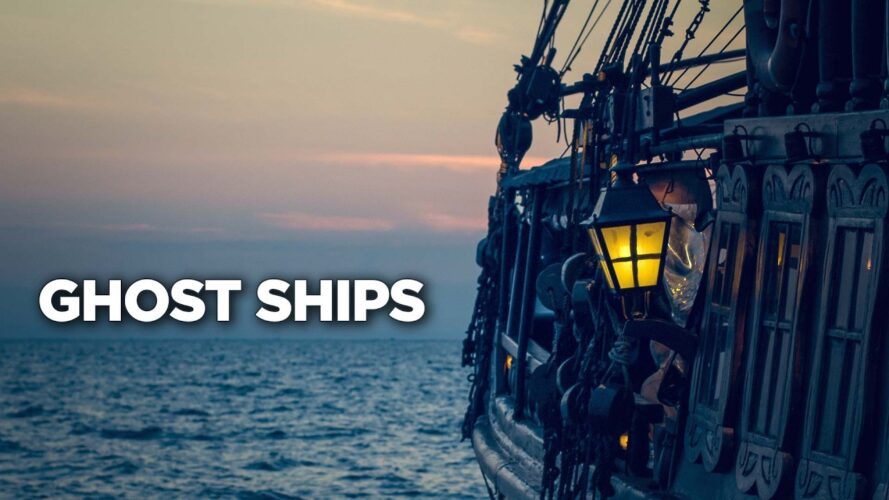
The ocean is wide and mysterious, and for hundreds of years, sailors, explorers, and merchants have disappeared beneath the waves or met mysterious ends on their ships. These tales have been passed down and become part of seafaring folklore and superstition. But they all have wild back stories that boggle the mind to this day.
TRANSCRIPT:
Let’s start with an English lesson. The term “planet” comes to English from French, which got it from Latin, which got it from Greek. In Ancient Greek, planētēs meant wanderer.
Planets are called that because they change positions in the sky. These days, we don’t think of planets as wandering so much as being dragged around by gravity. But the fact they do kinda wander is enough for me to accept “planet” as a good term for what we’re talking about.
I’m going to make the case that “ghost ship” is not a great term. On its own it doesn’t really describe what a lot of ghost ship stories are really about. To put it simply, they’re not all about ghosts.
Some of the ships in these stories act like ghosts themselves, appearing and disappearing into the mist. But they don’t all do that. In fact most “ghost ships” go missing and are found exactly once each.
So in today’s discussion of ghost ship fact and fiction, I’m going to break the stories down in to three distinct categories. First, I’ll tell you about ghost ships whose stories are Supernatural Tales. Next I’ll get into some Legends of ghost ships that could be real but were probably not.
Last, I’m going to get into some ghost ship stories that are Documented History. This is where “ghost ship” as a term becomes most problematic, in my opinion, since they involve real people. I don’t want to disrespect any of the missing, especially those who may have families and friends still around.
Cool?
Alright, just a couple more things before we get started. I’m confident most of my viewers will have heard some of stories I’m about to tell.
I’m skipping the Mary Celeste on purpose because I’ve covered it before. And I obviously won’t be able to cover every ghost ship in history. To keep this particular list interesting, I’m going to give you some trivia questions to think about.
The first one’s easy. Besides Mary Celeste, what do you think is the most famous ghost ship story? This next question is a little tougher. What’s the most recent ghost ship story you know?
I’ll give you mine in the historical section so if yours is newer, leave it in the comments. Last question: What is the closest a U.S. President routinely gets to part of a ghost ship? Stay tuned to see if I can tell you without getting controversial! Let’s get into it.
I’m going to start with Supernatural Tales mostly because they’re older. If there’s one ship that defines this category, it’s got to my pick for most famous besides Mary Celeste — The Flying Dutchman. And no, Millennials, that’s not just a dude from SpongeBob SquarePants.
It is the inspiration for the name, obviously. And it’s also the inspiration for Davy Jones’s ship from Pirates of the Caribbean 2. Remember The Rake from Fox’s Peter Pan and the Pirates, Gen-Xers? That one actually flew.
The fact is, just about every form of media has seen an adaptation of the Flying Dutchman story. The Richard Wagner opera probably did the most to make it famous. But the first story to see print was from a travelogue that came out 50 years before that.
The Scottish adventurer John MacDonald reported on the Flying Dutchman in 1790. The long-and-short of his tale is that sailors claimed to see a large ship sailing during stormy weather. They took it as a sign of doom, which is ironic, since they obviously made it home safe.
The ship was said to be a Dutch man-o-war, which is why it’s a called a Dutchman. Versions of the stories that came out over many years added different explanations for how the ship came about its ghostly qualities. MacDonald said it was lost in a storm off the Cape of Good Hope but 20 years of the whisper game made the doom a divine punishment for horrible crimes.
The poet Sir Walter Scott accused the crew of being pirates. My possible ancestor added that a friend of his thought the ship was the first to carry slaves from Africa. Later authors absolved the crew by putting all the blame for the Flying Dutchman’s fate on the captain.
And here is where a little history breaks through the fog of myth. There was a Dutch captain who sailed in the 1600s who some suspected of doing a deal with the Devil. This guy’s name was Bernard Fokke (FOK-uh).
And no, I can’t say it slower than that. FOK-uh had a diabolical reputation because he finished his trips to-and-from Java and other trading locations faster than anyone else. Did he help or was everybody jealous? I’ll let you be the judge.
In May 1821, an edition of Blackwood’s Edinburgh Magazine published a story with a different Dutch captain standing in for the real guy.
In VanDerDecken’s Message Home, a captain of that name is said have gotten so mad at a storm that he swore he would sail ‘til judgement day rather than stop at port. Ships that met VanDerDecken’s ship at sea were advised not to accept their letters for fear of some unspecified curse.
It’s worth noting that the real and fictional mariners in these tales worked for the United Dutch East India Company. The VOC, as it’s abbreviated in Dutch, lost plenty of ships near the Cape of Good Hope, which ties into the 1790 story and the VanDerDecken version. There’s also a slave connection because the VOC transported hundreds of thousands of slaves to various locations, some of them their own colonies.
The VOC ran the Cape of Good Hope from 1652 through 1806, so it’s no surprise it was their ships that got wrecked. That’s more-or-less the explanation of the Flying Dutchman from a historical standpoint.
What about a scientific one?
Sailors who saw the ship claim it appeared and disappeared with no trace, sometimes in stormy weather but also when the weather was calm. They may have been describing an actual, non-ghostly ship that atmospheric conditions let them to see over the horizon. This is a type of mirage called Fata Morgana.
It happens when warm air gets trapped above cold air. That and some other conditions bend light so that an observer can see distant objects as though they were close. The effect is temporary, so the ship would be there one minute and gone the next.
This lines up with at least some accounts of the Flying Dutchman’s appearance, including one that involved the future King George V of England. While touring the seas on the HMS Bacchante, the Prince of Wales and his brother saw the Flying Dutchman at a distance of 200 yards. Though if this was a fata morgana mirage, they were actually seeing a ship that was farther away.
That’s a neat explanation. Mind you, it doesn’t explain why the watchman on the princes’ ship fell to his death that same day. Maybe those doom-fearing sailors were onto something.
Moving on, our next supernatural ghost ship is from South America. Specifically, southern Chile, around the Chiloe archipelago. El Caleuche is a ghost ship with deep root in local folklore.
The “caleu” part of its name has something to do with change in the Mapuche language. “Che” means people, so the overall meaning is that people taken by El Caleuche are changed. Various retellings say fishermen who meet the phantom ship are transformed into mythological monsters or became part of its crew.
These stories stretch back centuries, to before Spanish conquistadors invaded in 1567. The native Chilotes had a mythology of their own that included several ocean deities. Eventually, those got blended with the teachings of Catholic missionaries to produce a unique syncretism.
Nowadays, the water spirits who were lords of the sea float around on a big party boat. Sometimes the boat looks like a flaming pillar. Other times it looks like a Spanish Galleon.
Wizards and zombies pilot the ship while the local equivalent of mermaids lure in the fishermen. I have to say that this all sounds like a drunk guy trying to tell his wife where he went last night. Some of the details are awfully convenient.
For example, there’s the idea that El Caleuche can turn into a rock or a tree, which explains why the wives can’t see it all the time. There’s also the wrinkle that kidnapped victims enter a stupor. They come back forgetful, so what happens on El Caleuche stays on El Caleuche.
To the surprise to no one, there is little for El Caleuche’s existence aside from anecdotal accounts.
Two reports from professional seamen have been documented, one from 1909 and the other from 1911. They amount to little more than a glimpse of moving lights and a ship that failed to respond to signals.
Are their scientific explanations for El Cleuche? Fata Morgana works here. There’s also St Elmo’s Fire, the natural phenomenon that makes ionized air molecules glow in faint light.
And speaking of natural phenomena, what’s more natural than freezing to death? That was the fate that befell the crew of the the Octavius, a ghost ship that leads off our second category: Legends. Some of the Octavius story rings true, but there are good reasons to believe this account is a paste-up job, combining true and imaginary details from a bunch of different sources.
The most common story starts with the merchant ship Octavius leaving London for China in 1761. The captain of the ship, plus his wife and son, were part of a 28-person crew. They made a routine voyage to their destination port and traded their cargo for goods to sell back in England.
It’s at this point that the captain made a stupid decision. The weather was warm for late in the year, so he decided to try going home by sailing east instead of west. The Northwest Passage through-and-above Canada was being actively sought by sailors at the time and this genius thought he’d chase it with his whole domestic situation on board.
Spoiler warning: no ship would make a successful trip through the Northwest Passage until 1906. Our nameless captain was taking a serious risk. To his credit, the story says that Octavius made it to the other side of the passage, but the trip was still a failure because everyone aboard was dead.
14 years after it went missing, the Octavius was found by a whaling ship. All 28 crew were frozen stiff including the captain and his wife and kid.
At least, that’s what the legend says.
Per the captain’s log, the ship was north of Barrow, Alaska when the fires they used to keep warm went out. This sort of thing did cause problems for wooden sailing ships. There’s only so much wood you can harvest ships and still have a ship left.
But did it actually happen to a ship called the Octavius, captained by this deadbeat dad? Probably not. I say this because a story like that of the Octavius was published multiple times in the 19th and 20th Centuries, and every time the details changed
The Octavius name seems to be a late 20th Century invention. In the late 19th Century, the ship was most often called the Gloriana. Before either both of those names were invented, it was called Jenny, if a name was mentioned at all.
An 1862 article published in the German journal Globus, mentions that the Jenny was found trapped in Antarctic ice. That’s ice on the opposite side of the world from where the Gloriana and Octavius were said to have been found. And yet, the rest of the Jenny’s story is nearly identical.
Consider this entry from the Jenny’s logbook:
”January 17, 1839. Today it is seventy-one days that our ship has been trapped between the ice. All our efforts were in vain – Last night the fire went out, and all our master’s efforts to rekindle it failed – This morning his wife died of hunger and cold, as did five sailors from the crew. Hope no more!”
The captain’s son goes unmentioned here but the other similarities are clear.
Also consider this log entry printed in an 1828 edition of an American literary journal:
”11th Nov. 1762: We have now been enclosed in the ice seventy days. The fire went out yesterday and our master has been trying to kindle it ever since but without success. His wife died this morning. There is no relief –.”
November 1762 is the time period given for the Gloriana-slash-Octavius, so I think we can see what happened here.
At some point before 1828 a story was told about a nameless ship frozen in icy waters. For decades after, authors embellished the story. They named the ship, changed dates and location, and even added family members.
The setting is probably the most interesting feature of this tale for reasons I’ll get to when we discuss the story of the HMS Resolute. For now, it’s enough to note that legends like that of the Octavius, Gloriana, and Jenny grow over time. It’s best to take stories like these with a grain of salt.
Mind you, if everybody did that, there would be fewer ghost ship stories to go around. Our next Legend for today is a good example of one that suffers under scrutiny. It starts with an SOS, moves on to a mystery, and follows a twisting path to a solution. I think you’ll agree that each of these steps comes with so much salt, the story overall is hard to get down.
Here’s how a a Dutch newspaper from 1948 related the message that came with the SOS in Morse code:
”[W]e float. All officers including the Captain dead in chartroom and on the bridge. Probably whole of crew dead.” After that came a pause and some gibberish, then then the chilling concluding words: “I die.”
A ship called Silver Star, or possibly Silver Star Park, was the first to find the distressed vessel, whose name is given in the Dutch paper as SS Ourang Medan (meh-DAHN). The Silver Star sailors boarded the ship but were too late to help the crew of the Ourang Medan. Why? Because they were all dead.
What killed them is where the mystery comes in. Accounts tell of unmarked bodies splayed on the deck. The mouths of the victims were open like they had died screaming.
Before the investigators could learn more, a fire started below decks that forced them back to the Silver Star. Minutes later, boom! The Ourang Medan exploded and sank, taking with it any evidence that could have explained the disaster.
If that sounds a little convenient to you — fair. If it makes you want to know more, you’re in luck, because an Ourang Medan officer is said to survived on a lifeboat. He made it to an island where he told his story to a missionary.
That missionary later told it to a Mister Silvio Scherli of Trieste, Italy, who was the source used by the newspaper. So what killed the Ourang Medan’s crew? Per the officer, it was fumes, specifically fumes from a cargo of sulfuric acid.
Now, sulfuric acid fumes can be deadly. This is typically after long exposure and a diagnosis of larynx cancer. So it seems like the Ourang Medan must have been carrying other chemicals that combined with the acid to form a poison gas.
Theorists have wondered if the ship’s cargo was a chemical weapon left over from the second World War. This makes sense, given the 1948 date, but here’s the thing — like the Octavius/Gloriana/Jenny before it, the setting of the Ourang Medan story is subject to change.
1948 was the just publication date of the Dutch newspaper, or series of articles, rather. They placed the events in the previous year. Up until recently, June 1947 was assumed to be the actual time setting.
This changed in 2013, when Internet-powered bloggers found out the Ourang Medan story went back earlier than that. Again like Octavius, this seems to be a case of retellings overshadowing the original story to the point the original is forgotten. Except that in this case, the earliest known version comes with a dateline that reveals the probably not-so-reliable author.
That author’s name was Silvio Scherli.
Remember him?
It turns out the Dutch newspaper’s source was a freelance journalist who wrote about the Ourang Medan in an October 1940 edition of Il Piccolo di Trieste.
Scherli’s article was picked up by the Associate Press, which is the newspaper equivalent of going viral. In Scherli’s initial telling, the Ourang Medan was a ship with European officers and a crew of oppressed Pacific Islanders. Its final voyage started in Singapore and was planned to end in Sydney, Australia.
A mysterious cargo of sealed boxes set the Ourang Medan’s crew on edge. They got more nervous still when the captain diverted from his original course to head to Panama. A sailor died from exposure to fumes, the rats jumped overboard, and the crew mutinied.
Based on what I’ve heard about rats, that was a good move. Unfortunately, it came too late in the game. The improperly sealed boxes in the hold contained the ingredients for hydrogen cyanide gas that made short work over everyone on board.
That included everybody except the sole survivor in the lifeboat. While he was floating, the SOS call went out. It was answered by a US ship and you know the rest already.
Scherli really must have liked this story because he retold it more than once over the years. In the 1948 revival at least — I can’t find the others — he refreshed names and dates.
Maybe he was just trying to make the story feel contemporary?
I mentioned the Silver Star Park earlier because no vessel named Silver Star was in service at time the Dutch articles came out. A ship called Silver Star Park did exist at the time. It’s possible to squint at the other details Scherli shared like this and kind of, sort of believe what he said.
But Silver Star Park aside, nothing can be confirmed in official documentation. If there was ever an Ourang Medan that carried cargo from Singapore or any of the other port, it did so under the radar. As ghost ships go, it’s properly ghostly, as in it’s nothing but a phantom.
Want to hear about something more substantial?
I have three ghost ship stories to tell you that are part of Documented History. Actually four, because I want to mention briefly the story of the Carroll A. Deering.
It’s fairly well-known so I’m not going to dwell. Real quick, the five-masted built in Bath, Maine crashed into the shoals near Cape Hatteras North Carolina back in January of 1921. The crew of 11 was missing.
Two lifeboats were missing, too, along with the personal effects of the crew. It seems they had some reason for leaving, it’s just nobody know what it was. Maybe they panicked when they heard warnings of a hurricane and ditched, or maybe the crew mutinied…there are plenty of possibilities but very little evidence.
And that is not too unlike our next story. Remember when I asked about the newest ghost ship story you know? Here’s the one to beat.
On April 18, 2007, a 12-meter catamaran named Kaz II was found drifting off the coast of Queensland, Australia. The engine was running, a laptop was on the table, and clothes had been piled on a bench. The three men who set out on a planned two-month three days before were missing and still are to this day.
The Kaz II left Airlie Beach on April 15th, crewed by Derek “Des” Batten and brothers Peter and James Tunstead. Weather conditions in the area were rough but not catastrophic, and no mayday was picked up from the ship. After it was spotted by a plane operated by the Australian Coastal Surveillance Organisation, a rescue officer came onboard to find knives strewn on the floor.
There was no blood or any other signs of a struggle. It seems like the knives just fell and nobody was around to pick them up. There was no obvious damage to the ship other than a torn sail that probably happened because no one was there to steer with the wind.
Investigators eventually decided that the most likely explanation for the men being gone had to do with a fishing line. Some line was found tangled in the propeller. It’s thought one of the Tunstead brothers fell out of the boat while trying to free it and his brother jumped after him on instinct.
Des Batten is thought to have been at the helm, since he appears there in a video recorded earlier in the day. If the theory is correct, he was probably knocked overboard by the yacht’s boom when he left the helm to drop the sails. None of the men were good swimmers and the youngest of them, Des, was 56 years old.
They all ranked pretty high on the “bloke” scale, which means none of them were wearing their life jackets. The coroner called the possible circumstances of their drowning as “an unfortunate series of events.” His explanation of the line and the propeller and the boom fits the clues.
There’s just one thing that bothers me. According to Des Batten’s wife, he had been around boats for 25 years. Would a guy like that have lost his head so easily when his friends went overboard?
Of course, this is armchair quarterbacking, maybe armchair mid-fielding since we’re talking about Australia. Whatever caused the loss of the three men aboard Kaz II, their story is a sobering reminder of how dangerous the sea can be.
I’m going to close today with two historical incidents that are surprisingly similar despite taking place sixty years apart.
The HMS Resolute and SS Baychimo were both ships both that got trapped in northern ice. The Resolute, as I alluded to earlier, was the inspiration for reviving the tale of the Jenny, while the Baychimo kind of fulfilled a prophecy in the later Octavius story.
Let’s talke about Resolute first.
In 1848, two ships that were launched under the command of one Sir John Franklin were abandoned near Melville Island. Melville is a large island in the Canadian Arctic, which makes sense since Franklin’s goal was to reach the North Pole.
Or, to be accurate, he was trying to reach magnetic north so he could take some scientific measurements. A sidequest for Franklin was to finish charting the Northwest Passage. You already know that didn’t go well.
Honestly, the Franklin Expedition could be its own video. What you need to know for this one is that his two ships, the HMS Erebus and Terror, got trapped in the ice in 1846. Franklin himself died during the long wait for a thaw.
His second in command finally ordered the ships abandoned when supplies got critically low. He and his men tried to reach the nearest trading post. But it was 300 miles south.
Suffice it to say, they didn’t make it. Actually, later expeditions confirmed that none of the 129 men from the original expedition survived. But before that happened, several ships were sent out to search for Franklin and his crew.
One of these was the HMS Resolute. It was specially fitted for arctic exploration with extra timbers, and a spare furnace for heating. It even had a polar bear figurehead!
And of course it got stuck in the ice, too. The first time this happened was in 1850. The ice cleared and Resolute was freed, but it got stuck again in 1854.
This time there the captain had orders to abandon the stuck ship. He and his crew made their way by sledge to the HMS North Star, a relief ship waiting about 70 southeast. All told, three ships from that rescue expedition were abandoned.
In an interesting twist, they actually discovered another ship from a different expedition. It also got stuck in the ice, but the combined crews were able to reach safety together. Then, a year later, a whaling ship spotted the Resolute.
“Whaling ship” should sounds familiar because this was copied for later versions of the Jenny, Gloriana, and Octavius stories.
See what I mean about those being pasted together? There were some differences in the accounts, obviously, including the lack of a deadbeat husband and dad.
Another difference is that Resolute was drifting when the whalers found it. Despite some battering from the ice it was in nice enough shape that the crew ditched their vessel to pilot back to New London, Connecticut, where they were based. In 1856, the US Congress agreed to purchase Resolute for $40,000, the equivalent of more than $1.3 million today.
The government repaired the ship and returned it to England as a goodwill gesture. Queen Victoria herself even visited the ship, taking along with several princes and princesses. This did not include the future George V, however. The guy who saw the Flying Dutchman was Victoria’s grandson and he hadn’t born yet.
Alright; this is where we get back to our final trivia question.
The closest a US President routinely gets to a ghost ship is…sitting behind it. In fact every US President since Rutherford B. Hayes in 1880 has touched part of a ghost ship.
The Resolute Desk — that desk with the carving of the eagle that usually sits in the Oval Office — is made of wood from the HMS Resolute. It was a gift, the reverse of the American goodwill gesture, sent along after the retired ship was broken apart for scrap.
There’s one more story to tell, and as I alluded, it also has a tie to the Resolute or at least the legends it inspired.
If you think back to the Octavius story specifically, one of the details that made it believable was the real world geography. The world’s worst seafaring dad supposedly got his family frozen to death north of Barrow, Alaska.
The Franklin Expedition tooled around there, too, and other ships have gotten in trouble in those waters. One of them was the SS Baychimo, a steel-hulled cargo steamer that traded between Sweden and Germany during the World War I. It used to have a different name that I’m not going to try to pronounce (Ångermanelfven) because it was under the Baychimo name that the ship met her end.
She was being operated by the Hudson’s Bay Company at the time. This was the same Hudson’s Bay Company that ran the trading post sought by the Franklin expedition’s crew. Baychimo spent years supplying remote trading posts in the Canada.
It also traded in other ports around the world. Along the way it passed through both the Panama and Suez Canals, which is pretty impressive for a small ship based in the frozen north. You could even say the Baychimo was lucky…but in September 1931, that luck ran out.
While transporting furs near Point Barrow, Alaska, the Baychimo pulled an Octavius. There was a freak storm and Baychimo got stuck in the pack ice with little hope of breaking out. The crew still had a bit of luck going because they weren’t far from the city of Barrow.
Some of the crew went there for shelter while a small party stayed behind to guard. They were sent supplies from the company to hang out and maybe get going again in the Spring. They filled the time in part by offloading the cargo, which was smart because another freak storm struck in late November.
The leftover crew fled, and when they came back, the Baychimo was gone. They guess it had sunk or been crushed by the ice but soon after, an indigenous hunter reported seeing the ship miles away. The crew located the ship and offloaded more cargo.
At this point they had zero confidence that Baychimo would make it through the winter. So they said their goodbyes, went back to their lives, and presumably laughed every time the newspapers reported that their old ship had been sighted again. They laughed a lot because Baychimo kept floating for another 38 years.
It was occasionally boarded by explorers. At one point, a group of Alaskan natives got trapped onboard for 10 days during a storm. But mostly, the Baychimo just bummed around the waterways of Alaska and Canada, travelling hundreds nautical miles with no direction except what came from the wind and waves.
The last widely reported sighting of the Baychimo happened in 1969. She was then trapped in the ice near Point Barrow again. Searches have since been made but so far without result.
The Baychimo is almost certainly buried under layers of ocean mud by now. But who knows? She’s surprised us before, so it’s possible the historic arctic ghost ship will return one day to surprise us again.



Add comment