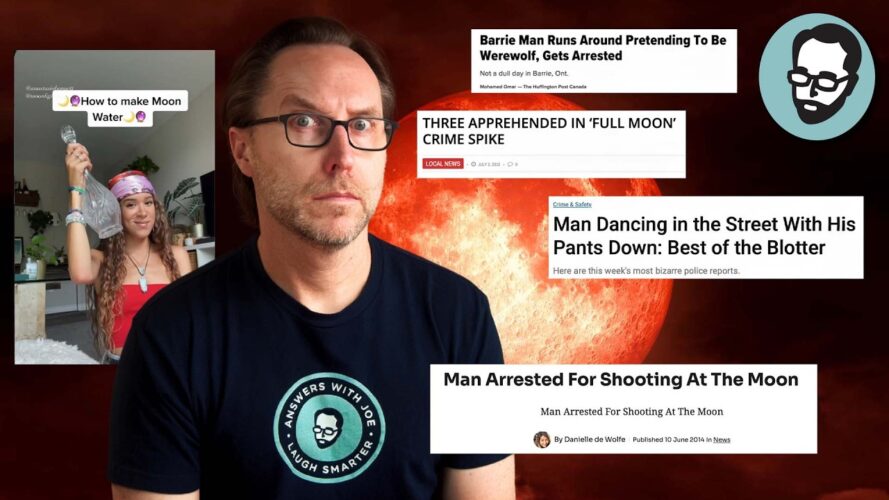
Ask any emergency room technician and they will tell you, things get crazier on nights with a full moon. In fact, stories about weird occurrences under full moons go back millennia, across cultures around the globe. But what do the studies actually say about this weird but seemingly universal phenomenon? The answer might surprise you.
TRANSCRIPT:
Have you ever had one of those nights that just feels… weird?
Like people say things that don’t make sense? Some weird coincidence happen? Have you ever had an accident you couldn’t explain?
On nights like that, there’s a good chance you might have looked up and seen a full moon and said, “there you go.”
Now we know that the phases of the moon don’t phase us. There’s no possible way that the position of the moon in the sky would have an affect on us physically or mentally and yet… A lot of people believe it.
Including 80 percent of mental health professionals, according to a recent study.
In fact, 43 percent of health care workers say they make extra preparations around the week of the full moon.
Call it superstition. Call it medical folklore. Call it exhausted nurses trying to make sense of chaos. But the belief itself is very real.
And who are we to say they’re wrong? It’s hard to argue with someone who’s dealing with their fourth overdose patient by 3am.
Superstitions around the full moon go back as far as superstitions themselves. In fact this might be the first superstition humanity ever came up with.
But we don’t live in the age of superstition anymore, we live in the age of science, so how does the science line up with the belief? Many people have studied this phenomenon, and there is a definitive answer.
And some of you won’t like it.
Maybe the moon doesn’t actually make people act differently. Maybe it does. Maybe it’s just a case of correlation instead of causation.
But if you spend enough nights answering 911 calls, eventually you’ll work a shift so bizarre, so chaotic, and so absurd that you’ll find yourself staring up at that giant glowing rock and thinking, “Maybe there is something to this.”
Here are a few stories from EMS workers from Reddit.
Some swear that every machete-related incident they’ve ever responded to somehow lands on a full moon. Others have answered calls for a man lying across the double yellow lines in the middle of the road because he was, in his own words: moon tanning.
When it comes to emotionally disturbed patients, though, the stories stop being funny pretty quickly.
One woman working ER reception was approached by a man who calmly informed her that he planned to wait until her shift ended and then set her on fire. On the bright side, I guess it was considerate of him not to interrupt her workday.
The receptionist later laughed about it with a friend and shrugged it off as a typical full-moon encounter.
Another nurse remembered a patient who suddenly began verbally abusing her for no apparent reason. The patient became so agitated that she climbed out of her hospital bed and chased the nurse down the hallway, screaming the entire way. The nurse and another staff member ended up barricading themselves inside a break room until a supervisor arrived and calmed the patient down.
Well, mostly calmed her down. Even afterward, the patient repeatedly asked that the nurse come back to her room so she could fight her.
One Reddit user shared a story from his mother’s ER shift.
A bearded man walked into the emergency room with both hands around his neck saying, “Help, I cut myself.” When he moved his hands away staff discovered a massive gash across his throat— blood everywhere. The problem was that he apparently talked with his hands. (Well, maybe it was his second problem.) Every time he tried to explain what had happened, he’d start gesturing and sending blood everywhere. This is how most Italians die. Miraculously, he survived. The surgeons eventually got him stitched up. They said he was incredibly drunk. The nurses had a simpler explanation: Only on a full moon.
And it isn’t always violence that people remember. Sometimes it’s just pure, inexplicable restlessness. One nurse described working on a floor full of, like, stroke patients – people who needed assistance with daily activities. Eating, walking, even getting out of bed. He said on the evening of a full moon, kinda randomly all of them started wiggling around and trying to get out of their beds. One even succeeded! So like, these people who normally were very immobile were suddenly all over the place and it kinda freaked out the staff.
Whether the moon had anything to do with it is another question entirely.
There are hundreds of stories like these. Some are bizarre enough they verge on ghost stories.
It’s not just the E.M.S. workers who have stories about the moon. It’s everybody. It seems humanity has found the full moon to be an object of fascination across vastly different cultural landscapes. It is a global wonder that seems we all share.
“O, swear not by the moon, th’ inconstant moon, That monthly changes in her circled orb, Lest that thy love prove likewise variable.”
That was Juliet in Shakespeare’s Romeo & Juliet. And apparently even a love-struck thirteen-year-old in the 1500s knew the moon could make people act irrationally.
But the moon’s influence on human behavior goes way deeper than poetry and dramatic teenagers.
Before gas lamps arrived in the nineteenth century, people depended heavily on moonlight once the sun went down. Your options were basically candles or the moon. And candles weren’t cheap.
So the moon wasn’t just some rock floating in space. It was the main source of light at night time for the large majority of our human existence.
Entire societies organized life around it. It became a tool for measuring time in a way you’d recognize today: the month.
The lunar cycle lasts about 29.5 days, which is where we get the concept of a month in the first place. Long before calendars were hanging on kitchen fridges, people looked to the moon to measure time.
Even the word month traces back to moon. Linguistically, both come from ancient roots tied to measuring time. Month comes from moon, or rather mehno, the proto- Indo European word méh₁nōs with the base “me” meaning to measure.
It’s no surprise we became obsessed with it. Across cultures and throughout history, people looked to the moon for explanations. And where answers were missing, myths filled the gap. And those myths are everywhere.
Just look at Genesis. On the fourth day of creation, God makes the sun and moon. He created “light” on the first day. Not sure where that light was coming from without the sun…
Then there’s Hippocrates, the “Father of Medicine” himself. He once said “a physician without a knowledge of astrology has no right to call himself a physician.”
This man was known for being one of the first to attribute sickness to natural causes, and not superstition or punishment from the Gods. As early as four hundred B.C.E., he formalized the practice of medicine, and was known for his professionalism. For this reason, his quote can probably be interpreted to mean unless you were educated, you had no business practicing medicine. I wonder what he would think of modern medical professionals saying the moon makes people crazy.
And speaking of people losing their minds, we have to talk about werewolves.
The idea of humans transforming into wolves goes back thousands of years. One of the earliest references appears in The Epic of Gilgamesh around 2100 B.C.E., where the goddess Ishtar supposedly turns an old lover into a wolf.
The term lycanthropy refers to the ability, or curse, of transforming into a wolf-like creature. Sometimes voluntarily. Sometimes triggered by moonlight. And while that sounds like pure fantasy, there’s actually a rare psychiatric condition called clinical lycanthropy, where a person genuinely believes they can transform into an animal.
Which brings us to Florida. Because of course it does.
On August 15, 2016, police found a nineteen-year-old man gnawing on the bloodied face of another man while claiming to be a wolf and making growling noises. Authorities also discovered the body of a woman in his garage.
So, of course, I checked the moon phase on record that night. Waxing gibbous. About ninety-one percent illuminated.
Not technically a full moon, but was pretty close. Or maybe it was just another Tuesday in Florida.
What’s fascinating is that wolf-human shapeshifter myths appear all over the world.
In Navajo tradition there are the yee naaldlooshii [yeh NAHL-dloh-shee], often called skinwalkers. They’re associated with dark magic and transformation. In Ethiopian folklore, the bouda become hyenas and rob graves. In Indian mythology, the Rakshasa [ruhk·shaa·suh] are shapeshifting demons known for causing chaos.
But not all shapeshifters are evil. Irish folklore has the faoladh [FWEE-luh] who are wolf-like guardians that protect women and children. In parts of Mexico, the Nahual [nah-WAHL] acts as a spiritual protector connected to the land and community.
But, most of these legends weren’t originally tied to the full moon at all. The dramatic “man transforms under moonlight” thing became popular after the 1941 film The Wolf Man.
But Hollywood aside, there are spiritual practices that treat the moon as something powerful.
Have you ever heard of “moon water?” I hadn’t!
Some people leave jars of water under a full moon to create “moon water,” which is believed to absorb lunar energy.
Sometimes they even put crystals in the jars of water to charge them with moon energy.
According to the Farmer’s Almanac, you can use your moon water for drinking, brewing tea, bathing, mixing into essential oils, cleaning your house, watering plants, cooking, or simply removing negative energy. You can add a pinch of salt if you want.
And then there’s the big argument people always bring up: “The moon controls the tides, and humans are mostly water… so doesn’t it affect us too?”
At first glance, it sounds weirdly convincing. Our bodies are about sixty percent water. The moon’s gravity moves entire oceans. Maybe it tugs on us, too. Maybe that’s why people act strangely during a full moon.
American psychiatrist Arnold Lieber thought so. He proposed a theory called “biological tides,” arguing that lunar gravity caused shifts in the fluids within the human body, almost like miniature ocean tides inside us.
He said, “The moon, via the effects of gravitational forces on the human organism, causes cyclic changes in water flow among the fluid compartments of the body (extracellular, intravascular, and intraluminal).” But that’s not how gravity works. Reference my space video.
It’s an interesting idea. And whether these beliefs come from mysticism, religion, psychology, or science, they all point to the same thing. Humans have always stared at the moon trying to understand it.
Some people swear emergency rooms get busier during a full moon. Others believe mental health worsens, suicide rates increase, or violent crime spikes. There are claims about birth rates going up, and menstrual cycles syncing with the lunar cycle.
That last one at least sounds convincing. The lunar cycle is about 29.5 days, while the average menstrual cycle is around 28 days. Even the word menses comes from the Latin mensis, meaning “month.”
Whatever the topic, it seems like people want to find a connection between higher rates of incidents and a full moon. So what do the statistics actually show?
There have been a lot of studies, mostly looking at records of what happened and where the moon was in its lunar cycle. What the majority of them found was… the full moon doesn’t actually have an effect. There is no increase in frequency of incident, or in scope of how bizarre the emergency might be.
In 1996, two doctors reviewed four years of data from a suburban emergency room involving roughly 151,000 patient visits. They compared ambulance arrivals, admissions, and overall ER traffic against the phases of the moon. The doctors found there were no significant differences in total patient visits, in ambulance runs, or in admissions.
Another study examined psychiatric admissions at the Naval Medical Center in San Diego from 1993 to 2001. Researchers looked at 8,472 admissions to see whether full moons, new moons, waxing moons, or waning moons corresponded with increases in psychiatric episodes. Again, the results showed no pattern. Nothing. This was true for psychiatric patients as a whole, as well as those who were there for particular diagnoses, such as mood or psychotic disorders.
Research at a South Florida Veterans’ Hospital looked at a whopping 465,858 emergency department visits from 2013 to 2023. That’s a big data set. The same results: nothing. No increase in visits. No increase in severity. No surge in bizarre emergencies tied to moon phases.
And that’s pretty much the pattern across the board. Study after study has looked for links between lunar phases and things like violence, heart attacks, kidney stones, births, suicides, accidents, and emergency admissions. And consistently, researchers find little to no evidence that full moons make people behave differently.
But…
Researchers at the Indiana University School of Medicine published a study that showed that suicide rates do actually go up under full moons. They noted that ambient light plays a major role in circadian rhythms. Brighter nights can interfere with sleep. And poor sleep can absolutely affect mood, judgment, mental health, and overall functioning. The study even said: “High-risk patients should possibly be followed more closely the week of the full moon, during late afternoons and perhaps the month of September.”
I mean people in higher latitudes where the sun stays up until the wee hours of the morning can often have trouble adjusting to the extra light conditions.
Also there is a slight increase in accidents on the road in rural areas at night. That’s because the brightness of the full moon increases wildlife activity, causing more automobile accidents.
What’s interesting to note here is that these effects are stronger in rural areas than in cities. That’s likely because moonlight matters more when there isn’t light pollution drowning it out.
A bright full moon in a pre-industrial world would’ve been a much bigger deal than it is today. Before electric lighting, moonlit nights may have genuinely kept people awake longer, made nighttime activity more common, or disrupted normal sleep patterns.
But now? We have streetlights, TVs, phones, LED billboards, doomscrolling at two a.m. Modern humans live surrounded by artificial light twenty-four hours a day. If moonlight once had a noticeable effect on human behavior, it now has to compete with TikTok.
So maybe people really did act differently under the full moon centuries ago. But now, with screens just inches from our faces for most of the day, we can act irrationally whenever we want!
If there is no empirical correlation between emergencies and a full moon, why do so many people swear it to be true?
Most likely, the frequency illusion has something to do with it. Frequency illusion is a cognitive bias when you hear about something for the first time and then start noticing it everywhere. It’s also known as the “Baader–Meinhof phenomenon.”
The term was coined in 1994 when a man named Terry Mullen wrote a letter to a newspaper in St. Paul, Minnesota, discussing a military group known as Baader–Meinhof. The letter mentioned that after hearing the group’s name just once, that all of a sudden, he started hearing it everywhere. It’s not like it didn’t exist before he learned about it, he just never clocked it before. Other people read his letter and started writing in sharing their own similar experiences.
The frequency illusion involves two psychological processes: selective attention and confirmation bias.
Selective attention happens because your brain has to process an endless amount of information. It filters and tags what it thinks is important and lets the rest fall away.
Once you do start noticing something is when a confirmation bias can start coming into play. Each time you notice it again it feels more significant, and more validation that the thing you think is happening, is happening. In no time, your brain can start to build a story… such as more emergencies happening on the night of a full moon.
We naturally remember events that support what we already believe while ignoring the countless examples that don’t.
Someone screams at a vending machine during a waxing crescent?
Nobody cares.
Someone screams at a vending machine during a full moon? “Ohhhhhh, there it is. Moon madness.”
Dr. Bryan Bledsoe once wrote in an article that the E.R. staff wouldn’t even say the “q” word, because as soon as someone says it’s quiet, all of a sudden they are slammed. He reviewed thirty years of studies linking frequency of incidents to the lunar cycle and determined that many of his peers fell into the frequency illusion trap. Perceived frequency is not the same as actual frequency. Bledsoe said, “Sometimes, you see what you’re looking for.”
We are pattern-seeking creatures. It’s how our brains make sense of the world. Understanding causation is a tool that has helped us survive. We aren’t even aware when we’re using it. It helps us predict threats and assess danger. Our neural hardware is built for analysis. We take in data, decipher what’s important, and use it to better understand how to move through the world.
On top of that, our memories aren’t nearly as objective as we’d like to think. Emotional or striking moments tend to stick in our minds far more than ordinary ones. And a full moon is definitely striking.

Add comment