
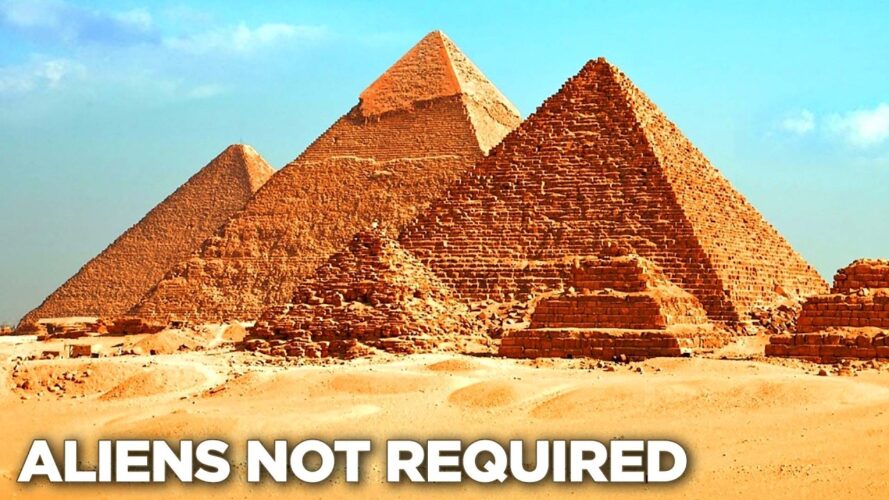
The pyramids of Giza are old. Insanely old. They reigned as the tallest human-made structures on Earth for the majority of recorded history. Because of this, there have been countless theories as to how they were built, everything from water systems to aliens. But today, I’m going to make the argument that the pyramids were, in fact, not that complicated. No aliens required.
TRANSCRIPT:
I’ll be brave enough to say it. The pyramids are overrated.
Yeah, I said it, they’re overrated. They’re cool. They’re very cool. But in terms of amazing feats of humanity, I want to make the argument that they were actually very easy.
The preponderance of theories around how the pyramids were built, honestly I think we’re overthinking it. It’s really not that complicated.
I mean people take it all the way to saying that only aliens or some super advanced civilization could have built some thing this perfect and complex, when it’s not perfect, and it’s not that complex, it’s basically a giant pile of bricks in the shape of a triangle. I’m sorry.
Ancient Egypt is fascinating, and it goes so far back, to me that’s the coolest thing about the pyramids, they are so much older than all the other wonders of the world.
Like I love the fact that Cleopatra lived closer to today than she did to the building of the pyramids. Like they were ancient to her. They were as ancient to her as Ancient Greece was to us.
That is so old! It’s almost the oldest thing! That’s what blows my mind
So some people look at how old they are and think they couldn’t have possibly been built by people back then. But I see that and just think humans are clever and always have been.
Seriously, I think that 90% of the viewers on this channel could figure out how to do this if given enough time and resources.
Here’s how I think they did it.
The pyramid is a special shape, not because it’s sacred or anything, but because it’s kinda ubiquitous amongst ancient civilizations.
You’ve got the Great Pyramids of Giza in Egypt. The Pyramid of the Sun in Mexico. The Prang of Koh Ker in Cambodia. The Bass Pro Shops at the Pyramid in Memphis… Tennessee.
All shining examples of one of humankind’s crowning achievements in architecture. Especially that last one. Go Grizzlies.
Pyramids show up so much that a whole cottage industry has evolved to claim that non-humans built them, or at least helped humans build them.
Which is ridiculous because… and I’m going to lean forward when I say this… A pyramid is literally the easiest thing to build.
A pyramid’s shape makes it very stable, which is important for its use as a tomb or religious structure. It needs to stand the test of time.
So what stands the test of time more than a pile of blocks arranged in such a way that none of them can fall. That’s a pyramid.
So, while Egypt’s pyramids are obviously impressive works of human achievement (and man, I wish I could’ve seen them back in the day), they aren’t beyond understanding. And they don’t require any special or advanced technology.
Just good ol’ human gumption.
There are several competing theories about how the pyramids were constructed.
In 2018, researchers discovered a ramp system dating back 4,500 years. It was at Hatnub [Hat-noob], a rock quarry in Egypt.
Apparently they used this ramp to move the stones out of the quarry and get them on their way, that that lead to the Giant Ramp theory.
The Giant Ramp theory is that Egyptians built a ramp that would increase in size for each layer added to the pyramid.
This is perfectly reasonable for maybe the first third of the pyramid, but after a while, the angle becomes too steep to get these 2 ton blocks up without sliding back and crushing the workers.
Yeah apparently to keep it at a reasonable angle, you’d have to build a 1km long ramp to reach the top of the pyramid, which is basically another pyramid worth of building that’s required. Also, there’s no evidence of this ramp anywhere around the pyramids. They are at the quarry, but not at the pyramids.
Spiral Ramps
So some have adjusted this theory to suggest that they ran a ramp around the outside of the pyramid, that spiraled from the bottom to the top.
You might call this the outside spiral ramp theory.
The problem with this is they need a line of sight to ensure the accuracy of the lines and the outside ramp would obscure the view needed to do that.
So this led to the inside spiral theory. That’s where ramps were built, and the pyramid was built around the ramps.
Computer scientist Vicente Luis Rosell Roig [Loo-EES ro-SELL ROYCH] said this is possible. That’s because if the ramp was built into the pyramid and then covered with stone blocks from the top down as it was completed, nothing would be left to remove. There wouldn’t be visible traces of it left behind. One problem is that this would be extremely difficult to pull off.
Another problem is that it might be too tight to make turns with those giant blocks inside of the small corridors. Some have suggested that they built landings in the corners so they actually went outside in that part, but it’s not confirmed.
Both of these ideas would require extreme engineering to pull off.
Water/Buoyancy
Another theory that’s kind-of wild is the water buoyancy theory. That’s the idea that they pumped in water and floated the stone blocks on buoyant rafts.
It does make some sense, we know they floated the stones down the Nile to get to the pyramids. And there were water features as part of the Giza complex. it would make it easier to use the water to float the stones to the top.
The problem is, this is almost impossibly difficult and way too slow. And there’s no evidence of any giant canals built around the pyramids or a water system on the inside.
It’s a neat idea, but very unlikely.
Cannibalization Theory
This next theory is wild and I heard about it from DamiLee’s channel.
She calls it the cannibalization theory. An independent researcher named Huni Choi [Hoo-nee Chweh] came up with this idea. According to him, the pyramids were overbuilt.
They started with a huge trapezoidal mass with a ramp system. When it was topped out, it was then carved down and left the pyramid shape behind. And all the leftover stone was used to build the next pyramid.
And the math kinda works out when you consider the entire Giza complex.
So it’s interesting… But I’m not sure if that follows the actual chronology of the building of the pyramid complex. Others may know better than me. Also, again, it seems like a lot of extra work.
Grand Gallery Counterweight
This next theory is starting to blow my skirt up a little, this is the Grand Gallery Counterweight theory.
So inside the Great pyramid – the Pyramid of Khufu, there’s this space called the Grand Gallery. It’s this massive, steep hallway at a 45 degree angle. It’s nine meters high and forty-eight meters long, but only less than two meters wide. The walls are corbelled, with each stone set a few centimeters from the one below. It leads up to the King’s Chamber. And the general consensus is that it was designed to create a sense of awe as you approach the final resting place of the Pharaoh .
But some people believe that the purpose of the Grand Gallery was actually to house a counterweight that helped move the blocks up the side of the pyramid.
This would let them go up steeper angles with less effort than giant ramps.
I like this theory a lot, and there seems to be some evidence for it. There are marks on the inside of the gallery that suggest that something had scraped against it multiple times. There are also ridges along each side that many considered to be benches and places for people to sit, but it may have been a surface for wheels or logs to roll on. I like this idea, it feels like a lot less construction than these other ideas, and it makes a lot more sense for this weird shaft right in the middle of the pyramid. The only problem is it might be a little too slow to get all the rocks in place in the 20 years that it took to build the pyramid.
But it does have an element that ties into a theory that I’ve locked into a little bit…
My Theory
Counterweights. I like me some counterweights.
There are images from ancient Egypt that show people pulling sleds loaded with blocks. Many take that to mean that’s how they got them up the pyramids, but this may have just been how they got the blocks to the pyramids.
I mean, to them, that may have been the actual feat – just getting them there. So they documented it, and they never even documented how they actually constructed the pyramid because it was so obvious to them.
Another case of, it’s so common and obvious at the time that nobody thought to write it down.
Counterweights have been used throughout history to make it easy to move heavy things, like drawbridges in medieval castles. The Grand Gallery counterweight theory uses this idea.
But what if they just had scale-shaped fulcrums with a counterweight on the other end that’s just a little less than the average weight of the stones?
And once the rock is loaded on the fulcrum, they could just add workers to the other side of the counterweight until the stone lifts off the ground. Then, it’s easily guided up to the next level.
They could probably have even rigged each lever to move the counterweight in and out, giving it more or less torque to adjust its lift.
Just line them all the way up on each face. One level hands it to the level above, which hands it to the level above that, and so on.
They say that in order to move all the two-point-three million blocks over twenty years, it would take something like a block every two minutes. With four going at a time, each lift had like ten minutes to load and unload a block.
I kinda got this idea from a guy named Brad Porter. Brad Porter was a former engineer at Amazon. He’s now the CEO of Collaborative Robotics, and his idea about the counterweight is interesting.
He says that instead of using blocks for weights, only workers were used.
He points to a story from Herodotus, who was a Greek historian who traveled through Egypt in the 4th century BCE, where he claims that the locals told him that the pyramids were made by, “machines made of short wooden planks” that raise the blocks one level at a time.
Of course, that was two thousand years after they were built, so the locals who told him that probably didn’t know, either.
I also want to point out that there’s no evidence of this in any writings or wall carvings.
But it would help explain the lines that run down the center of the pyramids’ faces. That could be where the lifts lined up which would’ve been in the center in order to reach the top.
What’s In the Great Pyramid
Here’s the thing: The pyramids aren’t just a huge pile of rocks. There’s stuff in there.
Take the King’s Chamber in the Great Pyramid, for example. It’s made entirely of pink granite, and its flat roof supports more than four hundred tons of masonry.
As long as it’s been around, only one small crack has appeared in the ceiling.
A red, granite sarcophagus is inside the chamber. Since it weighs about four tons, it was probably put in there during construction.
Between the King’s Chamber and the Queen’s Chamber is the Grand Gallery, which I talked about before.
You enter the Queen’s Chamber through a horizontal passageway from the lower end of the Grand Gallery.
This chamber is entirely made of finished limestone blocks, with a gabled ceiling. The walls are bare with no inscriptions. But there is a niche in the east wall about four meters up from the floor. It has a corbel ceiling, and a statue may have stood there.
There are two air shafts in the Queen’s Chamber. They were originally bricked up and not discovered until 1872. They’re only about twenty centimeters square and rise from the chamber’s north and south walls, climbing up through the masonry above.
They’re not straight, either. For example, the north one bends, possibly to curve around the Grand Gallery. Similar shafts are found in the King’s Chamber.
The air shafts in the Great Pyramid are one of its most mysterious features. One theory is that they were used for ventilation during construction. Makes sense, but they don’t run all the way to the outside. Also, no shafts have been found in other pyramids.
The discovery of small limestone doors at the top of the shafts suggests they had other purposes, possibly for astronomical or religious reasons.
Another purpose… maybe? Is it was used for ropes that went down to that Grand Gallery counterweight. Huh? Eh? I just pulled that out of my ass.
At the bottom of the Great Pyramid is the Subterranean Chamber. It’s unfinished and is located thirty meters below the surface of the plateau.
Just standing in it is insane. There’s no oxygen, and there are 2.3 million blocks of stone weighing around 6.5 million tons over your head.
Workers chipped away at the limestone bedrock to create the chamber, which is thought to be where King Khufu [KOO·foo] would originally be buried.
But this chamber is unfinished because Khufu decided he wanted his burial chamber higher in the pyramid and told the workers to stop. There’s also the theory that it was created at the beginning just in case he died before the pyramid was finished.
Based on all these chambers and air shafts, it might make sense that the Great Pyramid was built in sections.
Like the interesting thing about the pyramid shape is that the higher up you go, the fewer blocks you need. For example, the lowest third of the pyramid used 80% of the blocks that was used for it. It also just happens to line up with the bottom of the King’s chamber. So maybe the foundation was built, the lower third, using a ramp, then the inside structures were built on top of that, then the remaining 20% of blocks were moved up on counterbalanced fulcrums, and built around the inside chambers.
So yeah, maybe they used a combination of all the theories.
The point is, they had a lot of perfectly plausible options and may have used a combination of them. But it’s basic engineering, which they had mastered and had practiced on many previous pyramids for centuries. Nothing crazy or supernatural. It was a wild, monumental project, and they figured it out.
No Evidence
The thing is, there’s no evidence of any of this. Even though there are fairly detailed records of pay and logistics procuring and transporting the stones, there are no records or images of how they were built.
Recently, though, a group called ScanPyramids used a few different methods to scan the insides of the pyramids, and they found a couple of voids that remain unexplained.
The group uses cosmic ray particle detectors to see what’s inside them. And in the Great Pyramid, they found a large void deep inside of it in 2017. In fact, it was the first big structure found inside that pyramid since the Middle Ages.
They found a large, open space above the Grand Gallery that’s about thirty meters long and two meters wide.
Another thing. What we see today is not even remotely what people saw when the pyramids were built.
Like, white limestone casing stones once covered the outside, making the facade smooth and shiny. But they were taken down in the Middle Ages and reused to build mosques and fortresses in Cairo, such as the Alabaster Mosque.
The pyramid of Khafre [KA·fruh] is the only one that still has some of the original casing stones at the top.
This is like if you removed the brick facade from a McMansion, you’re not really seeing it the way the builders wanted you to see it. We’re just looking at the stuff underneath when we look at the pyramids today.
Also, these things are 4,600 years old. A lot has happened to them since they were built. Most of what we see when we look at them has nothing to do with how or why they were built.
And they’re also the result of forty-six centuries of travelers, conquerors, looters, and thieves passing through. It’s an exercise in human erosion as much as human ingenuity.
Remember those “lines” going down the sides? I said earlier that they could have been made from the line of fulcrums? They’re probably just from falling rocks at the summit. They’ve been worn down over time, and dozens of rocks may have fallen, either by human hands or just time. And those rocks would have fallen in all four directions, traveling straight down from the top. In other words, right down the center, making a line.
Ancient Egyptians were just as clever as we are, and there are multiple plausible ways they could have built the pyramids. They’re easy to build, and they had plenty of practice on multiple pyramids for centuries.
For example, the tombs of early Egyptian kings were housed in bench-shaped mounds called mastabas. Well the first pyramid was built by basically stacking six mastabas on top of each other to form the Step Pyramid. That was around 2780 B.C.E., done by King Djoser’s [JOW·sr] architect, and it’s considered considered the first pyramid in Egypt.
They transitioned to smooth-sided pyramids during the Fourth Dynasty, that’s when the Bent Pyramid was built. It’s called that because… well, look at it. Its angle of incline decreases from over fifty-one degrees to around forty-three degrees, giving it a bent look. This was built for the pharaoh Sneferu and it clearly was an architectural mistake, his son turned out to be Khufu, who built the Great Pyramid. Probably just to outdo his dad.
I think we can say he succeeded.
Actually the credit should go to his architect, Hemiunu. He’s considered the genius that designed and executed the Great Pyramid.
And I’m sure he was a genius, who built off the experience of previous pyramids going back hundreds of years.
By the time the Egyptians built the Great Pyramid of Giza, they had it dialed in.
So, I should probably wrap this up by saying… I barely know what I’m talking about here.
There are Egyptologists that have spent their entire lives studying this, I just skimmed the surface and like a good YouTuber, am sitting here telling you I know what’s going on.
I highly suggest checking out the channel History for Granite, he has tons of videos specifically about the building of the Giza Pyramids.
I also recommend DamiLee’s video on the cannibalization theory, I’ll put other links down below.



Add comment