
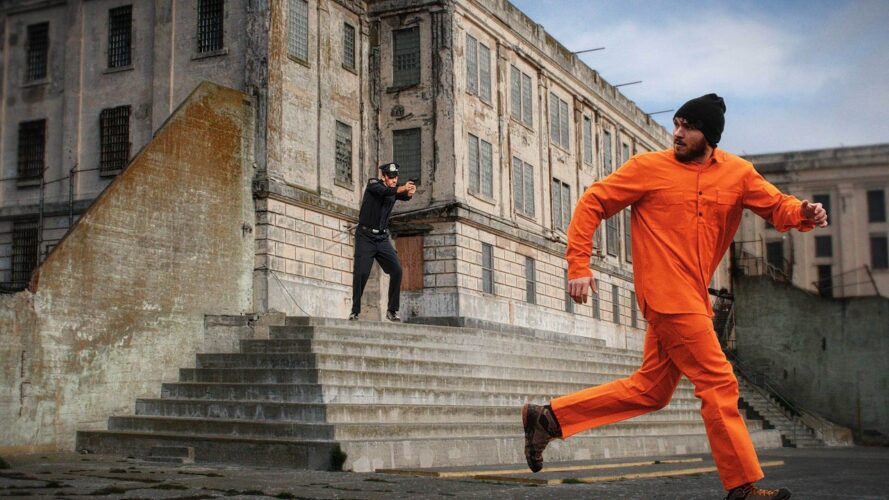
Alcatraz. The Rock. The inescapable prison that held some of the most ruthless and colorful criminals the world has ever seen. Some of whom were notorious for escaping other prisons. But there’s only a handful of escape attempts at Alcatraz that could remotely be considered successful. Here’s the story of (and the mystery around) those attempts.
TRANSCRIPT:
The island of Alcatraz was named by the Spanish explorer Juan Manuel de Ayala who was the first to sail into San Francisco Bay in 1775. Then in 1850, President Milliard Fillmore issued an order to set aside the island for use as a military reservation. Then the California gold rush and the growth of San Francisco led the US Army to build a citadel on the island.
By the late 1850s, the military started housing prisoners on the island and as its role as a defensive outpost diminished, the island found another use for housing.
In the Civil War, the fixture became a fort. A group of confederate sympathizers tried to outfit a schooner into San Francisco in 1863 to raise Union shipping ports into the Pacific but authorities foiled the scheme and the crew were arrested and imprisoned on Alcatraz Island.
Several native Americans were also arrested and imprisoned on the island on trumped up charges.
In 1909, the Army tore down the Citadel and the basement served as the first form of the prison as inmates built the main structure.
The US Army used the island until 1933 when it transferred ownership to the US Department of Justice’s Federal Bureau of Prisons. The government decided to use it to open a maximum security prison to house the worst of its worst criminals as a way to stand up to rampant organized crime in the 1920s and 30s.
The ro…I mean, the island of Alcatraz was designed to be a maximum security prison in the strictest sense of the word. It was created to house the worst criminals with the most likelihood of attempting escapes or those who had escaped from other prisons.
For starters, the waters around the island are extremely cold year round with an average of 55 degrees Fahrenheit.
When the wind runs parallel to the California coast, the milder water that’s warmed by the sun gets sent out to sea. The cold water from underneath comes up to replace it in a process called upwelling. So it’s hard to swim in without the proper equipment to keep the body from contracting hypothermia.
These same winds that keep the warm water out of the bay also create strong currents and choppy waters that make it hard to navigate in a crude, homemade craft.
The cold waters also make it great for fishing but are also known to attract great white sharks.
Even if the prison wasn’t an island, it would also be hard to escape from on land. It was known as a “prison system’s prison.” It had a lower than average prison population, making it easier for guards to keep track of prisoners. It also kept inmates on a strict, monotonous schedule where the only things they were entitled to were food, clothing, shelter and medical care.
Often if inmates could prove they could be model prisoners, they could have access to special privileges such as music and art programs and if they could prove they could follow the rules, they’d be transferred to main land prisoners where they could visit with family members and access visitors more often.
The main prison only had four main cell blocks, A, B, C and D, that were three stories. A, B and C were used for general confinement and D for solitary confinement, a block of completely enclosed cells completely devoid of light for problem inmates.
The prison also housed an open air recreation yard and gardens for prisoners with special privileges.
There were also homes on the island where the staff’s family lived while the prison was operational including the warden’s family. Approximately 60 families lived on Alcatraz for half of the staff including 75 children so it basically housed a small community of civilian families at the same time.
Escaping from the prison was, of course, no small feat. Those who attempted to escape not only had to navigate the choppy, cold waters surrounding the island, they’d also have to make their way out of a heavily fortified cell block with a small population undergoing constant head counts. The island was also surrounded by several layers of barbed fencing with guard towers monitoring each inch of the land day and night.
Of course, that didn’t stop anyone from attempting to escape. There were a total of 14 escape attempts in the island’s history. Inmates attempted just about every method of escape possible from filing down bars to starting riots and overpowering guards to give them a chance to escape while making it harder to track the inmate population.
The only men to make it off the island without returning to Alcatraz or prison (as far as we know) including a daring and ambitious escape attempt in 1962 by inmates Frank Morris and John and Clarence Anglin. Inmate Allan West was the fourth member to participate in the escape attempt but he wasn’t able to join the group in time.
Morris and the Anglins are still on the US Marshals wanted list to this day.
All four men are considered career criminals with escape attempts on the record, which is what put them in Alcatraz in the first place.
Morris was unique even for this crowd. He had an IQ of 133 and spent pretty much his entire adult life in and out of prisons. He was sent to Alcatraz for escaping from Louisiana State Penitentiary where he was serving a 10-year sentence for bank robbery. He got caught while committing a burglary in 1960 and was sentenced to 14 years on Alcatraz.
The Anglin brothers may not have been as smart but they also knew a thing or two about escaping from prisons. They spent a lot of time in jails in Alabama, Florida and Georgia, also for burglary. They often attempted escapes but unsuccessfully before landing themselves in Alcatraz in 1958.
Even West attempted to escape from a state prison while serving time for car theft.
According to the FBI, Morris, the Anglins and West had been prepping their escape plan for a year.
They started by gathering tools and making the things they needed from whatever they could find.
They even made tools out of tools. They basically MacGyvered their way through the whole operation. I figure if I get the MacGyver reference out of the way now, it won’t clutter the whole episode.
For instance, they made homemade drills from the motor of a broken vacuum cleaner so they could loosen the air vents in their cells by drilling a series of holes around the cover. This had to painstaking work because they not only had to drill enough holes to break through the wall but they had to do it quietly enough so they wouldn’t get caught. Then they covered it whatever they had lying around the cell during the day so none of the guards would notice it.
Once they broke through, they crawled down the corridor and set up a workshop on the roof of the cell block where they could build the things they needed to get off the island.
For months, the four of them snuck into their hidden workshop while one worked as a lookout using as a homemade periscope.
A periscope? They thought of everything. Were they also planning on building a second Alcatraz to confuse the guards and make them think they were in the wrong prison?
The raft and life preservers they made to help them get off the island were pretty ingenious in their design.
They gathered up more than 50 raincoats and fastened them together to make a 6X14 foot rubber raft and life preservers.
Morris got the idea from articles he read in magazines like Popular Mechanics like this article “Your Life Preserver – How Will It Behave If You Need It?”
Actually, Morris got a lot of his ideas for the escape from magazines.
He figured out how to make resin from another Popular Mechanics article on how to make your own lamp shade. He learned about how to use channel buoys to indicate course and navigation hazards from a 1962 issue of Sports Illustrated. Frank Morris should’ve had his own celebrity “READ” poster that they put up in libraries in the 80s and 90s.
They stitched the raincoats together by hand with liquid plastic they swiped from the prison workshop and vulcanized the whole thing together with hot steam pipes. They also made oars from plywood and screws. They also modified an accordion to inflate the raft.
Then on the evening of June 11, 1962, they put their plan into effect.
Allan West ended up staying behind because he wasn’t able to remove the grill in his cell.
The three remaining escapees snuck into the corridor and gathered their gear from their secret workshop. They escaped through a ventilator on the prison roof, and shimmed down a bakery smoke stack on the northeast side of the building. They snuck around the island’s main water tower and storehouse, climbed over a barbed wire fence, and launched their raincoat raft on the northeast shore of the island.
The plan once they left the island was to paddle north to Angel Island, then cross the Raccoon Strait and into Marin County where they could steal some clothes and a car.
The FBI only found remnants of the raft and paddles the men made to aide their escape, and the dummy heads the men left in their cells so their absence wouldn’t alert the guards.
On the morning of the escape, the guards did their usual inmate count and three of the inmates didn’t report for roll call.
The guards raced to the cells and realized that whoever had done the evening inmate count didn’t notice that Morris and the Anglin brothers’ cells had counted the homemade dummies in their beds. The three inmates who escaped thought of everything when it came to their escape. The dummy heads were made of papier-mâché and they even added hair to them collected from the floor of the inmate barbershop. So when the guards raced to the empty cells during the morning count, the dummy head rolled out of the bed and landed on the floor.
The guards started interviewing inmates and they soon discovered that Allan West was the fourth inmate in on the escape who didn’t make out of his cell that night. He spilled the beans about the whole plot.
They learned that Morris was the brains behind the whole escape, which wasn’t a surprise to the authorities. The inmates who ended up in Alcatraz were usually the worst of the worst and included inmates who attempted escapes from other prisons.
The FBI scoured the waters around the bay hoping to find their bodies or even just some evidence of where they might have gone if they survived the trip. Agents posted photos of the men all over the area hoping to find out where they were hiding but they had such a big head start, they were long gone. Even if they had help getting off the island and out of the area, agents couldn’t substantiate any credible evidence. They couldn’t even get help from their families since they were too poor to provide any real means of support.
FBI agents searched the waters around the islands in the bay for days.
Two days after the escape approximately 200 yards south of Angel Island, searchers found one of the makeshift oars the escapees used to steer the raft. They also found a wallet wrapped in plastic that contained names, addresses, and photos of the Anglin brother’s friends and relatives.
Then on June 21, searchers found one of the inmates’ life vests on Cronkhite Beach, now known as Rodeo Beach just three miles from the Golden Gate Bridge.
The next day, they found another life vest with the strings still knotted together at the back off the coast of Alcatraz Island.
There were even more delays when a passing ship spotted a body in the water. A Norwegian Freighter called the SS Norefjell (Nora-Fee-Yell) that left Pier 38 found a floating body 20 miles northwest of the Golden Gate Bridge on July 17. The problem is they didn’t report it until the following October because they had no radio contact.
The body was floating facedown wearing denim clothes similar to the kinds of uniforms the inmates wore on Alcatraz.
The San Francisco County Coroner, however, publicly stated that he didn’t believe the floating body belonged to one of the inmates. He said it wasn’t possible for a body to remain floating more than a month after drowning. He also stated on the record that he believed the body belonged to Cecil Phillip Herman, a 34-year-old unemployed baker who took their own life by jumping off the Golden Gate Bridge five days earlier. Also, no one could recover the body to determine its true identity.
Off-duty San Francisco police officer Robert Checchi also reported seeing some men take off in a boat just before midnight from Marina Green.
Checchi reported seeing what he called a “pristine white boat” in the Bay. At first, the boat didn’t have any lights on, which he found suspicious so he couldn’t see the faces of any of the people on the boat. Then he saw someone shining a flashlight in the water before it took off and disappeared in the dark. He didn’t think much of it at first but when he learned the following day that three men escape from Alcatraz, he filed a report.
Checchi’s report fueled even more rumors that Morris and the Anglin brothers had outside help getting out of the city but the FBI didn’t pursue it further outside of their initial interviews.
In fact, hoaxes and rumors impeded the investigation years after the escape happened.
In 2013, the San Francisco PD received a letter from a man claiming to be John Anglin. The public wouldn’t learn about the letter until five years later.
The writer of the letter admitted to breaking out of Alcatraz and said they were dying of cancer. The letter also Morris and the other Anglin brother had long since passed away. Experts and even a family member said they didn’t believe the letter came from John. A U.S. Marshal spokesperson also said that comparisons to Anglin’s known handwriting samples appeared to be inconclusive.
The conspiracies get even goofier from there.
One rumors that persisted for years is that the Anglin brothers tried to attend their mothers’ funeral in 1973 by either wearing fake bears or women’s clothes. Does that sound like the work of three men who escaped from the world’s most escape-proof prison?
The FBI worked on the case for 17 years but in that time, they could find no evidence that the men survived the waters or were living anywhere in the US or abroad. The FBI closed the case on Dec. 31, 1979 and turned it over to the US Marshals Service without a trace of the men’s whereabouts.
Morris and the Anglins weren’t the first or the last inmates to try and escape.
John K. Giles was the ninth inmate to make an escape attempt from Alcatraz but his wasn’t as complex as others.
After a long life of crime, he received a federal prison sentence after escaping from prison and spending almost six months eluding the authorities.
While on the island, he worked as a stevedore loading and unloading the boats that arrived with supplies. During World War II, the prison was tasked with laundering army uniforms giving him an opportunity steal a disguise.
Giles stole enough pieces of uniforms to create a full disguise for an Army Technical Sergeant.
Then on July 31, 1945, he dressed in the uniform and snuck aboard a ferry through a freight hatch below the main deck. He started chatting with other soldiers to try and blend in with the crowd. Unfortunately, the counts got him caught. A head count of soldiers showed there was one too many on the ferry and a head count of inmates showed they were one person short. The assistant warden went after the ferry on a speedboat following it to nearby Angel Island. The prison officials also ordered the ferry captain not to let anyone off the boat but the captain misunderstood the order and only let those with a pass off the boat.
Giles had a forged pass and made it on the island but the officer of the day spotted Giles’ pass as a forgery and kept him in custody until prison officials could arrive and bring him back to The Rock .
Man, that’s starting to get addictive.
If you don’t believe the three made it off the island alive and free, then John Paul Scott is consider the most successful escape attempt in Alcatraz’s history.
In December of 1962, Scott and his partner Darl Dee Parker made their getaway from the culinary unit underneath the kitchen on the northeast end of the cell house. They sawed through some barred windows, possibly by using some violin or guitar strings coated with an abrasive cleanser.
First, Frank Morris uses an accordion case to hide his escape hatch and inflate the makeshift raft. Now these guys saw through bars with guitar strings. I don’t mean to be a hard ass but did the prison warden ever think about disbanding the prison band program? It sounds like he could’ve prevented a bunch of escape attempts if he just made them play recorders.
They followed a similar path to Morris and his crew once they made it out of the cell block. Then Scott and Parker went a little bit further to the northeast tip of the island and swam away on a pair of makeshift water wings they made.
Their floating devices weren’t as complex as the ones that Morris, the Anglin brothers and West made. They created a pair of water wings with some denim prison uniform shirts with the sleeves knotted shut. They stuffed some inflated surgical gloves inside of them to help them stay afloat.
Parker only made it around 100 yards away to a little piece of floating rock known as Little Alcatraz. Welcome to the Little Rock.
Scott swam the entire three miles to shore in 54-degree Fahrenheit water the mainland.
Hooray! You did it!… assuming the other three didn’t make it out of there alive.
Unfortunately for Scott, he didn’t have long to celebrate his freedom. A group of teenagers found Scott naked and shivering from the cold just above the surf line under the Golden Gate Bridge. They originally called the police to report a dead body but they arrest Scott and took him to a nearby hospital to treat him for hypothermia before returning him to prison.
Scott would be the last inmate to attempt an escape from The Rock. Attorney General Robert Kennedy closed down Alcatraz in March of 1963 due to high operational costs. Supplies had to be transported to the island by boat making it three times more expensive to run.
These days, the only swimming people do away from Alcatraz is part of an annual triathlon that follows a similar route some of the escaped inmates took to get off the island.



Add comment