
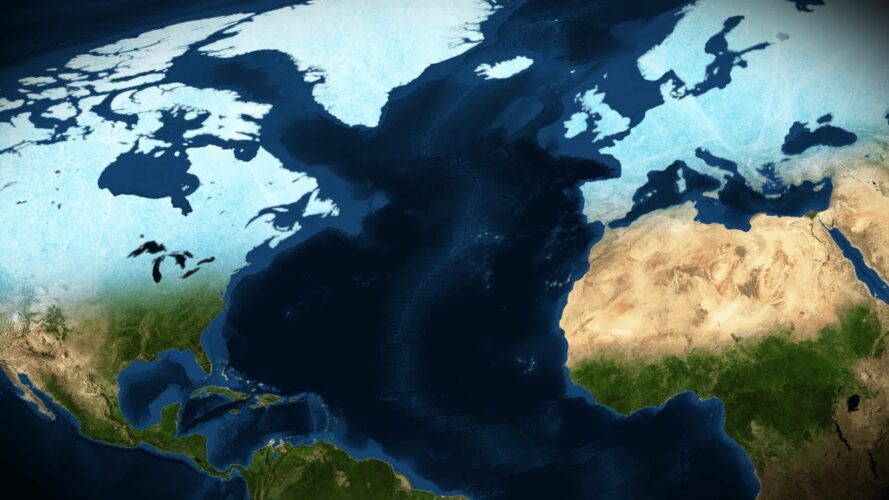
It’s been talked about for a while (in fact I covered this 6 years ago), but a lot of things have been said about the potential collapse of the Atlantic Gulf Stream, also known as the Atlantic Meridional Overturning Circulation or AMOC. This global current that keeps Europe and North America (but especially Europe) from being covered in ice is increasingly under threat of slowing or even stopping. The results would be catastrophic.
TRANSCIPT:
Let’s start with the dismal outlook.
Back in 2021, a study in Nature Geosciences showed that the AMOC was the weakest it’s been in more than 1,000 years.
The study looked at 11 indicators like deep-sea sediments and ocean temperature patterns going all the way back to 400 C.E.
Nine indicators showed a consistent pattern of the AMOC weakening.
A more recent study from 2024 found that the abyssal [uh·bi·sl] limb of the AMOC in the North Atlantic is weakening.
Also published in Nature Geosciences, the study used mooring observations and hydrographic data from multiple sources in the North Atlantic.
So, the AMCO has an upper cell and a deep-sea cell that is underneath it.
The upper cell moves warm water from the South Atlantic Ocean to the North Atlantic, where it cools down, sinks, and then flows back down south.
The deep-sea cell of colder water at Antarctica’s edge is called the abyssal cell.
This Antarctic Bottom Water is the… wait… bottom water?
Anyway, this water is the coldest and densest water mass of the oceans.
But the study found that the northward movement of the Antarctic Bottom Water at 16 degrees North weakened by around 12 percent from 2000 to 2020. This weakening is associated with observed warming throughout the deep Western Atlantic Ocean.
That means an increase in deep-sea heat and rising sea levels in the region.
Another study in 2024 showed that a collapse of the AMOC before the year 2100 was unlikely. But when climate models were run to the years 2300 and 2500, they showed that a tipping point for an AMOC collapse would likely happen within a few decades. The researchers found that if carbon emissions keep rising, 70 percent of the model runs lead to a collapse.
An intermediate level of emissions showed a 37 percent chance of collapse in the model runs.
And even if there were low emissions in the future, an AMOC collapse happened in 25 percent of the models.
One of the study’s authors found the results shocking because he thought the chance of the AMOC collapsing from global warming was less than 10 percent.
Professor Stefan Rahmstorf told The Guardian:
“These numbers are not very certain, but we are talking about a matter of risk assessment where even a 10% chance of an Amoc collapse would be far too high. We found that the tipping point where the shutdown becomes inevitable is probably in the next 10 to 20 years or so.”
Scientists started seeing warning signs of a tipping point about five years ago.
In fact, observations in the far North Atlantic are already showing a downward trend that is consistent with the models’ projections.
Even in intermediate- and low-emission models, the AMOC slows a ton by 2100 and completely collapses afterward. The scientists say this shows the shutdown risk is more serious than many people realize. There’s also a patch of cold water south of Greenland that has resisted the Atlantic Ocean’s overall warming for more than a century.
It’s been a mystery as to why.
Well, researchers from the University of California, Riverside say only one explanation fits both salinity patterns and observed ocean temperatures. And it’s that the AMOC is slowing down.
Using a century’s worth of data, the researchers reconstructed changes in the circulation system and compared them with around 100 different climate models. Only the models that simulated a weakened AMOC matched real-world data. Models that assumed a stronger circulation didn’t even come close.
One of the study’s authors said:
“It’s a very robust correlation. If you look at the observations and compare them with all the simulations, only the weakened-AMOC scenario reproduces the cooling in this one region.”
The researchers also found that the AMOC’s weakening correlates with decreased salinity. That’s another signal that less warm, salty water is being moved northward.
It’s not just climate models that are showing an eventual collapse. We also have “fingerprints” from satellite images.
Recent high-resolution images show water temperature increasing over time. The researchers say it proves that the AMOC weakening is underway.
But you know what. Maybe the AMOC collapse isn’t a pressing problem. Several studies offer a more optimistic view of the situation. For example, a study published in Nature last year showed that the AMOC is resilient to extreme greenhouse gases. Researchers said that upwelling in the Southern Ocean, driven by consistent winds, helps sustain a weakened AMOC in climate models.
This upwelling has to be balanced by downwelling in the Atlantic or Pacific. The AMOC can only collapse if a Pacific Meridional Overturning Circulation forms.
In almost all their models, a PMOC did emerge, but Southern Ocean upwelling overcame any destabilizing effects of it.
They predict that an AMOC is unlikely this century.
But they say that projections should focus on ocean circulation changes beyond the North Atlantic to fully understand AMOC’s future. Then there’s a paper published in Nature Communications in January 2025 that found that the AMOC hasn’t declined in the last 60 years.
One of the study’s authors said:
“Our paper says that the Atlantic overturning has not declined yet. That doesn’t say anything about its future, but it doesn’t appear the anticipated changes have occurred yet.”
The study is a stark contrast to a 2018 study that said the AMOC had declined over the last 70 years.
That research relied on ocean surface temperature measurements to track how the AMOC changed. But measuring surface temperature doesn’t work that well. Researchers for the latest study used new data from 24 climate-earth models created by the World Climate Research Program. They found that recent surface temperature data didn’t accurately reconstruct the AMOC. They took things further by looking at air-sea heat fluxes, which is the exchange of heat from the ocean to the atmosphere.
They found that a stronger AMOC releases more heat from the ocean into the air over the North Atlantic. The study shows that air-sea heat flux anomalies in the North Atlantic are closely linked to the AMOC and that it hasn’t weakened from 1963 to 2017. Ready for more positive news? Well, a study by Caltech researchers found that even though the AMOC will weaken because of climate change, it will do so less than predicted.
The researchers developed a simplified physical model based on how density differences and the AMOC’s depth are related.
They included real-world measurements of the current’s strength collected over 20 years from monitoring arrays and other observation products in the Atlantic basin.
The team found that the AMOC will only weaken by about 18 to 43 percent by the end of the 21st century. Yeah, 43 percent is a lot, but it’s nowhere near what other climate models project.
As the study’s lead author said:
“Our results imply that, rather than a substantial decline, the AMOC is more likely to experience a limited decline over the 21st century—still some weakening, but less drastic than previous projections suggest.”
The researchers say that some of the extreme AMOC weakening projections came from biases in how climate models simulate the ocean’s current state, especially its density stratification.
The AMOC has collapsed before. It was about 12,900 years ago.
That’s when the rapid melting of the frozen Lake Agassiz in North America caused vast amounts of freshwater to move into the sea.
This led to fluctuations in temperature of 10 to 15 degrees Celsius in the Northern Hemisphere within a decade. A comet impact may have caused the event, leading to 1,300 years of freezing, a period of time known as the Younger Dryas. The same thing would happen today if the AMOC were to collapse.
Scientists predict that some European cities would see a five to 15 degree Celsius drop in temperatures within a few decades after the AMOC shuts down.
But Europe wouldn’t be the only place affected. The Atlantic Ocean would rise by 70 centimeters, submerging many coastal areas and cities. And in the Southern Hemisphere, regions would get warmer than they already are.
An AMOC collapse is definitely something to be concerned about. In fact, it’s so serious that Iceland declared it a security risk in November 2025. The country’s government is looking at what policies and research are needed, and work has already started on a disaster preparedness policy.
Some of the risks being evaluated include energy, food security, infrastructure, and transportation. Iceland isn’t waiting for definitive, long-term research. It’s acting now because it believes in not “if” but “when.”
The will-it-won’t-it collapse of the AMOC is something to keep an eye on. But there are other pressing climate change issues to address in the near term, such as food security, ecosystem degradation, and rising disease rates.


Add comment