
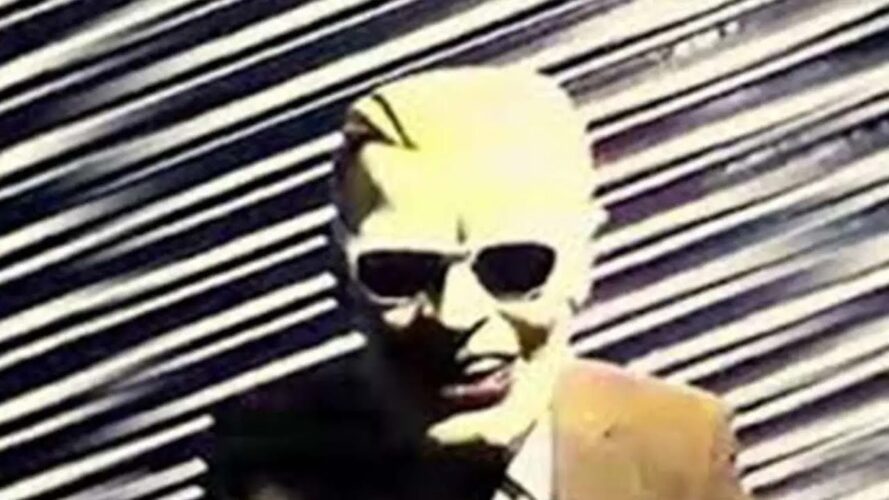
On November 22, 1987, TVs across the city of Chicago were interrupted by the strange image of a man in a Max Headroom mask, babbling incoherently and getting spanked. It was one of the most brazen TV piracy events in US history, and a mystery that has eluded experts for nearly 40 years. Today we look into the infamous Max Headroom Incident.
TRANSCRIPT:
The Internet has been as obsessed about this incident as people were as obsessed with Max Headroom in the 80s. There’s been a lot of talk about why it happened and no shortage of theories.
The one that comes up the most is that the prank was just that: a prank.
Whoever did this could’ve been using the airwaves create a little chaos in a harmless, non-Heath Ledger Joker kind of way.
It could be a work of ironic art…
or it could just be a couple of teenagers screwing around, doing the TV equivalent of leaving a flaming bag of dog poop on Chicago’s doorstep.
That may explain why the references are so varied. For instance, at one point, the guy in the mask hums the theme song and seems to make an obscure reference to the final episode of the animated series “Clutch Cargo” in which real mouths were imposed on cartoon faces.
Only on the human faces. Thank God they didn’t put a human mouth on the dog.
The masked person in the video also makes a reference to Chicago sportscaster Chuck Swirsky . The voice purportedly says he thinks he’s better than Chuck and calls him a “frickin’ liberal.”
Also, why did the hackers decide to use Max Headroom has its “spokesman”? Maybe it’s because Max Headroom was everywhere. Max Headroom was the most 80s thing that ever existed. He was like someone threw the Rubik’s Cube, Duran Duran and wearing sneakers with a dark suit in a blender and set it on puree.
Max was a fictional AI character played by actor Matt Frewer. The character was created by George Stone, Annabel Jankel and Rocky Morton. He was sort of an anti-corporate, counterculture figure who thumbed his digital nose at everything…
even though later he would a key part of the marketing campaign for New Coke, which is also referenced in the video.
Max was originally pitched as a virtual VJ with his own show. The character was supposed to be a “digital” creator played by a real actor. However, he stuttered to make it seem more like a robotic, computer generated being. Max made sarcastic comments and pop culture references that he delivered with a big, flashy, over the top personality and he was known for interrupting live broadcasts with cryptic messages.
That became the basis for a TV drama that ran on ABC in America.
Max’s smiling, slick haired mug appeared on TV shirts, watches, magazines, his own celebrity talk show, even on other talk shows as a guest. Max is still referenced to this day. Matt Frewer provided a voice over cameo for the character in the critically panned video game movie “Pixels.”
Eminem also featured a facsimile of Max in his video for his 2013 single “Rap God,” which holds the Guinness record for the most words in a hit single at 1,560 words averaging four words per second.
Max basically predicted the AI boom that we’re experiencing today. Except, of course, they intended it to be glitchy and amusing.
The character was also known for breaking into other broadcasts on his TV show and earned a reputation as a distributor.
So even if we don’t know the meaning of the hacking, it kind of makes sense that the hackers chose to use the character to disrupt not one, but two live broadcasts on Nov. 22, 1987.
The first interruption happened on WGN during a 9 pm news broadcast right in the middle of the show’s sports report.
The screen suddenly cuts out right in the middle of a clip package and the image of someone in a Max Headroom mask appears on the screen.
The only sound you can hear is some static and possibly some distorted audio but nothing’s intelligible.
The station manages to knock the rogue feed off the air and cuts back to sports reporter Dan Roan who laughs it off.
Then two hours later, the hackers cut into the feed of Chicago’s public TV station WTTW during an episode of “Doctor Who.”
Ok, interrupting a sports report? I understand why A/V geeks would cut into that, but “Doctor Who?” Now I’m mad. This time, the Max Headroom hijack last for almost a minute and a half and you can hear a distorted voice talking to the camera.
The voice makes several, seemingly random media references including WGN sportscaster Chuck Swirsky, New Coke’s “Catch the Wave” tagline, the theme to “Clutch Cargo” and CBS. The voice also claims (Video line: Oh I just made a giant masterpiece for all the world’s greatest newspaper nerds.”)
Then there’s the final part where Max bends over and gets spanked with a fly swatter. What could they possibly be referencing?
You know what? I’d rather not have seen that. Maybe there’s such a thing as having “too much knowledge.”
Since the people who pulled off this prank were never caught, it’s not known exactly how they were able to break into a TV station’s signal and broadcast their little prank. So we should probably start by looking at how TV broadcasts worked at the time. Now some of you may be too young to remember this but back then, TVs had these long metal things sticking out of the top of them called antennas.
Believe it or not, there was a time when you actually had to get out of your chair and fiddle with these things to get a clear picture on your TV.
Sometimes, you had to wrap aluminum foil around them to get a clearer picture or get someone to stand a certain way in the middle of the room to direct the signal or jump up and down to fix it. Watching TV in the 80s was more fun because it felt like you were doing a “Double Dare” style physical challenge just so you could watch “Flintstones” reruns with a clear picture.
It’s actually pretty simple.
TV stations would broadcast its signal from an antenna on a massive tower. WGN’s signal came from an antenna on the top of the Sears Tower, now known as Willis Tower.
WTTW’s antenna was located on the John Hancock Building, now called 875 North Michigan Avenue, which is about 15 miles north of Willis Tower.
Powerful electromagnetic waves are transmitted from these buildings’ towers to TV antennas that are positioned in the right direction. That’s why everyone’s dad in the 80s spent so much time cursing at the TV while trying to adjust the set so he could get a grainy picture of the football game that determines whether or not you still had money for college.
These signals are relayed from the TV stations to transmitters on other tall buildings. These links are called the studio transmitter link or STL for short.
The waves also travel with encoded audio and visual information that your antenna would receive and translate through your television. Or more specifically, the sound through your speakers and the cathode rays that fed into your TV’s screen. Since TV switched to a digital signal in 2009, this kind of pirate intrusion is no longer possible.
The signals from these mobile stations like TV news vans would also get weaker the farther they were from the towers. Whoever made the pirate broadcast would also have to be high enough to reach the receivers on top of both buildings with high-power microwave frequencies. So they probably were positioned in a high rise apartment or on a roof top or maybe even someone who worked for the stations or broadcasters.
Now you might think that the broadcast pirates would need some powerful equipment or at least the equivalent of a TV news van to break into both TV stations’ signals. Actually, if they had enough technical knowledge about breaking into TV signals, they wouldn’t need a whole news van to do it. They wouldn’t even need to be that sophisticated or even ridiculously expensive.
Dr. Michael Marcus, a former assistant bureau chief for the FCC’s Field Operations Bureau and the lead investigator of the Max Headroom case, told Vice in 2019, that whoever broadcast the video would need a dish antenna and be close enough to the tower antenna. However, “The gear might have cost around $10,000, but would have been available, used, on the amateur radio market.”
The person in the video mentions that their brother is wearing “the other one,” presumably a glove that he had on at the time. There also could have been someone behind them turning the giant metal background and another person operating the camera even the shot is stationary and jump cuts to a second scene. So at a minimum, two or three people could have been involved with the broadcast including the guy who plays Max Headroom and the person who spanks them.
I’m never gonna get that image out of my head, am I?
So who pulled off this epic spank…I mean, uh, prank?
One name that constantly pops up in theory threads is artist and filmmaker Eric Fournier.
Eric was an LA-based artist best known for a character he created in the 1990s in a series of short films called Shaye St. John. He plays a fictional supermodel who used parts of mannequins to rebuild her look following a horrific accident.
He uses lots of shock and surreal humor in his videos. He pumps in a disturbing soundtrack with absurd jumpcuts. He has kind of a Tim and Eric style before Tim and Eric became a thing.
A lot of Reddit users believe he’s the culprit because the Max Headroom video and his early films have a similar style and look. He lived in Bloomington, Indiana at the time of the broadcast and had access to student film equipment.
Some users claim that Eric made the pirate broadcast to promote his punk band but one of his former bandmate Harry Burgan dismissed this theory as “ridiculous bull-BLANK.” According to an article at WeirdDarkness.com, Eric says he didn’t have any access to broadcasting equipment and they never made any music videos for the band.
Unfortunately, Eric passed away in 2010 when he was 42 years old.
Another theory that started at Reddit’s /IAmA section suggests the culprits are a pair of brothers in Chicago known as “J and K.”
Reddit user bpoag claims that J, a young man with “moderate to severe autism” and his caretaker brother K both participating in the Chicago hacking and phreaking scene.
They were teenagers at the time and bpoag claims J’s speaking voice sounded similar to the voice in the video. They also claim the brothers had access to high-power broadcasting equipment and even teased the incident to him. He claims he overheard them saying they were up to “something big” and when pressed further just said, “watch channel 11 later tonight.”
Unfortunately, there’s some big holes in the story.
A Neocities website points out, for starters, that they would need a way to haul their heavy equipment closer to the broadcast towers in order to hack into the feed. They’d also have to do it without getting
Bpoag also later concluded that upon further interviews with former employees of both stations conducted by himself and the online curator of the Museum of Classic Chicago Television, the broadcast would most likely have to be an incident job.
Later on in one of the comments, bpoag admits that even though the theory started to gain traction, he had to rule out “J and K” entirely as suspects.
A Reddit moderator later removed bpoag’s post laying out his theory about the brothers.
Despite some heavy investigations from federal agencies, no one has been caught or blamed for the hack. The only things we know for sure is that it had to be someone in the Chicago area, which really doesn’t narrow it down. The only lead with any plausibility is that the hack may have been pulled off by a disgruntled TV station employee.
According to district court records, WGN-TV suffered from “serious financial difficulties and declining revenues” in 1986 and 1987 that led to staff cutbacks.
Documentary filmmaker and reporter Chris Knittel who wrote pieces for VICE on the subject has also conducted his own investigation into the hacking. He said in an interview with Chicago’s public radio station WBUR that Dr. Marcus had an idea of where the broadcast came from but…
“Someone who he would not name, specifically who he worked with — I think his boss — did not want him to go and pursue that, did not want him knocking on doors.”
What is this? “The X-Files?” It’s a guy in a Max Headroom mask getting spanked on camera, not The Cigarette Smoking Man.
Knitell theorized that the layoffs may have pointed to an ex-employee committing the hacking.
“To me, I feel like it’s most likely someone who is a former broadcast employee in whatever capacity. But there’s no hard evidence out there.”
Wait, someone high up may have been covering for whoever did this hack? Crap. Maybe it WAS The Cigarette Smoking Man.
There are similar incidents of hackers and hacker groups hijacking the airwaves or infiltrating media companies. Less than a year before the Max Headroom incident, a hacker known as “Captain Midnight” broke into HBO’s programming to protest the subscription price. John MacDougall of Ocala, Fla. was arrested and charged within a month of the jacking with illegally operating a satellite uplink transmitter.
MacDougall worked part-time for a Florida satellite relay service and admitted what he did to authorities. He also own a company that sold satellite dishes and pled guilty in federal court as part of a plea bargain.
Also in 1987, Thomas Haynie, an employee of the Christian Broadcasting Network, broke into Playboy TV’s signal to broadcast a Bible verse from Exodus and Matthew.
Haynie’s case went before a jury in federal court who found him guilty and sentenced him to three-years of probation.
In 2004, cable viewers of Super Bowl XXVIII in Tucsson, Arizona accidentally saw 37 seconds of an adult film during the climactic (no pun intended) final three minutes of the game.
Seven years later, the FBI arrested Frank Tanori Gonzalez who worked as a liaison for Comcast cable.
Gonzalez pled guilty to his charges and received three years probation. Comcast subscribers in the area also received a $10 credit on their bill.
There are also incidents similar to the Max Headroom case where no suspects were ever identified or charged.
In 2013, hackers hit stations in five states to broadcast a false alert about a zombie outbreak.
Instead of completely overtaking the broadcast, some hackers sent a phony Emergency Alert System warning over some commercials. The alert warned viewers that “the bodies of the dead are rising from the grave attacking the living.”
According to Ars Technica, the hackers were able to gain access to these EAS systems by using default passwords listed in user manuals that were never changed by their operators.
An NPR report says investigators never arrested anyone but they traced the hack to an overseas source.
The only major difference between these incidents and the Max Headroom incident is there’s really no strong evidence about where the hack originated or who pulled it off. All we have are theories and guesses.
The truth is we’ll probably never know who wore that Max Headroom mask. Even if logic dictates that it had to be someone in the area and probably someone who worked in the broadcast industry.
The only thing we know for sure is that we’ll never be able to unsee this image.
I don’t know how this is possible but I can still see it when I shut my eyes.



Add comment