
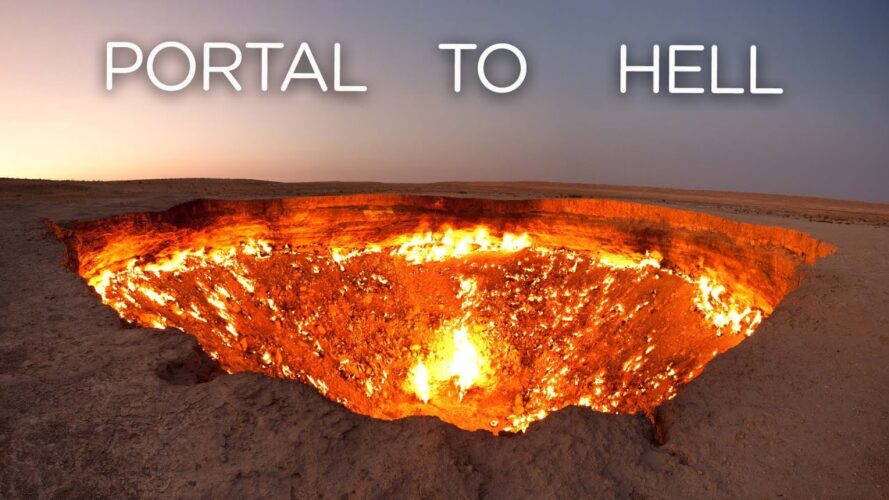
There is a hole in the ground in Turkmenistan called the Darvaza Gas Crater, but it’s better known by its nickname: The Portal To Hell. The name comes from the fact that it’s been on fire for the last 70 years. But that era may be coming to an end, so let’s take a look at one of the world’s most unique geographical oddities before it’s gone.
TRANSCRIPT:
Imagine standing in the middle of a desert, staring into a crater the size of a Little League baseball field—except instead of grass, it’s filled to the brim with thousands of fires that never go out.
This death crater has been burning at over 700° not just today, or yesterday, but every single day for the past 54 years. This flaming pit, known as the Darvaza Gas Crater, has been on fire since 1971. 100’ deep and 230’ wide, the crater could fit a Christ the Redeemer statue inside and his crown would barely graze the rim. An interesting visual, considering the crater is also known as The Gate to Hell. Seen from space, the crater looks like a fiery abyss crafted by Dante himself. At night, it blazes even brighter thanks to the methane gas pumping through it.
The crater puts out 1000 – 3000 kg of methane an hour. For comparison, your average cow burps out about 100 kg per year. So to match the crater, you’d need to stuff a herd of 87,600 cows, all burping in unison. Maybe not entirely relevant. Welcome to the internet.
If a geological inferno wasn’t grim enough, there’s another reason it’s known as the Portal to Hell— camel spiders.
Hundreds of them march across the desert each night, crawl right up to the rim, and leap to their deaths. They just yeet themselves straight in.
Now camel spiders are not technically spiders since they don’t make silk, but the giant creatures look like the stuff of nightmares. They can be as big as 6” and have jaws powerful enough to eat small lizards. There’s a myth that they chase people but the truth is they chase shadows. Just remember that when one of these is running after you.
Their scientific name literally means “those that flee from the sun.” So why would they be attracted to the fires?
Most likely? Dinner time. Camel spiders eat insects, small lizards, and scorpions. If the moths are drawn to the flame, the camel spiders are right behind them ready to eat. Maybe they’re just unaware of the danger and fall in. Or maybe they’re mesmerized by the glow, like watching a Windows ’98 screensaver for the very first time.
I’d die for you, unending maze of pipes.
Whatever the reason, the Darvaza Gas Crater—also called the Shining of Karakum—remains a mystery.
No one can say with absolute certainty how it started, though we’ll get into the theories. What we do know is that after fifty years of relentless burning… it’s finally starting to peter out.
So, what happened here?
Theories & Origins
Where did a burning pit of gas in the middle of the Turkmenistan desert come from? It’s not like these things just appear on their own, do they? According to the government of Turkmenistan – Yes. Yes they do. Don’t worry about it. Stop asking questions. La la la la la la. Turkmenistan sits snugly between Iran, Afghanistan, Uzbekistan, and the Caspian Sea.
The current government is one of the most repressive countries in existence. Reporters Without Borders ranked it 178th out of 180, right behind North Korea and Eritrea. Only one of five people there even have internet access. It’s been run by a series of dictators since 1991 and before that, it was part of the USSR for most of a century.
It’s thanks to the Soviet rule that we have zero records about how this fire started. Proof of the event are either missing, classified, or deleted. Historically the Soviets weren’t big on owning their mistakes. Chernobyl, anyone? If the State had responded faster, far fewer people would have suffered from the radioactive fallout.
So what did happen with the Darvaza Gas Crater?
Most people think engineers were drilling for oil when there was a collapse due to an underground petroleum reservoir. Toxic gases poured out, so they lit it on fire to burn harmful fumes, kind of like the controlled burns you see in the oil fields around Texas.
If you’ve ever driven through Midland, you’ve probably seen those 200’ stacks with the fires on top. It’s a common practice called flaring, which allows oil companies to burn off excess gas while drilling. It’s just that in the case of the Darvaza Gas Crater, it’s not-so-much controlled, and nobody expected it to burn this long.
If engineers were nearby during the collapse, it would have been a truly hellish death. All of a sudden the earth opens up and if you survive the fall, you would suffocate from the methane. If that isn’t enough, you’d be cooked like a pizza in a roar of flames. In that sense it truly was the Gate to Hell.
That’s one theory. Another is from some local geologists who insist the crater collapsed in the 1960s. They say no one noticed until the 80s, when it was finally set on fire to stop the gases.
It’s not impossible. The crater sits in the middle of the Karakum Desert, where the population density is one person every two and a half miles. In fact, Turkmenistan is 70% desert. Like, desert desert. The average yearly rainfall there is only three to six inches.
It raises the question: If a crater falls in the middle of the desert and no one is around to see it, will it burn?
Economy of Gas
Whether it was a natural collapse or a drilling disaster, one thing is clear: Turkmenistan depends on gas. They hold the fourth-largest natural gas reserves in the world. That’s about 9% of the planet’s supply.
Their top customers? Russia, China, and the UAE. In 2009, China funded an 1,100-mile gas pipeline straight from Turkmenistan. Another pipeline later went to Iran, and in 2018 construction began on one leading to Afghanistan, Pakistan, and India.
Gas production is the lifeblood of the country. So is oil, which hit 216,000 barrels per day in 2022.
Which brings us to a key point. If this gas reservoir has been on fire since 1971… that’s money literally going up in flames. Who’s going to pay for the giant rotating gold statue of the president? (We’ll get to that.)
Believe it or not, the Darvaza Crater isn’t the only place that’s been burning for decades.
Centralia, PA
In 1962 an abandoned mine in Centralia, Pennsylvania caught fire and it’s been smoldering ever since.
Not to be confused with the Centralia mine explosion that killed 111 men, the Centralia Mine Fire has spread underground across 3,700 acres. It has burned as deep as 300 feet. Its origin? Also a mystery. Humans have a habit of setting things on fire —uh oh— and then running away.
The mine opened in 1856 after some guys discovered top notch anthracite coal. Anthracite is the highest quality of coal with the most carbon and fewest impurities.
But the town’s history got violent fast. In 1868 the founder was murdered in his buggy by the Molly Maguires, an Irish rebel group fighting for miners’ rights. In their own way. They may have also done some light arson and attacked a priest who then put a curse on the town but who’s keeping score? Surely that wouldn’t actually lead to anything bad, would it?
Well. Then WWI rolled around. If that wasn’t bad enough, the draft took 5 million men overseas, including the mine workers.
People in bad times were ready to take advantage of the empty mines. Bootleggers stripped coal illegally, often from the very pillars holding up the mines. Safety was… not a priority. Structural collapses became common, and the town shrank.
As for how the fire started, most believe local firefighters were burning a landfill, but new flames kept popping up days after they extinguished the burn.
Another theory is that someone dumped hot ash into the landfill, igniting the coal seams below.
Either way, the flames spread because of a perfect storm of safety failures by local waste services and mining companies. The companies are supposed to build flame-resistant clay barriers between mining strips, but those in the area were known to fall behind.
For years the town lived blissfully unaware of the fire below. It wasn’t until 1979, when a gas station owner checked his fuel levels. He lowered his dipstick underground and noticed it came back hot. He then took the temp and found his oil to be 170°.
Not far from there, a 12 year old was playing in his backyard and fell into a sinkhole. Thankfully his cousin was there and helped pull him out of the sulfuric mud with a tree root. It seems that mining the Earth for it’s resources comes with with some serious cnsequences. Noxious fires, collapsing mines, climate impacts.
Do you want to wake a Balrog? Because this is how you wake a Balrog.
The USSR
The history of politics in Turkmenistan reads like a Madlib of crazy oppressors. It’s why we know so little about how the crater started. It’s also why visiting it is so hard. Government control with a splash of censorship is simply part of the rich tradition of the country. Let’s rewind. The capital of Turkmenistan is Ashgabat. It was founded in 1881 when Turkmenistan was annexed into Russia, though Russia had been using their land long before then. The Russian military would come through their port off the Caspian sea to march on what is now Uzbekistan. Before Russia, Ashgabat was mostly yurts and one story adobe homes. ‘Cuase earthquakes. But Russia began building up the area after the Trans-Caspian Railway was built … until it was flattened by an earthquake in 1948. Since then, two extremely theatrical dictators have rebuilt it into what they now call the “White City.” More on them later.
Until WWI, the Turkmen mostly just tried to carry on under Russian rule. But when Russia started conscripting the locals into their war, the Turkmen put their foot down. And so we have the Central Asian Revolt of 1916.
Th Muslim leaders said “This isn’t happening” and rebellions popped up all over Turkmenistan, Uzbekistan, and Kazakstan. But it was the empire of Russia versus indigenous tribes. They got crushed.
The numbers are sketchy because the USSR censored, well, everything, but estimates suggest 100,000 to 500,000 Central Asians were killed. There were mass executions, famine, and an exodus of people into China. At one point, Russia diverted 30,000 troops from the Eastern Front just to crush the revolt.
The Bolshevik Revolution flipped the Russian Empire upside-down in 1917, but by then the Turkmen were exhausted. “Oh, cool. Our monarchist colonizers are now socialist colonizers. Fantastic. Here comes another earthquake”
In 1924 Soviet leaders divided up Central Asia and by 1925 the Turkmen Soviet Socialist Republic was born. Under the USSR, industrialization skyrocketed. Natural resources were heavily exploited. Religion was banned. Mosques were closed. A nomadic, tribal culture was forced into a controlled, sedentary lifestyle. It was during this time the mining of natural resources put Turkmenistan as one of the leaders in petroleum and chemical production. Official government statistics from this time claim that petroleum production grew 114 times from before their Soviet rule. It tracks that digging for oil during this time might have resulted in the collapse of a reservoir. When you’re in the middle of a Cold War, fuel is kind of important.
Under Gorbachev’s reforms the TSSR began criticizing Moscow, and in 1991 Turkmenistan declared independence.
The first secretary of the Communist Party of Turkmenistan became the first President of a free, democratic Turkmenistan. Until he refused to leave, becoming the nation’s first dictator.
Dictators!
This was Saparmurat Niyazov, and boy, was he crazy.
He wrote a manifesto called the Ruhnama and made it mandatory for everyone to read.
He closed all libraries and hospitals outside of the capital.
He banned operas, ballets, circuses, and lip syncing, declaring them to be “decidedly UnTurkmen like.”
He renamed entire months after himself and his mother.
He banned car radios, calling them useless, and gave every citizen a watch with his portrait on the dial.
He abolished the word for bread and replaced it with his mother’s name, Gurbansoltan.
Naturally, he a $12 million golden statue of himself built that turns to face the sun. That’s right, it rotates.
But perhaps the cornerstone to his legacy is the national holiday he created: Melon Day. The man loved melons.
After he died in 2006 he was followed by Gurbanguly Berdimuhamedow.
Gurbanguly Berdimuhamedow— I’m just going to call him Berdie— began his illustrious political career as a
… dentist?
In 1995 he became the nation’s head of dentistry, then the Minister of Health in 1997. And 10 years later he was Turkmenistan’s hottest autocrat.
He did immediately return the months back to their original names, but his crazy would not be outdone by Niyazov.
He carried on the obsession with the color white, especially in the capital. He ordered all black cars to be impounded until owners painted them white, out of pocket.
He had a statue built of his favorite dog breed, the Central Shephard. Not his favorite dog… his favorite dog breed. But honestly? After looking up a picture of that dog, you know what? I get it. Valid. Good boy.
There were rumors of his death so he appeared on national television driving doughnuts around the crater.
But at least he kept Melon Day!
His son took over to run the family business in 2022, making Turkmenistan the first Central Asian dynasty in modern history.
And what did Serdar Berdimuhamedow do? He immediately appointed his father the Chairman of the People’s Council of Turkmenistan.
These leaders have created one of the most eccentric countries. Sure, the people have limited internet access, but they also have the world’s largest indoor ferris wheel, the densest collection of dinosaur footprints, and Dead Goat Polo.
The correct name for Dead Goat Polo is Buzkashi. It’s sport where riders on horseback compete over a dead goat. (Dead Goat Polo.) One travel account described the match ending when the victor slung the goat over his motorcycle and rode off into the sunset. Why haven’t the Olympics picked this up?
So really, is it any surprise that a crater called the Gate to Hell has been burning in their desert for 50 years?
It’s Turkmenistan, baby.
Tourism to the Gates of Hell
Between the hundreds of miles of desert, the political megalomaniacs, and the guard spiders with a death wish… it’s pretty hard to visit the crater. The country could not care less about tourism. Word is that Serdar may be trying to change that, but as of now Turkmenistan is still stingy with visas. You must submit a detailed itinerary, and travel at all times under the mandatory supervision of a guide.
Most who do visit come through a Transit visa from the neighboring country of Uzbekistan. If you do get to go, the best times are during the cooler months of October through April.
At one point Niyazov did start to develop a National Tourist Zone, which is how they ended up with the world’s largest indoor ferris wheel, but it was abandoned and the area is off-limits to tourists. I like to think Garbunguly and Serdar take a dictator’s day off and ride it together from time to time. Sort of a Father/Son moment.
Hell is Closing
If you want to go, act fast. After half a century, the Portal to Hell is starting to peter out.
And it’s not by accident. In 2022, Berdie announced plans to extinguish the crater. In an effort to reduce methane emissions and recapture valuable gas, Turkmenistan finally appears to be taking action.
In 2025, Irina Luryeva of the state-owned energy company Turkmengaz reported the flames have diminished by three times. Traveler photos and satellite images confirm the fires are now significantly smaller.
They’ve done this by reopening mothballed wells. “Mothballing” refers to deactivating a well but preserving it to use again in the future. So by mothballing wells around the crater they have been able to redirect the stream of methane so it doesn’t even reach the crater.
Has anyone tried putting a big cup over it? Just asking.
Extremophiles
There are other scientific perks to closing the crater. Organisms known as extremophiles have been found in the soil—microbes like bacteria that love extreme heat. Studying them gives researchers a look into how life adapts and evolves in environments that would normally kill everything.
How did researchers collect the soil? The same way anyone would: by dropping a Canadian wrapped like a baked potato into the fire.
In 2013 George Kourounis became the first and only person to visit the floor of the crater. George is a scientist, a television presenter, a bit of a daredevil, and in general, a storm chasing badass. Some of his titles on Wikipedia are pretty epic.
After years of preparation, George donned a Kevlar suit, strapped on a firefighter’s breathing tank, and used heat-resistant ropes to lower himself into the world’s hottest zipline.
He described the scene as a coliseum of fire.
“Everywhere you look it’s thousands of these small fires. The sound was like that of a jet engine, this roaring, high-pressure, gas-burning sound. And there was no smoke. It burns very cleanly so there’s nothing to obscure your view. You can just see every lick of flame.”
Once he was at the bottom, at temperatures around 750°, he collected soil samples. What he found helped scientists discover extremophiles not yet recorded in the DNA database. These included thermophiles and chemotrophs, in particular microbes that metabolize methane.
Complex organisms generally don’t survive inside a flaming pit of methane, but extremophiles don’t just survive… they thrive. Studying them can actually help us understand the origins of life on Earth.
For example some scientists believe life may have begun with extremophiles near hydrothermal vents far below the ocean’s surface.
Microbes found in Antarctica that feed on air show similar genetic adaptations to those in other cold deserts. Extremophiles like these entertain the possibility of microbial life on other planets. They can argue for the theory of panspermia—the idea that life might hitch a ride across the universe on cosmic dust. If bacteria can survive three years in the vacuum of space, who’s to say life didn’t start somewhere else and land here by meteor?
Beyond astrobiology, extremophiles also play a role in bioremediation, using biological processes to clean up pollutants. Some organisms absorb and metabolize harmful materials, helping ecosystems recover. Usually from messes humans created, like the Deepwater Horizon oil spill. There is actually bacteria feeding off the methane from the crushing depth of 3,600’ below the ocean’s surface.
Life… uh… finds a way.

Add comment