
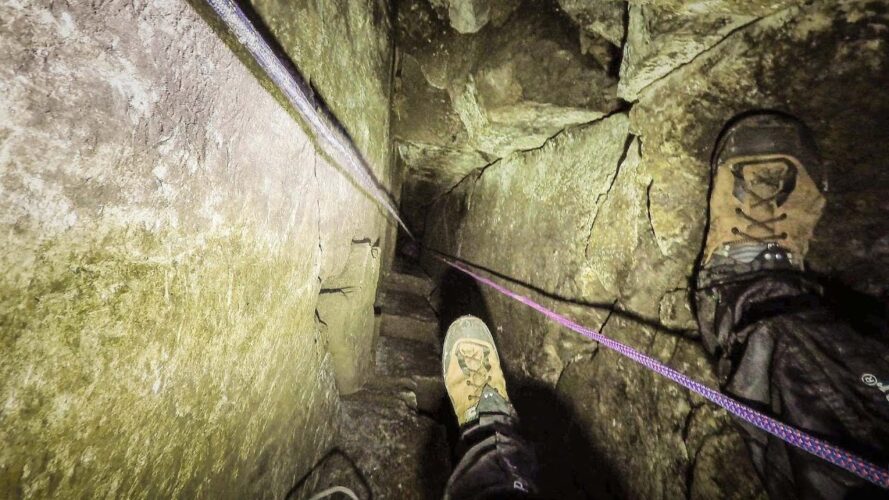
The Khara-Hora shaft in Russia is one of the most mysterious rock formations ever found, and has become something of an internet mystery. Depending on who you ask, it could have been built by an unknown ancient civilization (who may still be at the bottom of it), or it could be a secret superweapon from World War II. Or… It might just be a weird natural formation. We look at all the theories in today’s video.
TRANSCRIPT:
In 2011, a Russian speleologist named Arthur Zhemukhov was exploring the rugged slopes of Khara-Hora, a mountain high in the North Caucasus Mountains.
The region is wild country, full of glacier-carved valleys, jagged outcroppings, and weather-beaten cliffs.
It’s a place that would be good at keeping its secrets, if it had secrets to keep.
Zhemukhov found out that it did.
He discovered a hole in the mountainside that led to a deep shaft.
Reports describe it like something out of Indiana Jones: a hidden passage with unnaturally straight and cold air swirling up from below.Zhemukhov got a team together and rappelled down the shaft.
They thought it might be a lava tube or some other geological feature at first.
But as they continued past the smooth, parallel walls to a depth of forty meters, or about 130 feet, they became convinced they were seeing something man-made.
This was huge.
Zhemukhov had discovered an artificial structure — an underground building made of megalithic blocks that sat so close together, not even a knife could slip between them.
The scale of the place brought to mind the pyramids.
So did the discovery’s implications.
It would have taken a highly advanced civilization to build the Khara-Hora shaft and its surroundings.
Learning who this civilization was and what happened to them was sure to keep scientists busy for a lifetime.
And yet, it didn’t.
Outside of a few Russian news shows and several conspiracy websites, Arthur Zhemukhov is a total unknown.
His life is so poorly documented online that for much of the research for this video, I thought he was made up.
I don’t think that anymore because of pictures like this.
Zhemukhov was loved and admired by people who knew him.
This is a friend of his, Viktor Kotlyarov, at his grave.
I’ll talk more about his death later.
For now, I’ll just mention that according to the blog post that features this photo, Zhemukhov wrote extensively about the Khara-Hora find.
His diary is lost media, as you can see by following the link below and checking for non-existent archives.
That’s weird, right?
There are a couple ways to look at this.
Maybe the diaries weren’t interesting enough to preserve.
Or maybe they were interesting to somebody who didn’t want them to be read.
It leaves us wondering exactly what Zhemukhov found that might be a threat to people in power.
According to Kotlyarov, it was an underground city with tunnels stretching 45 miles to Mt Elbrus, the highest mountain in Europe.
I’m skeptical about that claim, but something is clearly inside that mountain.
Let’s get back to our story.
We haven’t talked about the Nazis yet!
But first things first.
Let’s talk about the setting of our tale.
The Greater Caucasus Mountains are part of the Caucasus region that sits on the border of Russia, Georgia, and Azerbaijan.
Khara Khora, sometimes called Khara-Hora or Kharakhor, is a group of connected mountain peaks just Northwest of the Greater Caucasus’s mid-point.
The peaks are in a Russian Republic called Kabardino-Balkaria.
“Balkar” is another word for the Turkic people, who are mostly Muslims, which is why Zhemukhov’s gravestone features the star and crescent.
Much of Kabardino-Balkaria is rough, craggy, and heavily forested.
The roughness and cragginess are due to its origin as layers of seabed that got shoved upward by a collision of tectonic plates.
Glaciers later carved out its valleys, adding to the overall ruggedness.
If you’re wondering what Khara Khora means, the name translates to something like Dog-Boar.
That sounds pretty metal and is probably a holdover from a time when one of the peaks resembled those animals.
Erosion has since made it hard to see.
Now here’s where this rock talk gets interesting.
The Khara Khora area is mostly made up of volcanic and metamorphic stone: tuff, schist, limestone, with some granite intrusions.
These tend to break along straight lines as they cool and shift, which can give them an engineered appearance.
There’s also a process involving chemical weathering that can erode stone into large, blocky shapes called corestones.
I’m not saying that’s all this shaft business is about.
It’s just, you know, something to keep in mind.
Alright.
We now come to the post-discovery story.
We’re still not to Nazis, sorry, but I swear we’ll get to that.
There are two other important names I’m going to mention aside from Arthur Zhemukhov and Viktor Kotlyarov.
These are Vadim Chernobrov and Alexander Sploshnov.
These Russian names are kind of a lot so from now on I’m going to call them Arthur, Viktor, Vadim, and Alexander.
Vadim is – or was – a really fascinating guy.
He was the founder of Kosmopoisk, a group of science professionals and hobbyists who like to visit mystery sites, chase UFOs, and explore crop circles.
I’ve got the Woo Woo alarm ready but to be fair, Kosmopoisk mounted some cool expeditions over the years.
Between 1980 and 2016, they visited the Tunguska meteorite site, searched Mount Ararat for traces of Noah’s Ark, and conducted an investigation at Lake Brosno.
That last one was about finding a Nessie-like monster.
Kosmopoisk concluded it was gas bubbles in the lake, which viewers of this channel will know is not good news.
Anyway, those trips are the tip of the iceberg.
The group made many more before Chernobrov died in 2017.
Once again, that death is worth talking about…stick a pin in it for now.
Chernobrov led a team to the Khara-Hora Shaft sometime after the 2011 discovery.
Strangely, it’s not mentioned on the Kosmopoisk website, which covers expeditions in the period from January 2011 to March 2018.
Chernobrov was gone before the final update, so if Kosmopoisk supported the Khara-Hora trip, they’ve stopped talking about it.
Who is talking about it?
A YouTuber, of course.
Gotta love those guys.
Specifically, the key source for everything I’ve mentioned, and most of what’s left, is a video from a faceless YouTube channel called the Universe Inside You.
It’s…interesting…to say the least.
One thing you may notice about the video is the narrator’s voice.
It’s AI generate.
For proof, look no further than how it reads this number.
Yeah.
That is not how a human being would handle that sentence.
Now, let me be clear.
There are plenty of creators who use AI voices to tell true stories.
My friend Ben Sullins used to put out a podcast like that.
But the AI voice in this video makes me wonder what else in it was given a bit of finesse.
There are definite indications that the whole thing has been Frankensteined together from a bunch of different parts.
And some of those parts have been altered, in ways that make me suspish, suspish…bleh!
Sorry about that.
Where were we?
Right. Vadim Chernobrov.
One of the things the Universe Inside You video is definitely right about is Vadim’s taking part in a Khara-Hora Shaft investigation.
We don’t have to depend on the Universe Inside You footage to confirm this. [repeat clip]
…which is for the best.
Here’s an interview with Vadim that seems to be from a Kalbardino-Balkarian news affiliate.
He mentions the shaft descent, the smooth walls, and a large underground hall his team visited.
Interestingly, the reporter that comes on after Vadim mentions Kosmopoisk’s activities, despite this one being absent from their records.
Quick aside here.
It’s possible that Kosmopoisk doesn’t mention the expedition because they didn’t fund it.
Universe Inside You said Vadim made the trip for a news program.
It also says he made it with Arthur, but there’s no independent evidence of that.
After figuring out the key video source was…eh…I tried to find where its footage came from.
One possibility is a show hosted by Anna Chapman.
She’s a spy.
Born Anna Vasilyevna Kushchenko, she also a model and all-around media personality.
Oh! And she holds a master of economics.
Good for her.
Circa 2010, Anna was accused of being part of a Russian spy ring.
She pleaded guilty to conspiracy and was deported from the US to to Russia after Britain, the country of her ex-husband, refused her entry.
The return home came with celebrity status that she spun into a TV show.
Secrets of the World with Anna Chapman definitely featured a segment on Arthur Zhemokhov.
It would make sense if Vadim Chernobrov also appeared on an episode or two.
I can’t find clips or any other evidence to say that happened, but I can explain why I went down this path.
See the logo in the top right of this shot?
It looks like PEH in English.
In Russian, it’s REN.
REN TV is Anna Chapman’s network.
The footage on her show could feature a logo like that.
Only…hey, is it just me, or does that H look a little off?
We’ll get back to that.
In addition to confirming some of Arthur’s discoveries, Vadim made or at least showed off a map of the Khara-Hora Shaft to yet another news segment.
It shows the shaft and hall and a number of branching tunnels.
In the earlier clip I showed, Vadim mentioned that some branches were too small to get through, so they may have had a technological function, like ventilation.
That bit at the top of the map?
It says Ancient Cave in the Caucusus.
Skeptic that I am, I searched for other caves with a layout like this and though some are similar, none really fit.
It seems this really is the Khara-Hora Shaft explored by Arthur, Viktor, Vadim…and Alexander.
Let’s talk about him.
Alexander Sploshnov’s name is all over the Universe Inside You video because his Khara-Hora photos are the most recent.
They come from his social media, which highlights his 3D art and interest in caving.
Alexander has a connection to Kosmopoisk, too, as his YouTube channel has videos of their events.
One of his channels, I should say.
His other one is mostly for 3D art.
It features a killer showreel that dates to before the pics.
Wow. Is there anything this guy can’t make on a computer?
At this point in the video you can probably guess where I’m going to come down on all the weirdness in the Khara-Hora story.
There are red flags all over.
The Woo Woo Alarm is on a hair trigger.
So it may surprise you to learn that this next part — the Nazi part — is actually pretty credible.
Remember our old friend Viktor?
Here he is standing at a spot near the shaft entrance and next to a familiar symbol.
Viktor credits the discover of this swastika to Arthur.
There’s a date carved under it on the rock.
That date is 28.X.42 or October 28, 1942, about three years after the start of World War 2.
That date is significant as the German army was in the Caucusus at the time.
On the next day, October 29, they captured the city of Nalchik, about an hour’s drive away from the Khara Khora peaks.
There were military reasons for the Germans to want the Caucuses, but history suggests some of their officers had an ulterior motive.
They wanted to find the entrance to an underground city that fellow nutjobs had tried and failed to find in Tibet.
This place was supposed to be the Garden of Eden for Hitler’s Master Race.
Would it shock you to learn they culturally appropriated the name?
“Shambhala” is sort of Buddhist paradise.
The Nazis stole it to describe a fictional homeland for white people.
I want to pause here to say that the Nazi obsession with the occult has been exaggerated by Hollywood…but it is a thing.
Heinrich Himmler — the architect of the Holocaust and therefore one of the few people in history who may actually have been worse than Hitler —was super spooky, even for an SS man.
He founded a Nazi bureau that mixed mythology with archaeology and that was called Ahnenerbe.
That means “ancestral heritage” which gives you a clue what it was about.
To understand why the Caucususes was an area of interest for these nutjobs, just look at name?
There’s an old and not very accurate idea the “white race” came from the Caucuses Mountains.
That’s why some pale-skinned people are called Caucasians.
It’s actually a terrible name as there’s not a single origin for the “white” phenotype.
There’s not a single, scientific origin for any set of traits that people use to draw tribal boundaries at this point in history.
I mean, OK, Conan O’Brien is 100% Irish, but other than him…
Anyway, one of many crackpot theories held by Himmler and his buddies was about Shambhala, a high-tech city where their Aryan ancestors hung out.
It was lost, some said.
Others said buried, which is why a shaft on Khara Khora would have been something they got excited about.
And then—
You know, I’m going to let this guy explain it.
Is that Mickey Rooney?
Long story short.
The Nazis were in the Caucuses in October 1942.
They may have stopped at Khara Khora and if they didn’t make the same discovery as Arthur Zhemukhov, they may have been close.
That is kind of a lot to hang on a single swastika carving.
But it’s not impossible, considering what we know about the very crazy people involved.
But what about the folks who are crazy — like a fox?
An interesting theory from Reddit is that it wasn’t the Nazis who carved that swastika, but Soviets looking to plant a false flag.
If this is true, it means the Khara-Hora structure isn’t ancient at all but a relic of the 1960s.
Reddit user longpickle claims to have met an ex-soldier who visited some huge Soviet engineering projects from back then.
A dig into Khara Khora would have provided a chance to test out ventilation systems, install seismic research tools, or safe store weapons materials.
This was the Cold War era, after all, and Soviets of the time did a lot of digging around.
Take, for example, their work at the Balaklava Submarine Base.
This is an entire underground military base carved out of a Crimean mountain that hid from NATO satellites until the 1990s.
The city of Moscow also hid an underground megastructure.
Called Bunker-42, it was a 65-meter-deep command post built under Taganka Hill.
There were elevators, airlocks, an independent power grid — all built below ground.
An even closer comparison to Khara-Hora might be found in the bunkers built under Tsibisi, Georgia.
They’re networked together into a what’s practically a underground city.
Tsibisi is in Southern Caucuses, btw.
I could go on, but the point is, Mother Russia buried a lot more than missile silos.
Digging into Khara Khora would have been par for the course for them.
There are no Soviet records of a massive digging project in Kabardino-Balkaria, and no matching design plans, but who knows what projects might have been attempted and abandoned in those heady, Cold War days?
Speaking of heady, another idea about who gave the Khara-Hora the shaft is part of wider theory — the Solar-Induced Dark Age.
Its adherents claim that a massive solar event forced humanity to retreat from Earth’s surface tens of thousands of years ago.
They build networks of underground cities, of which Khara-Hora’s hall and tunnels are merely a sample.
There’s a grain of truth hiding in this loaf of woo.
Solar activity can disrupt the climate.
Scientists have linked big solar flares to temporary cooling periods on Earth, like the Maunder Minimum in the 1600s.
That is a long way from saying the Sun scorched the world and drove cavemen into Hades.
Scientists have found no evidence the Solar-Induced Dark Age happened.
At least, not any evidence the mainstream media will let out!
I’m joking, of course.
The mainstream media is too busy faking bird footage to vet other stories.
Is that dank? Is dank dank?
And now I invite you to buckle up.
If you thought a subsurface shelter from solar storms was a strain on sensible speculation, you’re about to see some…stuff.
There are people who think the Khara-Hora Shaft might have been part of a planetary weapon.
This is mainly from Dr. Joseph P. Farrell, a writer best known for his book The Giza Death Star.
My fellow Joe argues that the Great Pyramid of Giza was built as a kind of resonance machine to focus planetary energy.
A hundred-meter shaft like the one at Khora-Hora Shaft be part of a similar mechanism.
Specifically, it could function like a QUOTE “large pipe in a pipe organ” UNQUOTE.
Played correctly, it could produce infrasound, which can be weaponized, as I’ve covered before.
If this theory is true than Arthur’s discovery of the shaft at is even more important than we thought.
Important to the Rebellion, I mean.
Where else is Red Squadron supposed to target their missiles?
If it felt like I rushed through that last segment, it’s because I did.
I promised earlier that we’d get talk about Nazis — check!
Now it’s time to get back to the other topic I promised to revisit, the deaths of the late, lamented explorers, Arthur and Vadim.
Arthur’s story ends suddenly.
In 2015, he was struck by a car while walking at night.
He was reportedly a bit drunk, having spent a few hours hanging at a pub with some friends.
Viktor — remember him? — reports that his waitress found him unusually cheerful, unable to sit still.
Viktor also says Arthur called him to report news of an incredible discovery that he would soon reveal.
Exactly what the discovery was is a mystery, due in part to the loss of Arthur’s online diaries.
At 12:15 AM on June 2, 2015, Arthur Zhemukhov’s life was ended by a light-duty truck on the road outside Islamey, a local village.
Why he was on foot at this hour is unknown.
He got a lift from friends earlier in the evening but left them to meet destiny alone.
Or did he?
If Arthur made a new discovery about the Khara-Hora Shaft or its connecting tunnels…
If he told friends, colleagues, or acquaintances what he found…
If he published a new entry to his diary that would be gibberish to most but handwriting on the wall to someone trying to keep a secret…
I don’t know how to end that sentence except to say that maybe he wasn’t alone in those crucial minutes before the end.
Maybe he was with someone who put him into the path of that truck.
Nothing of the kind happened to Vadim Chernobrov, the head of Kosmopoisk.
The science-adventurer, somebody I can’t help but relate too, especially as he died at about my age, died under sadly normal circumstances.
Russia’s answer to Fox Mulder — or Frohike, at least — lost a fight against cancer in 2017 at 51.
I haven’t found any medical timeline linking his illness to a Khara Khora visit.
That said, all the events in our story happened in a seven-year window.
Excluding Anna Chapman’s criminal past, that is.
Were the deaths of these men in such close proximity a coincidence, or were they victims of a curse?
Hydra would be behind their assassinations in Marvel comics, since they inherited from the Nazis.
A spy novel might put the blame on ex-KGB.
In the real world their deaths are a tragedy just because they’re deaths.
There’s no need to go searching for a complicated explanation.
Mind you, based of what we know about their personalities, Arthur and Vadim probably would have.
The reason I stick it out with these stories is the people involved.
Their belief is persuasive.
Even if I don’t believe the same thing, I’m moved to reconsider my point of view.
Over the course of researching Khara-Hora I’ve gone from thinking it was little more than a fantasy, a Frankenstory that got pushed to YouTube, then the forums, with nothing but a few threads of truth to stitch it together.
At that point I was prepared to dismiss Arthur Zhemukhov as made-up and to say Vadim Chernobrov’s celebrity was being abused.
There was a even moment when I looked at Alexander Sploshnov’s 3D art and thought, “I get it. He faked those pictures!”
It was then I saw Viktor Kotlyarov at his friend’s grave.
”Arthur, whose heart remained in the mountains” is the title of his memorial blog entry.
It’s sad and mournful and understated in a way that reads to me as genuine.
Heart, it turns out, is what makes even the craziest stories worth considering.
Now, is there validity to the claims of these enthusiastic seekers of Capital-T Truth — Arthur, Viktor, Vadim, and Alexander — have made?
It’s fairly easy to dismiss all they observed and recorded under Khara Khora as natural phenomena.
This is the Devil’s Tower in Wyoming.
It’s a bizarrely regular trapezoid of volcanic rock.
Those columns all along the side? They were formed by a process called columnar jointing.
Here’s a straight quote from nps.gov:
“As the molten rock cools from a liquid to a solid form, it begins to contract. This contraction stresses the cooling rock which begins to crack. Cracks radiate out from stress points, forming hexagonal (6-sided) shapes.”
I don’t know about you, but I find that pretty easy to picture.
You’ve got a blob of molten rock, the rock cools, it pulls in. [hugs arms to side]
The molten rock wants to be a circle because everything liquid wants to ooze evenly, but the solidifying of the rock makes straight cracks.
Result: you’ve got a circle with flat sides, like a hexagon.
Devil’s Tower is a lava core, which is different from Khara Khora’s lava tuff.
But the principle is similar: stress, cracking, and gravity carve out large, more-or-less flat blocks.
Chemical weathering plays a part, like I mentioned earlier.
Even simple erosion can cause pressure on underlying rock to decrease.
This makes the rock expand, causing it to crack into slabs.
Similar so-called megalithic rocks are thought to be caused by a combination of erosion and tectonic fracturing.
But not exclusively.
Each rock formation is different and there are many conditions that give them their shapes.
I think what happens when people look at formations like the Devil’s Tower and Khara-Hora is they imagine a much cleaner process than happens in nature.
Nature is chaotic.
Sometimes that chaos looks swirly or jagged.
Sometimes it looks like stacks of even blocks.
But don’t be fooled!
The blocks are chaotic, too.
The Khara-Hora Shaft is far from the first a strange rock formation people have sworn was manmade.
There’s an example not a million miles away from me, in Rockwall, Texas.
The city is named for its most famous feature, a mysterious wall of stone unearthed in the 1850s.
It was discovered piece by piece by farmers digging wells and plowing fields.
Every so often, a huge block of sandstone would show up.
Pretty soon, people started to wonder why they stacked in neat rows.
The effect is pretty convincing.
Rockwall’s rock wall looks just like a rock wall.
So for decades, the questioned everybody asked was, who built it?
the Caddo were an obvious choice. They were mound builders who likely held exposed portions of the wall in awe. But the Caddo weren’t its architects.
Modern geologists say nobody was.
The rock wall is a natural formation — the product of iron-rich sandstone cracking and fusing as groundwater and tectonic pressure worked on it for millions of years.
Blocky chaos, in other words.
It all goes to show that Mother Nature, for all her virtues, is a filthy liar.
That’s a good thing to keep in mind the next time you go looking for a lost, ancient world.



Add comment