
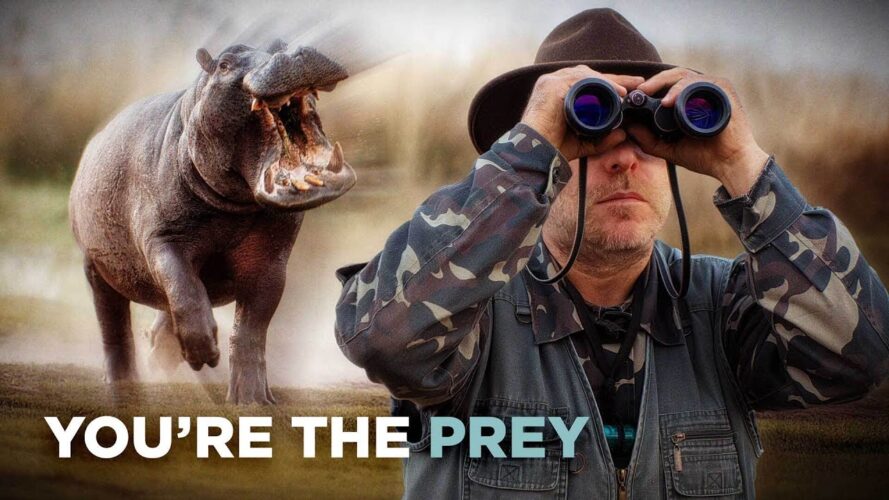
When hunting big game, sometimes you get Mother Nature, sometimes she gets you. These are the deadliest animals to hunt, and why they are such a risk to hunters.
TRANSCRIPT:
Last year, a man from Dallas named Asher Watkins was run down and killed by a Cape buffalo in South Africa’s Limpopo province. Cape buffalo can weigh up to 2,000 pounds and sprint at speeds of 35 miles per hour. Mean as hell and usually coated in mud, they’re often called Black Death.
Asher Watkins was pronounced dead at the scene. He never stood a chance.
The safari company leading his trip described the attack as “sudden and unprovoked.”
Sudden? Sure.
Unprovoked? Well… Asher was actively stalking the animal on a hunting trip.
And while his death is tragic, there’s an uncomfortable sense of irony here. Imagine paying tens of thousands of dollars to fly halfway across the world, only to be trampled by the very animal you were trying to kill. Nature is brutal.
Big game hunting is a massive industry. According to a 2022 national hunting survey, U.S. hunters spent $45.2 billion on gear, licenses, and travel. Companies that lead these excursions, and the governments they partner with, argue that the practice has real benefits.
For example The President of Botswana has said that big game hunting is part of sustainable tourism. Safaris employ local guides, license fees fund conservation efforts, and a large portion of the meat is distributed to nearby villages. In theory, it reduces human–wildlife conflict and helps people coexist with animals that could otherwise cause problems for a community.
Groups against trophy hunting call bullshit. National Geographic argues that killing animals in the name of conservation is counterintuitive. They claim it hasn’t slowed poaching, that villagers rarely see the money supposedly trickling down from license fees, and that the industry employs far fewer locals than it advertises.
The truth is trying to find objective data is difficult. Almost every source comes with a bias. Articles tend to come either from animal rights activists or from pro-hunting organizations, which are often very well funded by real estate developers, finance bros, and, well… middle-aged white guys with a lot of money and excellent lawyers.
But no matter where you land on the ethics, one thing is undeniable. Some animals are determined to survive. You hunt them—they hunt you back.
Take the Big Five. That name refers to Africa’s most dangerous animals to hunt and still walk away to tell the tale: lions, leopards, rhinos, elephants, and our old friend, the Cape buffalo.
So yes, there are many opinions around the ethics of big game hunting, I’m sure you guys will share them in the comments but for this video we’re going to focus on animals that will make you think twice about hunting them.
It’s a tier video, folks! Today we’re ranking the most dangerous animals to hunt. ** And if you’ve never paid thousands of dollars to kill an animal for sport, you might not realize this: big game hunting isn’t just expensive—it can be lethal. For the hunter, too.
People routinely drop tens of thousands of dollars traveling to distant countries to shoot exotic game. Companies that brand themselves as “consultants” or “luxury hunting experiences” will happily charge you painful sums to guide you to the kill. You can pay as much as you want for an experience as cushy as you want.
But no matter how bougie the lodge, at some point you’re out there in the brush, face to face with a wild animal that has spent millions of years evolving to not die.
Our first animal, which might surprise you with just how hard it fights back, is the wild boar.
Take a look at these teeth. A wild boar’s tusks grow continuously, but they stay sharp by grinding against each other. In some species, though, things get a little intense. Certain wild pigs can grow tusks so long they curve back and penetrate their own skull. This is the Babirusa, and while that fate isn’t super common, it is hardcore.
Wild boars are notoriously aggressive and will absolutely turn on a hunter if they feel threatened. And if Pumba decides he’s had enough, a boar can hit speeds of up to 30 miles per hour. For reference, Usain Bolt topped out at 27.78 mph. So unless you’re an Olympic sprinter with a head start, you’re not winning that race.
Another reason these pigs are so nasty is their hide. Beneath all that bristly fur is a thick layer of skin, cartilage, and gristle—especially across the chest, where years of fighting have created a natural armor plate.
Oh, and they’re smart. Wild boars have been known to circle humans and attack from behind. So it’s not hakuna matata. It’s matata. Much matata.
Wild boars are responsible for around 20 human deaths per year. So if you ever find yourself being chased by one, here’s your survival tip: climb the nearest tree. Because if evolution has taught us anything, it’s that pigs are fast, but still not great at climbing.
But climbing a tree won’t save you from the next animal on our list: the grizzly bear. Hunts for these bears average around $20,000, and odds are you’ll be heading to Alaska to find one.
With easier access to high-protein food, Alaskan grizzlies are significantly larger than their cousins farther inland. A steady diet of fatty salmon means they can weigh up to 1,200 pounds
Compare that to Yellowstone grizzlies, which usually fall between 400–700 pounds. Those bears survive mostly on moths, nuts, and roots. And they leaner and meaner for it.
Those are just the males. Females are smaller, about half that size, yet they account for roughly 70% of human deaths involving grizzlies. Why? Because hell hath no fury like a mother bear who thinks you’re a threat to her cubs.
Most grizzlies are solitary creatures. Think Clint Eastwood: “Get off my lawn.” Though they are apex predators, their strong preference for being left alone means they’re responsible for only about 100 human deaths per year. If startled, they’re more likely to run than fight—but if you shoot one and it survives, you’re about to find out just what an angry bear is capable of.
Grizzlies can sprint up to 35 miles per hour. Their claws measure 2 to 4 inches long, and their bite force is strong enough to crush a bowling ball.
And did I mention they can climb trees?
Legend tells of a notorious man-killier known as Old Mose. In the early 1900s, Old Mose enjoyed a 20 year reign of terror in the mountains of Colorado. He developed a taste for cattle and was famously clever, able to puzzle through every barrier or fence ranchers built to keep him out. Newspapers of the time credited him with the deaths of around 800 cattle.
Old Mose was also blamed for killing five men between 1883 and 1904. While it’s unlikely all those deaths were caused by the same bear, that didn’t stop his reputation from growing into full blown legend. After years of failed attempts, two hunters finally killed him in 1904. His death was celebrated far and wide. His pelt sits pelt sits at the University of California, and a statue commemorating the killer bear lives at Adams State University .
The next animal on our list brings us back to the Cape buffalo, aka Black Death. Aka Dagga Boys. Which honestly sounds like a pretty metal biker gang.
Dagga is Zulu for mud, and these old buffalo are often found caked in the stuff. But this title isn’t given to just any bull. Dagga Boy status is reserved for the grizzled bulls— the old farts who’ve been kicked out of the herd and now spend their days wallowing in watering holes, glaring at anyone who dares make eye contact. And like most things in nature, the older they get, the grumpier they become.
What makes Cape buffalo so dangerous is their temperament. They are notoriously mean and have been known to attack seemingly out of nowhere, even circling behind a hunting party once they perceive a threat. Unlike a rhino, which might snort or scrape its horn, or an elephant that flaps its ears as a warning, a Cape buffalo offers no signal. It goes from “eff around” to “find out” in a matter of seconds.
When they charge, they can run up to 35 miles per hour, all while swinging horns made for murder. Built like a tank, a full grown bull can weigh close to 2,000 pounds. The Black Death are responsible for an estimated 200 human deaths per year.
Mean, unpredictable, and coated their own poop, a Cape buffalo looks at you like you owe it money. With interest. If a hunter doesn’t drop the buffalo with the first shot, they’d better be ready to run like hell.
The next animal on our list is another member of Africa’s Big Five: the lion. Compared to a buffalo, a lion might actually be easier to stop with a bullet—but that’s not the part that should make you nervous. Speed is.
Bullets have been found embedded in the thick hide of a buffalo. With a lion, you might not even get the chance to take a shot.
Clocking in at up to 50 miles per hour, a lion can close the distance between “over there” and “oh no” in the blink of an eye.
Here’s an example of hunters trying to draw a lion out using their guide’s expert strategy… throwing sticks at it. The first stick does absolutely nothing. Then he upgrades to a rock. Success.
But can we pause for a second? The lion explodes out of the bushes, the hunter raises his rifle… and the local guides are completely unarmed. Their entire survival plan seems to be “We really hope this guy can aim.” I don’t know what a bad day at work looks like for them, but I don’t think it involves too many emails.
Not only are they crazy fast, they can jump as high as 12 feet and as far at 36. That’s about the length of an average telephone pole.
And they have the strength to pull down a giraffe, while running. I think if I ran, leapt, and tried to pull down a giraffe things would go differently. But I haven’t tried it so maybe?
As for hunting lions, it’s largely done for trophies. From a conservation standpoint, their numbers have dropped dramatically—from around 200,000 lions a century ago to about 25,000 today. Even so, they’re still called the King of Beasts for a reason.
Lions are hypercarnivores, meaning over 70% of their diet is meat, and if given the opportunity, they will eat a human without hesitation. If you ever encounter one, the best advice is not to run. Running triggers their instinct to chase, and you will lose that race immediately.
Lions have been known to pull people out of their huts in local villages at night, and are responsible 250 deaths of humans per year.
This one is big. Really big. Tipping the scales at up to 24,000 pounds, the African elephant is the largest land mammal on Earth. Adult males usually weigh between 10,000 and 15,000 pounds and can stand about 12 feet tall, while females are roughly half that size.
The sheer size of them make elephants a mouthwatering trophy for big game hunters, but this creature is one of the smartest on the planet. We even made a video about it 5 years ago.
In it, we talked about how elephants can recognize different human groups by their voices alone. Researchers found that elephants reacted much more defensively to the Maasai tribe who traditionally hunt them than to the another tribe, who do not. Even more impressive? Within the Maasai, elephants treated women and children as non-threats, reacting strongly only to the men who actually hunt. That’s not instinct. That’s discernment.
Elephant intelligence is so well documented that it has its own Wikipedia page. They can learn to use paintbrushes and create art. When a calf dies, the mother is known to lag behind the herd for days, making their own sounds of weeping. Elephants will gather around their dead, touching the body with their trunks, standing quietly, and investigating as if trying to understand what happened. In short, they mourn.
And somehow, despite weighing as much as 3 or 4 cars, elephants can move with shocking stealth. Hunters have reported elephants slipping through dense brush without snapping a twig. How? Their feet are packed with extra padding that acts like built-in shock absorbers, like 12’ tall ninjas.
That said, elephants are emotional animals, and when they get mad things can escalate quickly. Theunis Botha of South Africa was crushed to death when a charging elephant picked him up with her trunk. The hunting party shot and killed the animal, and he was crushed under her. Jose Monzalvez was hunting in Namibia when a stampede of elephants trampled him as they charged through his hunting party. From what we know about their discernment for hunters we have to ask, were they startled or were they making the first move to protect themselves?
There’s no shortage of videos showing elephants charging at hunting parties, though in most cases it doesn’t end well for the elephant. Proceed with caution.
It may be worth mentioning the meat from these hunts goes to local villagers.
Which brings us to our A-Tier animal. Not a mammal, but it earned its spot through sheer, unapologetic murder stats: the crocodile.
You can’t ignore what is essentially a present-day dinosaur. Evolution reached these giant death lizards and said f*ck it. No updates. No notes.
Crocodiles kill an average of 1000 humans per year. Not all of those deaths involve hunting, but every day the croc wakes up it chooses violence.
Their favorite strategy is to wait silently in a river or lake, then ambush its prey as it approaches the water for a drink. They can hold their breath for 2 hours, and for a 1600 lb lizard, they move shockingly fast. In a short burst, they’ll snatch their target and drag it into the water to drown it.
But once a crocodile gets its jaws on you, it’s game over. Their bite force is estimated at 5,000 pounds per square inch. Remember how a grizzly bear can crush a bowling ball with its bite? That’s about 1,200 psi. A lion? Around 650 psi. A croc literally has the jaws of death.
And here’s a fun fact: crocodiles can gallop. Like a horse. Yep! For an animal that looks like it should only crawl, imagine that coming at you.
One notable death occurred in 2017, when professional hunter Scott van Zyl went missing in Limpopo, South Africa. That’s the same region where Asher Watkins was killed by a Cape buffalo. Van Zyl ran SS Pro Safaris and was hunting for crocodiles with another guide when the two split up. His dogs later returned without him. Authorities matched his DNA to the remains found in the bellies of three crocodiles.
And finally, the S Tier. The most dangerous land mammal to hunt, responsible for more deaths than the lions, and tigers and bears combined… the hippo.
Hippos are highly aggressive and very territorial. They may look massive and slow with adorable Shrek ears, but don’t be fooled. When they’re triggered they can move with shocking speed and agility. Their bite alone is the stuff of nightmares. Their jaws unhinge to 150 degrees and can snap them shut with a force of nearly 2000 psi. They have been known to bite a crocodile in half! Their lower tusks can grow up to 20” long and grind against each other constantly like a whetstone. The edges are not as dull as they look.
Hippos kill an estimated 500 people a year. Most attacks are in the water. From below, a hippo sees the silhouette of a boat and assumes it’s an intruder. Boats get capsized or crushed, and the rider—often a local fisherman—takes the hit. Curious that hippos are vegetarian… Those tusks are for rage alone. And don’t take a yawn for sleepiness. That’s your warning sign that they feel threatened. It’s time to go.
Hippos will charge pretty much any man or animal that annoys them. Honestly? Relatable. Being overstimulated is the worst. Here this hippo saves a baby antelope from some hyenas like a hero. But then it gets stuck in the mud, gets mad about it, and charges the same baby antelope that it just saved. He crushes it in his jaws, thrashes around, and tosses it back to the dogs.
Which brings us to Colombia. The hippo has earned a whole new level of fame there thanks to one man—Pablo Escobar. He kept hippos in a private zoo on his estate but after he died, the property fell into ruin. Most of the animals were captured and relocated. The hippos were not. With no natural predators and plenty of lakes to explore, their population has exploded into the hundreds. Today they’re considered an invasive species, and as they move farther from the original estate, locals are facing a very real danger around their rivers. Asking the age old question: what are you supposed to do with a herd of escaped hippos left behind by a celebrity drug lord?
Similar to other of the large game around Africa, if the hunt is “successful” the meat is distributed to local villagers. They look pretty pleased to receive it in this video.
Apparently hunters refer to hippo meat as Lake Bacon, which turns out, is not a body of water in Idaho.



Add comment