
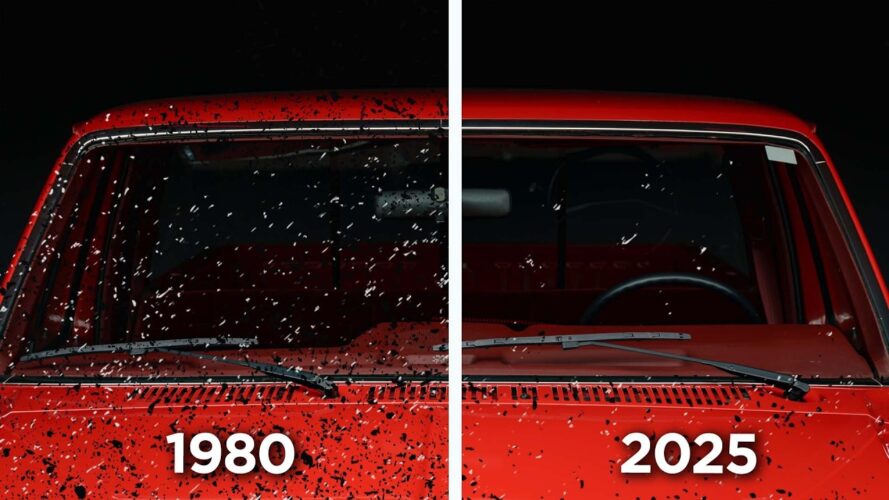
You’re not crazy. There really aren’t as many bugs as there used to be. And it’s kind-of a big problem. But is it an apocalypse? Let’s take a look.
TRANSCRIPT:
I miss lightning bugs.
Or fireflies, you might call them fireflies, in Texas we called them lightning bugs.
When I was a kid, we had family reunions every year on Father’s Day, and it was always held at this old Indian fort close to where I grew up called Fort Belknap.
The adults would gather on Saturday night and sing hymns in the old chapel while the kids would run around the fort, climb the defensive walls, and throw around a frisbee or football.
And as the sun went down and the stars came out, the grounds would become illuminated with thousands of blinking yellow lights streaking around us in almost mystical swarms, accompanied by the old time gospel music being sung by a chorus of family members who loved me.
It probably sounds like I’m waxing nostalgic here and I am but this was like a core memory for me. This was magical stuff when I was a kid.
Fireflies were everywhere when I was growing up, any given summer night we’d have hundreds of them in our backyard. We never even bothered to catch them in jars because we didn’t need to. They were everywhere.
Flash forward to today, my wife and I were handing out candy at Halloween and I saw one firefly in the yard. And I almost scared the kids I got so excited about it.
Seeing a firefly now is like seeing a shooting star, it’s like a noteworthy event.
Granted I live in the city now and that was out in the country, but my family still lives there, and I still make that drive. And that drive has changed.
When I was in college, every time I got back I had to wash my car because it would be covered with bug guts. Moths, mayflies, mosquitoes, big fat grasshoppers… It was disgusting.
But nowadays… I mean I get a handful of dead bugs but nothing like that.
Many of you have probably had a similar experience. And you may have even thought it was a good thing. It is not.
You’re not crazy. Bug populations have been declining all around the world in alarming numbers. So much that some researchers have started calling it the Bug Apocalypse.
The story I just told is anecdotal, and many of you may have had a similar experience. I’m sure many of you are sharing it in the comments right now.
Here in Texas, you might think bugs are multiplying based on the number of mosquito bites you get every summer.
But it’s not true. Bugs are vanishing. And the numbers are crazy.
Like in Germany, they have these insect reserves kind of like an animal reserve, but for insects, and they’ve seen a 75% drop in less than 30 years.
Beetle numbers have dropped 83 percent in the U.S. in the last 45 years. In Puerto Rico, insect biomass has dropped 60-fold over the last 50 years. And I’m not talking about in the cities, I mean in protected areas like those German reserves I was talking about – those are far away from human influence.
It’s estimated that 1 to 2 percent of insect biomass declines each year.
Dr. David Wagner thinks that’s too low, telling The Guardian:
“Now I would say that 2% is happening in some areas, and we’re seeing some places threatened by climate change or urbanisation or agriculture get as high as 5% decline per year.”
Ecology published a study that found the number of flying insects declined by an average of 6.6 percent annually over 15 years.
That’s almost a 73 percent drop in the population.
Okay, here’s one more stat.
The Bumblebee Conservation Trust in the U.K. found that 2024 was the worst year for bumblebees since they began recording their numbers.
It showed that, on average, 24 bee species in Great Britain declined by 22.5 percent. Some species even dropped by 39 percent.
Why It Matters
Here’s why this matters.
Let’s start with the bees. We all love bees, yeah? They’re nature’s pollinators. But they’re not the only ones. There are butterflies, ants, beetles, and even… ugh… wasps.
They’re all doing the hard work of pollinating more than 80 percent of the world’s flowering plants.
Plants that give us things like fruit, vegetables, nuts, spices, coffee, and chocolate.
Not having pollinating insects would be devastating. And not just for our food supply, but also for the economy.
In fact, according to a study from 2012, the economic value of insect pollination was $34 billion. And that’s just in the US. Those are some underpaid bees.
And without pollinators, some plant and tree species would disappear entirely.
Like, the Joshua Tree. We’d never hear that U2 album ever again.
But for real, the tree relies on the yucca moth to help it grow its population. The moth also depends on the tree for its survival.
Another example is the fig tree and the fig wasp. Both need each other to survive and populate.
Not to mention the predators that rely on insect populations to survive. Losing bugs would destroy entire ecosystems.
Yellowstone Wolves
You might have heard about the wolves in Yellowstone?
Yeah, in 1995, they reintroduced wolves to the park after being gone for 70 years. There was a very good reason for this.
While they were gone, the elk population exploded, which sounds great for the elk, right?
The problem is all these elk would overgraze the park’s lower valleys, meaning mice and rabbits didn’t have vegetation to hide under and were eaten by coyotes.
Also grizzly bears had no berries to feed on.
When the wolves came back, the elk changed their behavior. They avoided certain areas of the park where they could be trapped, like valleys and gorges.
Those areas started to regrow pretty quickly. Trees recovered because they weren’t being eaten or rubbed on.
Flowers and shrubs increased, causing more birds to come to the park, along with more bees and other pollinators. (worth billions)
But here’s the part that really blows my mind – reintroducing those wolves literally changed the flow of the Yellowstone river.
Because the Yellowstone River was the water source for all those elks, and they would gather there, and this would erode the river banks.
Once they were gone, there was less erosion, and this stabilized the river. Some sections were narrowed. Pools formed, fish and water insects increased in numbers. And a more diverse habitat was created.
Biological Control
Insects also play a role in biological control. That’s when natural methods are used to stop invasive species or pests that destroy crops.
Like, the flower fly. It’s a pollinator and a natural enemy of aphids, which suck the sap out of plants. So they pollenate and protect the plants. Biological control.
Then there’s the Minute Pirate bug.
If you’re a leafhopper, aphid, or mite, you’d better batten down the hatches because the minute pirate bug will make you walk the plank… by EATING YOU! There’s also the Japanese kudzu bug. Which eats kudzu plants and keeps it from spreading everywhere. It does however also eat soybean plants, which isn’t so great.
Pesticides
So, what’s causing the bug apocalypse?
One cause is habitat destruction. Over centuries, we’ve cleared out forests and fields for roads, houses, farms, factories and golf courses.
With farming, it used to be less intensive. This created a patchwork of habitats, like hay meadows and fields full of weeds that insects loved.
But modern farming is all about size. Large tracts of land are created and maintained to near perfection. How are they maintained to perfection? Pesticides: another reason all the bugs are disappearing. And one class of pesticides stands out. They’re called neonicotinoids and neonics.
They work by attacking an insect’s nervous system. And they’re used everywhere, like landscaping, gardening, and farming.
In fact, they’re used to treat 160 million acres of farmland in the United States.
They first came into use in the 1980s, and problem is they remain in the soil over the years, so they compound over time.
This means US farmlands are up to 48 times more toxic to insects than 40 years ago.
Also, we eat the food that’s grown in that soil. Just saying.
And neonics don’t just kill insects. Because it attacks their nervous system, it can also mess with a bee’s ability to fly and navigate back to its hive.
They can harm beetles and aquatic insects when they run off into streams. Neonics are sometimes used to coat things like corn, soy, and cotton seeds. This lets the chemical soak into the plant’s tissue, making the whole plant toxic to insects. If you’re a bee, that means you could bring toxic nectar or pollen back to the hive and expose other bees to it. Bees that never even got near the plant.
Light Pollution
Then there’s light pollution.
And while nighttime lights are great for our safety, they’re not so great for bugs. Artificial light can interfere with their ability to find food, because they’re attracted to the lights and then there’s not enough food for the mall to go around. It can also cause problems with mating, because a lot of insects mate at a certain time of day, and artificial lights mess with their perception of time.. Like, the corn earworm moth, not to be confused with earworms by Korn, never mates when light levels are above the light the quarter moon produces.
Sounds romantic.
Climate Change
And then there’s climate change.
Most insects can’t control their own body heat. This makes them vulnerable to changing temperatures and moisture levels. If the temperature gets too high, some insects may have development problems. Like, if they rely on temperature to tell them to initiate a stage of life, changing temperatures may cause them to develop out of sync with the resources they need to survive.
Heat waves may harm reproduction and fertility.
Extreme rainfall may knock insects off of plants or force underground bugs to surface, which exposes them to predators. And drought may threaten plants that insects rely on for food.
Another problem with warming temperatures is that it forces some species to migrate. Since insects rely on warm temperatures to help them know when to develop, they move to wherever there is warm weather. This means many insects have been pushing north and now have become invasive species in those. Once again, disrupting ecosystems. Like, oak and pine processionary moths have moved northward in Europe and are now threatening some forests up there.
Also, fun fact, people over the last 30 years are seeing more beetles, dragonflies, and grasshoppers at higher altitudes than ever before.
Where We’re At
So clearly something is going on here, some scientists have called it a sixth mass extinction. The question is why…
It’s us. We’re the ones doing it.
But we didn’t do all of them, there were five others before now.
First Extinction
The Ordovician–Silurian extinction took place around 440 million years ago. It was thought to be caused by a rapid ice age and a drop in sea levels. But a 2020 study found that volcanoes led to cooling, warming, or both. Either way, up to 85 percent of shallow marine species vanished, including trilobites, bivalves, and corals.
Second Extinction
The Devonian extinction took place about 370 million years ago, taking 75 percent of all species with it. Several things may have caused it, like excessive sedimentation, rapid global warming or cooling, meteorite or comet impacts, or massive nutrient runoff from the continents. More marine species were lost, including bony fish. Plant life also started to take over dry land, causing a drop in carbon dioxide levels.
Third Extinction
The third one happened at the end of the Permian Period about 250 million years ago. It’s known as the “Great Dying” or “Great Die-out.” That’s because up to 96 percent of marine species and about 70 percent of land species disappeared. Its main cause was large-scale volcanic eruptions that led to global warming. But some studies say an asteroid may have filled the air with particles that blocked sunlight and caused acid rain.
Fourth Extinction
The Triassic-Jurassic extinction happened around 200 to 250 million years ago. It claimed up to 76 percent of all marine and land species, paving the way for dinosaurs to dominate. Like the third extinction, there’s debate about what caused it. Everything from rising sea levels to increased C-O-2 emissions to massive geological activity has been suggested. Some scientists think a major event didn’t cause it, but instead it was a gradual turnover of species over time, and that it shouldn’t be considered a mass extinction event.
Fifth Extinction
The Cretaceous–Paleogene extinction event took place around 65 million years ago. It’s the best-known one, because that’s when all the dinosaurs disappeared. Up to 76 percent of all species died during this event, which was caused by a huge meteorite impact in what is now Mexico.
Sixth Extinction
Some scientists say we’re in the middle of a sixth extinction, due to things like climate change and habitat loss. A 2023 study found that 73 genera of land-dwelling vertebrates have gone extinct since 1500 A.D. Birds were the most lost with 44 genus extinctions, followed by mammals, amphibians, and reptiles. In fact, the current rate of vertebrate genus extinction is 35 times the rate over the last million years. If there hadn’t been human influence, Earth would have only lost two genera during that time.
Over 500 years, human actions have caused genus extinctions that usually would have taken 18,000 years. But a study from earlier this year that maybe it doesn’t qualify as an extinction event. Yes, biodiversity is declining, but not at a rate approaching mass extinction. That’s usually defined by a loss of 75 percent of all species over a geological timeline.
The study’s author said in a statement:
“We found instead that extinctions of genera are very rare across plants and animals, that they were mostly of genera found only on islands, and that these extinctions actually slowed down over the last 100 years instead of rapidly accelerating.”
A World Without Insects
So, maybe we’re not in a sixth extinction. But maybe we are. Who knows! What we do know is that a lot of insects are vanishing. If we use that 1 percent declining rate, it would take around 400 years for all the insects to be gone. But that’s a moving number. We’re still discovering new insect species all the time. And some insects are growing in number. So, unless a meteorite causes it, extinction doesn’t usually happen overnight. It might slow down, speed up, or go backwards, because of environmental changes or conservation efforts. But let’s just say they do all disappear, could we survive?
Maybe. Probably not.
Even if we found a way to grow and pollinate crops without insects, we’d still have to deal with other ecosystems collapsing. Insects play a vital role in most food chains. Without them, most amphibians and reptiles, and almost half of all bird species, would vanish because they would have nothing to eat.
As E.O. Wilson once said:
“If all mankind were to disappear, the world would regenerate back to the rich state of equilibrium that existed ten thousand years ago. If insects were to vanish, the environment would collapse into chaos.”
Reasons for Hope
It’s not all doom and gloom. Some insects are thriving and living their best lives.
Like the ringlet butterfly in the U.K. Warm weather has helped them spread to new areas, and they’ve increased in number by more than 100 percent over the last 50 years. Conservation efforts are also helping insects survive. Like, the Prague Zoo is part of an international effort to create better living conditions for the Lord Howe Island stick insect, which was thought to be extinct for more than 80 years. Efforts like this are just one of many ways to help head off the bug apocalypse.
There are things you can do, too. Things like…
• Grow native plants
• Convert your lawn into a natural habitat
• Reduce pesticide use
• Limit your use of exterior lighting
• Reduce soap runoff from washing cars and building exteriors
• Tell others the positive traits of insects
• Become an advocate for insect conservation
• Get involved in local politics, support science, and vote
That last one is good for more than just insects.



Add comment